

Process to appoint new Pakistan army chief to begin within 7 days — defense minister

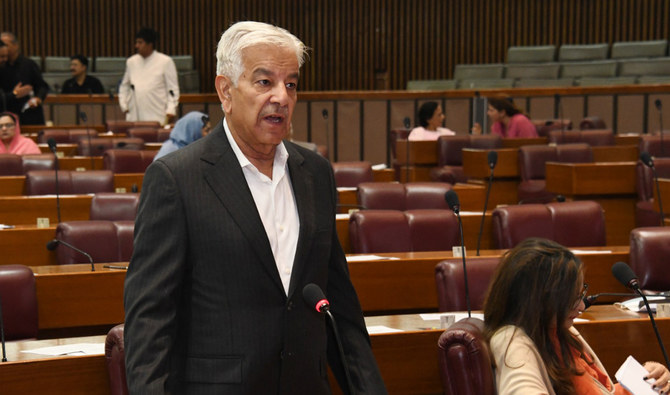
Pakistani Defense Minister Khawaja Muhammad Asif addresses on the floor of the National Assembly of Pakistan in the federal capital Islamabad on October 12, 2022. (Photo courtesy: Twitter/NAofPakistan)
Short Url
Updated 19 October 2022
Follow

Process to appoint new Pakistan army chief to begin within 7 days — defense minister

  • Defense minister says government yet to finalize new army chief’s name
  • Khawaja Asif rules out ongoing negotiations between establishment, ex-PM Khan

ISLAMABAD: Pakistani Defense Minister Khawaja Muhammad Asif said on Tuesday the process to appoint a new chief for the country’s all-powerful army would begin within the next seven days.

Pakistan’s current army chief, General Qamar Javed Bajwa, will complete his tenure on November 28. He became the army chief in November 2016 and was given a three-year extension in 2019 when now former PM Imran Khan was in power.

Though Bajwa, and the military’s media wing, have said the army chief will not seek a second extension and a new head of the army would be appointed on merit, there has been widespread speculation over whether Bajwa will actually retire and who the new chief will be.

Khan, who was ousted in a no-trust vote in April, has repeatedly alleged that the government of Prime Minister Shehbaz Sharif hoped to appoint an army chief of its choice who would not question it over corruption. Khan says the Sharif government, which came to power after Khan’s ouster through a parliamentary vote, has no right to appoint the head of the most important institution in the country and should announce fresh elections promptly and let a new, elected government appoint him.

“I think within the next five to seven days, the beginning of this exercise’s process [army chief’s appointment] should start,” Asif said during an interview with Geo News. “I say this on the basis of my estimate, based on my experience ... Otherwise, I don’t have any information.”

In response to another question, Asif said the government has yet not finalized a name for the new army chief: “No, we haven’t taken any decision yet, this much I can guarantee you.”

Reacting to widespread reports in local media that President Dr. Arif Alvi had arranged a meeting between Khan and top army officials, including Bajwa, to end the political stalemate in the country, Asif said a few meetings had been arranged by Khan’s aides in past weeks, ruling out ongoing talks.

“I don’t think any negotiations are taking place [between Khan and the military],” Asif said. “Imran Khan insists negotiations are taking place to give hope to his people.”


Pakistan’s deputy PM discusses ways to boost economic, trade ties with Iran

Updated 8 sec ago
Follow

Pakistan’s deputy PM discusses ways to boost economic, trade ties with Iran

  • Both countries agreed in August to increase bilateral trade to $10 billion by 2028
  • Pakistan and Iran have been working to stabilize relations after strained security ties

ISLAMABAD: Pakistan’s Deputy Prime Minister Ishaq Dar presided over a meeting to discuss economic and trade cooperation with Iran, the foreign office said on Friday, as the neighboring countries seek to expand ties.

The development took place during an inter-ministerial meeting on Pakistan-Iran bilateral relations chaired by Dar in Islamabad. Pakistan and Iran have been working to stabilize ties following a period of strained security relations.

Both countries have been working to enhance bilateral trade, setting up border markets and exploring barter trade to circumvent banking and currency restrictions. Sanctions and foreign exchange shortages remain key hurdles for Iran, making these alternative systems central to its trade strategy with Pakistan.

“The meeting reviewed ongoing cooperation across a range of sectors and discussed ways to further enhance economic and trade ties,” the foreign office said in a statement.

“The DPM/FM reaffirmed Pakistan’s commitment to deepening engagement with Iran in key priority areas.”

In December, the foreign ministers of Iran and Pakistan vowed to strengthen bilateral cooperation in trade and connectivity while working for regional peace.

Iranian President Dr. Masoud Pezeshkian also visited Pakistan in August, during which both countries signed agreements to increase bilateral trade to $10 billion by 2028.