

Ukraine moves to cut diplomatic ties with Iran after drone attacks

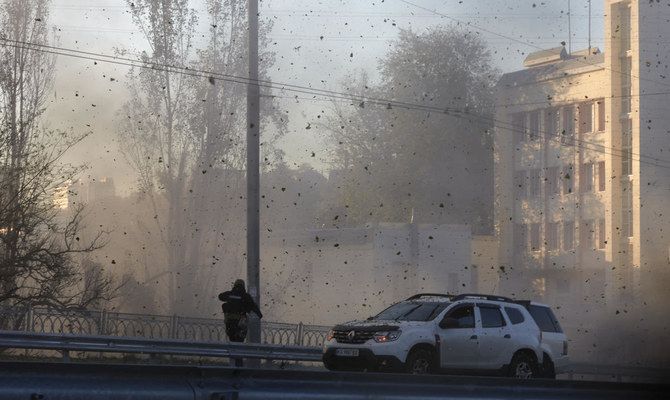
A police officer watches stone and earth debris flying through the air as Russian kamikaze drones hit the center of the capital Kyiv, Ukraine on Monday, Oct. 17, 2022. (AP)
Short Url
Updated 19 October 2022
Follow

Ukraine moves to cut diplomatic ties with Iran after drone attacks

  • Russia launched dozens of ‘kamikaze’ drones on targets in Ukraine on Monday
  • Ukraine says the attacks were carried out with Iranian-made Shahed-136 drones

JEDDAH: Ukraine moved on Tuesday to sever diplomatic ties with Iran for supplying deadly “kamikaze” drones to Russia.

Moscow has launched dozens of Iranian-made Shahed 136 drones at Ukrainian cities in the past two weeks, destroying energy infrastructure and killing civilians.

“The actions of Iran are vile and deceitful,” Ukrainian Foreign Minister Dmytro Kuleba said on Tuesday. “We won’t suffer them, because all those actions were done while Iran told us that they didn’t support the war and won’t support any of the sides with their weapons.”

The Shahed 136 is a delta-winged aircraft used as a “kamikaze” air-to-surface attack weapon.

It carries a small warhead that explodes on impact. Iran agreed to supply Russia with the drones, along with Fateh and Zolfaghar surface-to-surface missiles, in a deal signed on Oct. 6 when top officers from the Islamic Revolutionary Guard Corps visited Moscow.

NATO pledged on Tuesday to supply air defense systems to Ukraine to combat the drones. The Western military alliance “will in the coming days deliver counter-drone systems to counter the specific threat of drones, including those from Iran,” its secretary-general Jens Stoltenberg said on Tuesday.

Russia has destroyed almost a third of Ukraine’s power stations in the past week, President Volodymyr Zelensky said on Tuesday, as Moscow rained more missiles down on infrastructure in a campaign to intimidate civilians.

Missiles struck power stations in Kyiv, where they killed three people, and in Kharkiv in the east, Dnipro and Kryvyi Rih in the south and Zhytomyr in the west, causing electricity blackouts.


Deadly militant offensive sweeps northern and eastern Burkina Faso

Updated 6 sec ago
Follow

Deadly militant offensive sweeps northern and eastern Burkina Faso

  • Burkina Faso, ruled by a military junta since September 2022, has faced more than 10 years of raids by groups linked to Al-Qaeda and the Daesh
ABIDJAN: Al-Qaeda-affiliated JNIM has in recent days claimed to have inflicted heavy losses in Burkina Faso as a surge in deadly militant attacks sweeps across the Sahelian state.
Burkina Faso, ruled by a military junta since September 2022, has faced more than 10 years of raids by groups linked to Al-Qaeda and the Daesh, including the Group for the Support of Islam and Muslims (JNIM).
A February UN Security Council report noted that the “pace of JNIM attacks” had slowed in September as fighters were diverted to Mali to back an attempted fuel blockade.
“The group’s efforts in Mali have been the primary focus since early September last year,” said Heni Nsaibia, analyst at conflict monitor ACLED.
But attacks never fully stopped, and JNIM has launched a string of large-scale assaults in northern and eastern Burkina Faso since mid-February, killing dozens, including civilians.
“Since February 14, JNIM has claimed responsibility for 10 attacks across different regions of Burkina Faso,” said Hasret Kargin, an Africa studies researcher at intelligence firm Mintel World.
Deadly assaults
The deadliest incidents targeted Titao’s military base on February 15 in the northwest, where the group says it killed dozens of soldiers.
A separate ambush on the same day left around 50 forestry officers dead in Tandjari in the east.
Around 10 civilians were also killed in Titao, including seven Ghanaian traders.
“This latest round demonstrated a high degree of coordination, given the number of large-scale attacks that occurred between 12 and 22 February,” Nsaibia said.
“Over 130 people” — Burkinabe soldiers, civilian auxiliaries and JNIM fighters — “were killed in this series of battles.”
Kargin noted that JNIM has issued no formal statement explaining the recent uptick after several months of reduced activity.
But militant groups often strike “right before and during” the Muslim holy month of Ramadan, he said, adding current dry-season conditions had helped them on the ground.
‘Smuggling zones’
Recent attacks have gripped the country’s north and east, areas seen as financial hubs for Al-Qaeda’s Sahel branch.
“These are zones with numerous gold sites and key routes that fuel the group’s smuggling activities,” a Burkinabe security analyst said, requesting anonymity.
The north “acts as a bridge” to JNIM’s “main central command” in Mali, Kargin said, while he east — home to a vast nature reserve straddling Niger, Benin and Burkina Faso — allows the group to push into neighboring countries.
The forests, he added, both shield fighters from airstrikes and generate income through illegal timber sales and control of artisanal gold mining.
The Tandjari attack near regional capital Fada N’Gourma highlights JNIM’s growing freedom of movement after having “gained a lot of ground in recent years,” Nsaibia said.
“The question is not the frequency of attacks — they never stopped — but how these groups are able to inflict such heavy losses” when the army claims to be better equipped and better organized, said a Burkinabe political scientist.
The army, which rarely comments on attacks, said in mid-February it now controls 74 percent of national territory, with some “600 villages retaken.”
According to the UN report, JNIM recently appointed a senior leader in eastern Burkina Faso tasked with expanding into Benin, Ivory Coast, Ghana, Niger and Togo.