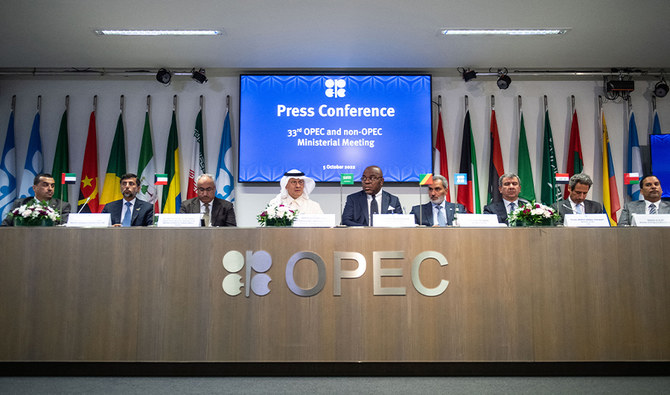
ISLAMABAD: The Pakistani foreign ministry said on Tuesday Islamabad stood with Saudi Arabia and its leadership in the wake of criticism of a decision by OPEC+ to cut its oil production target by 2 million barrels per day.
OPEC+, the oil producer group comprising the Organization of the Petroleum Exporting Countries (OPEC) plus allies including Russia, announced the production target after weeks of lobbying by US officials against such a move.
The United States has said the cut would boost Russia's foreign earnings and suggested it had been engineered for political reasons. Saudi Foreign Minister Prince Faisal bin Farhan has said the decision was purely economic and was taken unanimously by its member states. His comments were backed by ministers of several OPEC+ member states including the United Arab Emirates, Iraq and Kuwait.
"In the wake of statements made against the Kingdom in the context of OPEC + decision, Pakistan expresses solidarity with the leadership of the Kingdom of Saudi Arabia," the foreign office said. "We appreciate the concerns of the Kingdom of Saudi Arabia for avoiding market volatility and ensuring global economic stability."
The foreign office said Pakistan encouraged a constructive approach on such issues "based on engagement and mutual respect."
Saudi King Salman bin Abdulaziz has said the kingdom was working hard to support stability and balance in oil markets, including establishing and maintaining agreements of the OPEC+ alliance.
The OPEC+ cut has raised concerns in Washington about the possibility of higher gasoline prices ahead of the November US midterm elections, with the Democrats trying to retain their control of the House of Representatives and Senate.

Pakistan expresses solidarity with Saudi Arabia over OPEC+ decision to cut oil output
https://arab.news/y5ehm
Pakistan expresses solidarity with Saudi Arabia over OPEC+ decision to cut oil output
- US says cut would boost Russia's foreign earnings, claims it had been engineered for political reasons
- Saudi foreign minister says decision was purely economic and taken unanimously by its member states
How do Pakistan and Taliban Afghan militaries stack up as tensions flare?
- Pakistan fields 660,000 active troops, 465 combat aircraft and 170 nuclear warheads, dwarfing Taliban forces
- Afghan Taliban command about 172,000 personnel with limited air capability and no nuclear arsenal
Cross-border fighting between Pakistan and Afghanistan intensified overnight, with both sides claiming heavy losses and the Pakistani defense minister saying his country was in an “open war” with its neighbor.
As tensions persist, here is a look at how Pakistan dwarfs Afghanistan’s military forces and arsenals, according to data from the London-based International Institute for Strategic Studies.
OVERVIEW
Pakistan’s armed forces benefit from good recruitment and retention, bolstered by equipment from its main defense partner China. Islamabad continues to invest in its military nuclear programs and is also modernizing its navy and air force.
The capability of the Afghan Taliban’s armed forces, meanwhile, is declining, with a fall in their ability to use foreign equipment that the Islamist group seized when it returned to power in the landlocked country in 2021.
A lack of international recognition for the Taliban administration has also hurt military modernization.
PERSONNEL
Pakistan has 660,000 active personnel in its defense forces, of whom 560,000 are in the army, 70,000 are in the air force, and 30,000 are in the navy.
The strength of the Afghan Taliban’s military is thinner, with only 172,000 active personnel. The group has, however, announced plans to expand its armed forces to 200,000 personnel.
FIGHTING VEHICLES AND ARTILLERY
Pakistan has more than 6,000 armored fighting vehicles, and over 4,600 pieces of artillery.
The Afghan forces also possess armored fighting vehicles, including Soviet-era main battle tanks, armored personnel carriers and autonomous underwater vehicles, but their exact number is unknown.
The precise number of artillery they possess, which is of at least three different types, is similarly not known.
AIR FORCE
Pakistan has a fleet of 465 combat aircraft and more than 260 helicopters that include multi-role, attack and transport choppers.
Afghanistan has no fighter jets and no real air force to speak of. It is known to possess at least six aircraft — some of them dating back again to the Soviet era — and 23 helicopters, although it is not possible to assess how many are in flying condition.
NUCLEAR ARSENAL
While Pakistan is a nuclear-armed country and has 170 warheads, Afghanistan does not have a nuclear arsenal.


