

UAE-based Pakistani mechanic becomes millionaire overnight, pledges to help flood victims

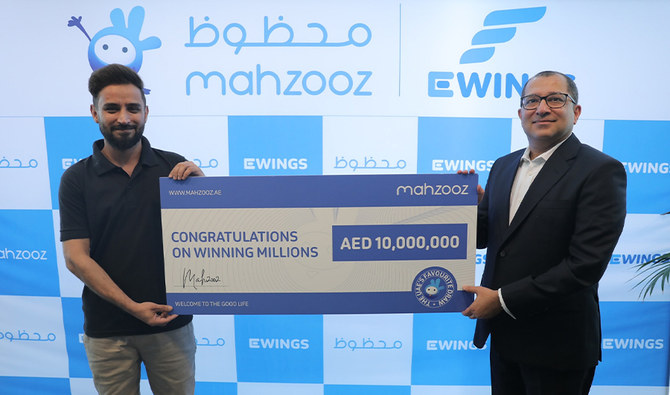
Abu Dhabi-based Pakistani Saad Sultan (left) receives a cheque of AED 10 million after winning the weekly Mahzooz draw on October 6, 2022, in the United Arab Emirates. (Photo courtesy: Mahzooz)
Short Url
Updated 16 October 2022
Follow

UAE-based Pakistani mechanic becomes millionaire overnight, pledges to help flood victims

  • Saad Sultan says he moved to the UAE from Abbottabad nine years ago for better economic prospects
  • The 32-year-old Pakistani says he is the sole breadwinner of his family and wants to set up a business now

DUBAI: An Abu-Dhabi-based Pakistani mechanic, who recently won AED 10 million in a lucky draw, said earlier this week he wanted to spend a portion of his money to help flood-affected people in his country of origin. 

Saad Sultan originally belongs to Abbottabad, though he decided to move to the United Arab Emirates nine years ago to secure better economic prospects. 

The 32-year-old Pakistan said he frequently participated in Mahzooz, which is billed as the only weekly live draw in the Gulf region, before getting lucky and becoming its 29th millionaire. 

“I didn’t have money to donate to flood victims earlier,” he told Arab News on Friday. “But now I want to make a difference in their lives.” 

According to Pakistani officials, more than 1,700 people have lost their lives in recent floods which were triggered by torrential monsoon rains that began in the middle of June. 

The resulting devastation displaced over 33 million people while leaving a third of the country under water. 

Sultan, who works as a machine mechanic and operator in an aluminum factory that pays him AED 2,000, is not the only Pakistani who has won the prize money. Last year in October, Junaid Rana, a 36-year-old Pakistani driver in Dubai, also won a massive amount after participating in the lucky draw. 

Despite being married for four years, Sultan said he was not able to bring his wife to the UAE since he could not afford a separate residence and lived with other factory workers in a shared accommodation. 

“I am my family’s only breadwinner,” he continued. “I am responsible for my ailing mother and a sister, who lost her husband to brain tumor last year, as well as her child.” 

Sultan said his life changed dramatically after he matched five out of five winning numbers. 

He recalled he had gone out with his cousin for a drive at night when he logged into his Mahzooz account to watch the draw. 

“I didn’t believe it at first,” he said. “Then I asked my cousin to stop the car on the side. We celebrated and also thanked God.” 

He told Arab News he was now planning to set up his own business in the UAE. 

Farid Samji, the top official of EWINGS which operates Mahzooz, said: “The biggest ever prize in the Middle East of AED 50 million was also won by a Pakistani, Junaid, who was a driver, and we are delighted to see that we have another deserving grand prize winner from Pakistan.” 

He added winning the money had also changed the life of the first Pakistani who invested in properties in Dubai which became his major source of income. 

Samji also informed that Pakistani nationals constituted Mahzooz’s third largest customer base. 


Return of millions of Afghans from Pakistan and Iran pushes Afghanistan to the brink, UN warns

Updated 14 February 2026
Follow

Return of millions of Afghans from Pakistan and Iran pushes Afghanistan to the brink, UN warns

  • Afghan authorities provide care packages for those returning that include food aid, cash, a telephone SIM card and transportation
  • But the returns have strained resources in a country struggling with a weak economy, severe drought and two devastating earthquakes

GENEVA: The return of millions of Afghans from neighboring Pakistan and Iran is pushing Afghanistan to the brink, the U.N. refugee agency said on Friday, describing an unprecedented scale of returns.

A total of 5.4 million people have returned to Afghanistan since October 2023, mostly from the two neighboring countries, UNHCR’s Afghanistan representative Arafat Jamal said, speaking to a U.N. briefing in Geneva via video link from Kabul, the Afghan capital.

“This is massive, and the speed and scale of these returns has pushed Afghanistan nearly to the brink,” Jamal said.

Pakistan launched a sweeping crackdown in Oct. 2023 to expel migrants without documents, urging those in the country to leave of their own accord to avoid arrest and forcible deportation and forcibly expelling others. Iran also began a crackdown on migrants at around the same time.

Since then, millions have streamed across the border into Afghanistan, including people who were born in Pakistan decades ago and had built lives and created businesses there.

Last year alone, 2.9 million people returned to Afghanistan, Jamal said, noting it was “the largest number of returns that we have witnessed to any single country.”

Afghanistan’s Taliban rulers have criticized the mass expulsions.

Afghanistan was already struggling with a dire humanitarian situation and a poor human rights record, particularly relating to women and girls, and the massive influx of people amounting to 12% of the population has put the country under severe strain, Jamal said.

Already in just the month and a half since the start of this year, about 150,000 people had returned to Afghanistan, he added.

Afghan authorities provide care packages for those returning that include some food aid, cash, a telephone SIM card and transportation to parts of the country where they might have family. But the returns have strained resources in a country that was already struggling to cope with a weak economy and the effects of a severe drought and two devastating earthquakes.

In November, the U.N. development program said nine out of 10 families in areas of Afghanistan with high rates of return were resorting to what are known as negative coping mechanisms — either skipping meals, falling into debt or selling their belongings to survive.

“We are deeply concerned about the sustainability of these returns,” Jamal said, noting that while 5% of those who return say they will leave Afghanistan again, more than 10% say they know of someone who has already left.

“These decisions, I would underscore, to undertake dangerous journeys, are not driven by a lack of a desire to remain in the country, on the contrary, but the reality that many are unable to rebuild their viable and dignified lives,” he said.