

Saudi microcredit surges 62 percent as Kingdom bolsters MSMEs: SAMA
Saudi Arabia’s startup sector has been booming thanks to the government and the private sector’s efforts to grow this prominent part of the economy
Updated 16 October 2022
Hala Hisham Koura
RIYADH: Saudi microenterprises credit surged 62.2 percent to SR18.1 billion ($4.82 billion) in the second quarter this year compared to SR11.2 billion in the same period last year, revealed the Saudi Central Bank, also known as SAMA.
The SAMA report further pointed out that banks disbursed 82.5 percent of the credit or SR14.9 billion to the microenterprises, while finance companies doled out the remaining SR3.2 billion.
Moreover, the total loans extended to small enterprises increased 25.4 percent to SR63 billion in the April-June quarter compared to SR50.3 billion in the corresponding period in 2021.
Midsize company loans rose 2.26 percent to SR139.9 billion in the second quarter from SR136.8 billion in the same period last year.
Banks were also the predominant lenders to the small and medium enterprises, disbursing SR55.8 billion to small firms and SR134.9 billion to medium-sized companies.
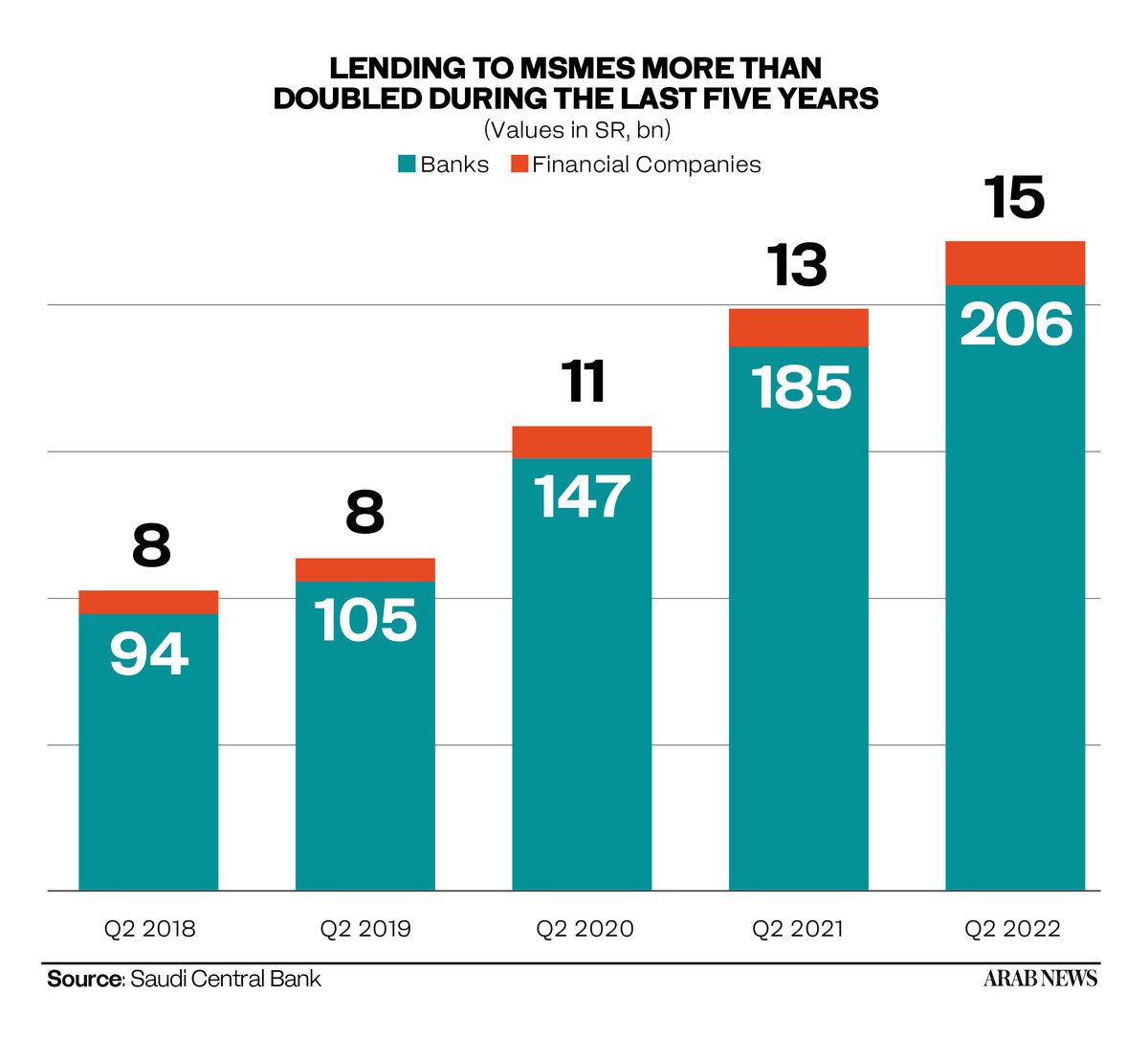
On the other hand, financial institutions lend SR7.3 billion to small companies and SR5 billion to their midsize counterparts.
Saudi Arabia’s startup sector has been booming thanks to the government and the private sector’s efforts to grow this prominent part of the economy.
According to the General Authority for Small and Medium Enterprises or Monsha’at, the Kingdom had 752,560 SMEs by the end of the first quarter of 2022.
The number of SMEs in the Kingdom increased 14.6 percent from 650,550 in the same period last year.
Monsha’at facilitated funding worth SR 64.6 billion in secured loans to entrepreneurs through its Kafalah program, providing bank guarantees that support SMEs by reducing lending risk.
It disbursed SR12.3 billion in loans through its Tamweel platform, an online portal that brought together SMEs and licensed financing agencies.
“SMEs need streamlined bureaucracy, lower fees, and the ability to compete in the market,” said Monsha’at Governor Saleh Ibrahim Al-Rasheed in a press statement.
The Kingdom has also held numerous events to synergize SMEs with the global investment community.
In March 2022, Riyadh hosted the Global Entrepreneurship Congress, a mega event that brought together leading voices in entrepreneurship, including innovators, regulators and financiers.
The four-day event facilitated deals worth SR51.8 billion and over 10 rounds of financing for Saudi startups, the Monshaa’t said in a statement.
“We are ensuring that SMEs get the support they need and that growth is transformed into sustainable business models,” added Al-Rasheed.
Startups attract fresh capital to scale AI, health tech, and infrastructure
Updated 06 December 2025
Nour El-Shaeri
RIYADH: Startups across the Middle East and North Africa are accelerating growth through strategic funding rounds, partnerships, and technological innovation.
From agriculture tech and AI-led cybersecurity to digital health and home renovation, this week’s developments reflect the region’s expanding startup ecosystem and investor confidence across key verticals.
Saudi agritech startup Nabt has raised $3.4 million in a seed extension round, bringing its total funding to $5 million.
The round was led by SHG Group, with participation from Merak Capital and several angel investors, signaling strong investor confidence in the company’s long-term growth strategy.
The funding announcement took place during a signing ceremony at the Sunbola program event under the Ministry of Environment, Water, and Agriculture.
Founded to build both physical and digital infrastructure for the fresh-produce sector, Nabt connects farmers directly with commercial buyers through fulfillment centers that handle sorting, cold storage, and last-mile logistics.
The company recently launched the Nabt Online Auction to support large-scale produce trading across the Kingdom, and Nabt Intel, which provides real-time pricing and market-demand data.
CEO Abdullah Al-Otaibi said: “In just two years, Nabt has proven that building transparent and efficient infrastructure for fresh produce is not only possible but essential.”
The new capital will support expansion into additional Saudi cities and further develop Nabt’s infrastructure and services to boost food security and farmer profitability across the country.
COGNNA raises $9.2m
COGNNA, a Saudi cybersecurity company founded in 2022, has closed a $9.2 million series A round led by Impact46 and co-led by BNVT Capital, with participation from Vision Ventures and Tali Ventures.
The company offers AI-driven security operations tailored for enterprises and SMEs through its Agentic SOC platform.
Combining AI automation with human oversight, COGNNA’s platform helps organizations simplify compliance and proactively defend against cyber threats.
Chief Technology Officer Ziyad Al-Sheri stated: “Through our AI-led platform, we are building an Agentic SOC that doesn’t just respond to threats — it anticipates them.”
The funding will be used to accelerate global expansion, enhance R&D in AI automation, and scale operational teams and infrastructure to meet growing demand.
The company plans to allocate capital across product development, marketing, hiring, and international operations.
Funch raises $500k
Funch, a Dubai-based AI-native lunch subscription startup, has secured $500,000 in a pre-seed round led by Angelspark, with participation from investors including Mostafa Kandil, Mahesh Murthy, and Tushar F.
Founded in 2025 by Ahmad Joehnny and Ghada Zanaty, the platform offers flexible, credit-based lunch subscriptions for 19 Emirati dirhams per day with no delivery fees.
Founded in 2025 by Ahmad Joehnny and Ghada Zanaty, Funch offers flexible, credit-based lunch subscriptions with no delivery fees. (Supplied)
Funch replaces traditional meal plans with a system where users can pause, skip, or cancel orders while using credits only when meals are delivered.
“Our model is built around pre-planned orders, enabling us to operate with higher efficiency, reduce waste, and cut emissions with fewer trips,” said co-founder and chief operating officer Ghada Zanaty.
The company leverages AI to forecast demand, optimize routes, rotate menus, and streamline logistics, and will use the funding to scale across Dubai and develop its AI systems further.
Paymob teams up with Robusta
Egyptian fintech Paymob and software development firm Robusta Technology Group have announced a strategic partnership to accelerate digital transformation across Egypt and the wider region.
The collaboration will integrate Paymob’s digital payments infrastructure with Robusta’s AI-driven product development and analytics capabilities.
The joint initiative aims to deliver intelligent digital experiences for SMEs and enterprises, supporting Egypt’s Vision 2030 goals.
Both companies plan to expand regionally and develop future offerings combining automation, analytics, and seamless payment systems to improve operational efficiency for merchants and startups.
Reno raises $4m
UAE-based renovation technology platform Reno has raised $4 million in a mix of equity and debt funding.
The round included investments from Sanabil 500, Hub71, and Plus VC, as well as Zero 100 VC, FlyerOne Ventures, and Sandstorm VC. AngelSpark and Swiss Founders Fund also invested.
Founded in 2024 by Marc Michel, Amr Hosny, and Farah Karabeg, Reno offers a tech-enabled, end-to-end solution for interior design and renovation services in both residential and commercial sectors.
Reno aims to streamline the renovation process through a unified digital platform, allowing customers to manage projects from planning through execution.
The company plans to use the new capital to expand across the GCC region, enhance its technological infrastructure, and further develop its customer experience.
Glenwood PE and Mubadala invest in Korean desalination firm NanoH2O
Glenwood Private Equity and Abu Dhabi’s Mubadala Investment Company, along with co-investors, have completed a co-investment in NanoH2O, a Seoul-based reverse osmosis membrane manufacturer previously operating as LG Water Solutions under LG Chem.
All closing conditions and regulatory approvals for the investment have been fulfilled.
NanoH2O, which became an independent entity in 2024, supplies desalination and brackish water treatment solutions to municipal and industrial clients worldwide. More than 95 percent of its revenue is generated outside South Korea.
“We have strong conviction in NanoH2O’s technology leadership and long-term growth potential,” said Mohamed Al-Badr, head of Asia at Mubadala.
The firm aims to support NanoH2O’s global expansion, particularly in the MENA region, amid growing concerns over water security and decarbonization.