

Saudi Arabia, South Africa sign 11 deals to promote investment

1 / 9
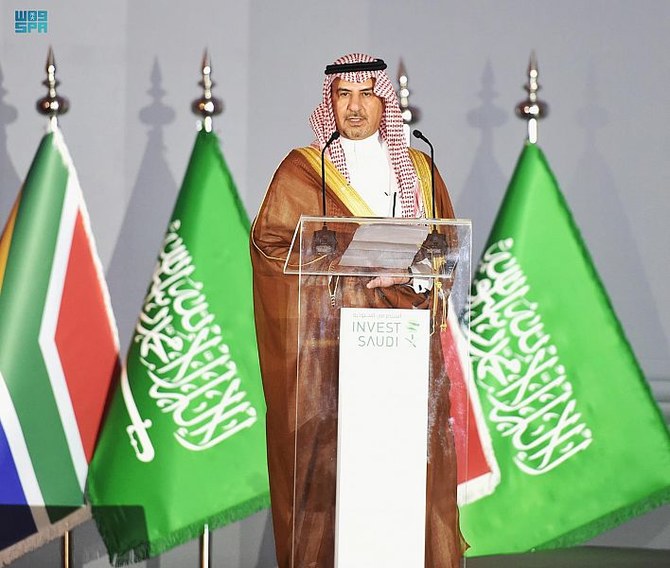
Saudi Arabia’s Ministry of Investment organized the Saudi-South African Investment Forum in Jeddah. (SPA) 
2 / 9
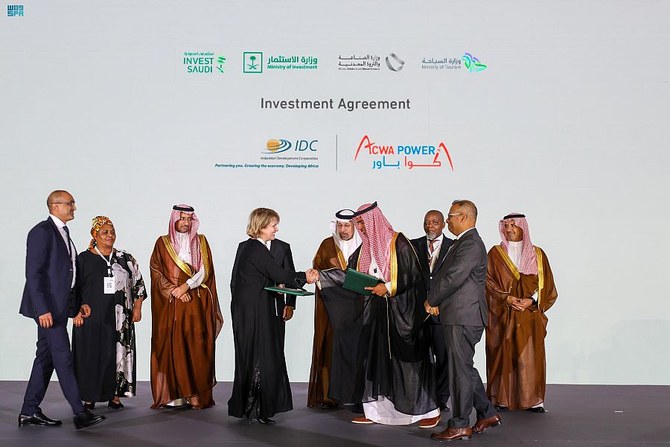
Saudi Arabia’s Ministry of Investment organized the Saudi-South African Investment Forum in Jeddah. (SPA) 
3 / 9
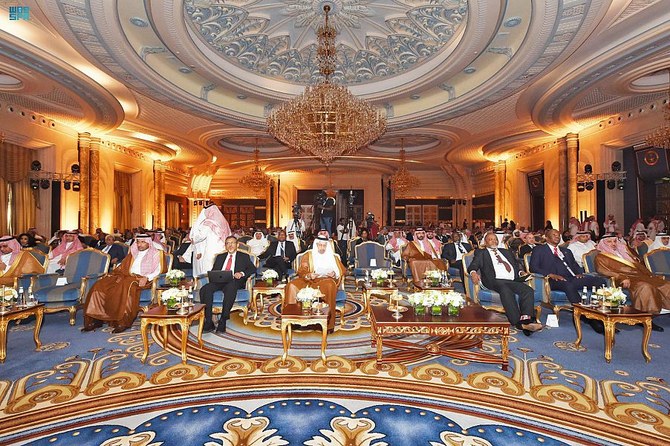
Saudi Arabia’s Ministry of Investment organized the Saudi-South African Investment Forum in Jeddah. (SPA) 
4 / 9
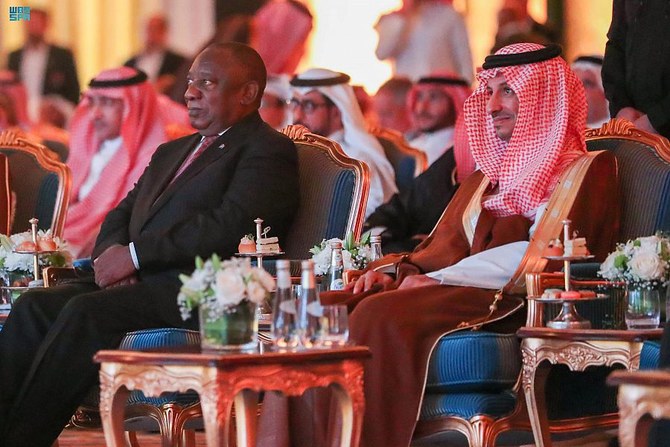
Saudi Arabia’s Ministry of Investment organized the Saudi-South African Investment Forum in Jeddah. (SPA) 
5 / 9
Saudi Arabia’s Ministry of Investment organized the Saudi-South African Investment Forum in Jeddah. (SPA) 
6 / 9
Saudi Arabia’s Ministry of Investment organized the Saudi-South African Investment Forum in Jeddah. (SPA) 
7 / 9
Saudi Arabia’s Ministry of Investment organized the Saudi-South African Investment Forum in Jeddah. (SPA) 
8 / 9
Saudi Arabia’s Ministry of Investment organized the Saudi-South African Investment Forum in Jeddah. (SPA) 
9 / 9
Saudi Arabia’s Ministry of Investment organized the Saudi-South African Investment Forum in Jeddah. (SPA) 
Short Url
Updated 15 October 2022
Follow

Saudi Arabia, South Africa sign 11 deals to promote investment

  • The deals were signed in the fields of energy, water, green hydrogen, waste diversion, logistics, and aerial survey services  

JEDDAH: Saudi Arabia and South Africa on Saturday signed 11 agreements and memoranda of understanding in the government and private sectors, aimed at promoting their developing investment sectors.

The deals, which were signed at the Saudi-South African Investment Forum in Jeddah, covered the fields of energy, water, green hydrogen, waste diversion, logistics and aerial survey services.

The forum, organized by the Saudi Ministry of Investment, was attended on the South African side by President Cyril Ramaphosa, Minister of Commerce and Industry and Competition Ebrahim Patel and others.


Saudi attendees included Investment Minister Khalid Al-Falih, Tourism Minister Ahmed Al-Khateeb, and Minister of Industry and Mineral Resources Bandar Al-Khorayef.

In his address at the forum, Al-Falih praised Saudi-South African relations, including economic and trade cooperation spanning more than three decades.

“Our nations share many traits. The Kingdom is the largest economy in the Middle East and in the Arab world, and holds a leading political and economic role in the region,” he said.


“Meanwhile, South Africa is the second-largest economy in Africa and the most diverse and technologically advanced economy on the African continent, with great market potential, well-developed infrastructure and a competitive private sector,” he added.

“These circumstances present an invaluable opportunity to strengthen our cooperation, which can be seen as an exceptional South-to-South exchange, especially given the timing, with the world undergoing tremendous shifts and challenges.”

Al-Falih said Saudi Arabia is growing at the fastest rate among the G20 economies, as it enjoys a strategic location linking three continents, and has a coastline of 1,200 km along the Red Sea, through which about 15 percent of global trade travels.


He added that Saudi-South African trade is constantly growing, has increased from $4.6 billion in 2019 to around $4.8 billion last year, and is expected to exceed $5.3 billion in 2022.

He said these numbers could increase further by activating the great commercial and logistical capabilities of the two countries.

Al-Falih underscored priority areas of cooperation, including renewable energy, mining, agriculture and food processing, manufacturing, defense and aerospace industries, tourism, communications and information technology.


He said South Africa represents a major access point to Africa, while Saudi Arabia is an important gateway to the Middle East and a link between East and West.

The forum’s agenda included sessions on major projects in the Kingdom, mining, agriculture, food, tourism and energy.


PIF-backed EV maker Lucid hits 16k 2025 deliveries, sets sights on robotaxi deployment

Updated 25 February 2026
Follow

PIF-backed EV maker Lucid hits 16k 2025 deliveries, sets sights on robotaxi deployment

RIYADH: Electric vehicle manufacturer Lucid Group, majority-owned by Saudi Arabia’s Public Investment Fund, announced a surge in deliveries in 2025 with volumes reaching 15,841 units, a 55 percent increase year-on-year.

According to a statement, the EV maker also provided an optimistic production outlook for 2026, signaling confidence in its operational turnaround and strategic shift toward autonomy.

In September 2023, the group opened its first-ever international car manufacturing facility in the Kingdom. The hub serves as the company’s second Advanced Manufacturing Plant and its first outside of the US.

According to the earnings report, the company delivered 5,345 vehicles in the fourth quarter of 2025, up 72 percent from the same period in the previous year, marking its eighth consecutive quarter of record deliveries.

Interim CEO Marc Winterhoff said that 2025 “was all about execution and strategy adjustment to set Lucid up for long-term success. Against a challenging macro backdrop, we nearly doubled production, gained market share, reduced unit costs, and strengthened our financial position.”

This commercial momentum translated directly into financial gains. Lucid’s fourth-quarter revenue soared 123 percent to $522.7 million, while full-year 2025 earnings climbed 68 percent to $1.35 billion. The company ended the quarter with a robust liquidity position of approximately $4.6 billion.

A key driver of the improved performance was the ramp-up of production, including the launch of the Lucid Gravity SUV. Despite facing supply chain and tariff headwinds, Lucid nearly doubled its total production for the year.

The company clarified its final production figures for 2025, reporting a total of 17,840 vehicles. This aligns with its previous guidance of approximately 18,000 units.

Lucid explained that a preliminary estimate of 18,378 units, announced in early January, was revised after 538 vehicles were found not to have completed the final internal validation procedures required to be classified as “produced.”

These vehicles are expected to be finalized in 2026, and the company stressed the revision does not impact previously reported financial results.

The manufacturer expects to produce between 25,000 and 27,000 vehicles in 2026, representing growth of up to 51 percent compared with 2025.

Chief Financial Officer Taoufiq Boussaid said: “Q4 marked a clear step-change in production and unit economics. The progress we made is structural, creating a more repeatable and stable operating cadence heading into 2026.”

Beyond the production numbers, Lucid outlined a pivot toward software and autonomy. Winterhoff highlighted the company’s ambition to become an “early mover in the emerging robotaxi market” by leveraging its industry-leading EV technology and strategic partnerships.

To fund these future growth platforms while maintaining financial discipline, the company is making targeted adjustments to its workforce.

“As we prepare for the next stage of our product and volume expansion, we are making targeted adjustments to our US-based, non-manufacturing workforce to reallocate resources to support the next stage of our growth and margin progression,” Boussaid added.

He reiterated the company’s commitment to “financial rigor, operational efficiency, and thoughtful capital allocation.”

In January 2025, the EV maker became the first global automotive company to join the Kingdom’s “Made in Saudi” program, granting it the right to use the “Saudi Made” label on its products, symbolizing the nation’s focus on quality and innovation.

Lucid’s facility, located in King Abdullah Economic City, can currently assemble 5,000 vehicles annually during its first phase. Once fully operational, the complete manufacturing plant, including the assembly line, is expected to produce up to 155,000 electric cars per year. 

This comes as the Kingdom is promoting the adoption of electric vehicles as part of its Vision 2030 strategy, which aims to achieve net-zero carbon emissions by 2060.
A critical target of the initiative is for 30 percent of all vehicles in Riyadh to be electric by 2030, contributing to a broader goal of reducing emissions in the capital by 50 percent.