

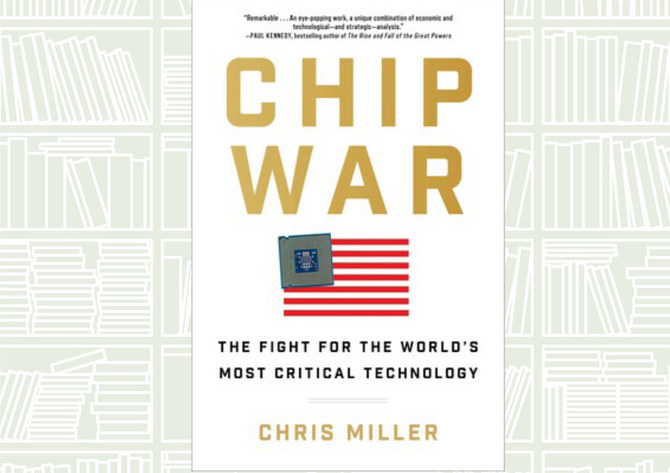
What We Are Reading Today: Chip War by Chris Miller

Short Url
Updated 15 October 2022
Follow

What We Are Reading Today: Chip War by Chris Miller

  • Economic historian Chris Miller explains how the semiconductor came to play a critical role in modern life

This is a fantastic book presenting the complicated and challenging development of the semiconductor industry, and its relations and impact on consumer electronics and national defense.

Economic historian Chris Miller explains how the semiconductor came to play a critical role in modern life and how the US became dominant in chip design and manufacturing and applied this technology to military systems.

America’s victory in the Cold War and its global military dominance stems from its ability to harness computing power more effectively than any other power. 

“Illuminating, timely, and fascinating, Chip War shows that, to make sense of the current state of politics, economics, and technology, we must first understand the vital role played by chips,” said a review on Goodreads.com.

The book explains the state-of-art of chip fabrication and where China, the US and Taiwan are today. Also, what this can potentially mean for the competition between the US and China.

The author is clear in drawing his lessons from a chronological set of main events and personalities that built the industry in the west.


What We Are Reading Today: ‘Collaborating with the Enemy’

Photo/Supplied
Updated 19 December 2025
Follow

What We Are Reading Today: ‘Collaborating with the Enemy’

  • This skill is certainly necessary to acquire and maintain in our increasingly globalized world

The title of the 2017 book “Collaborating with the Enemy: How to Work with People You Don’t Agree with or Like or Trust,” by Adam Kahane, is sure to catch your curiosity.

Printed by the independent, mission-driven publishing company Berrett-Koehler, the book delivers on delving into the topic.

Kahane, a director of Reos Partners — which describes itself as “an international social enterprise that helps people move forward together on their most important and intractable issues” — argues that traditional collaboration, which relies on harmony, consensus and a clear, shared plan, is often impossible to achieve in complex, polarized situations.

Instead, he proposes something called “stretch collaboration,” a framework for working with people you may not agree with, like, or even trust. 

This skill is certainly necessary to acquire and maintain in our increasingly globalized world.

Some of the practical techniques and strategies mentioned can arguably be applied beyond the workplace: in fractured families or friendships, for example.

“The problem with enemyfying is not that we never have enemies: we often face people and situations that present us with difficulties and dangers,” Kahane writes.

“Moreover, any effort we make to effect change in the world will create discomfort, resistance, and opposition. The real problem with enemyfying is that it distracts and unbalances us. We cannot avoid others whom we find challenging, so we need to focus simply on deciding, given these challenges, what we ourselves will do next.”

The book boasts a foreword by Peter Block, bestselling author of “Community and Stewardship,” who writes: “The book is really an annotation on the title. The title asks me to collaborate with people I don’t agree with. Not so difficult. But then the stakes are raised, and I am asked to collaborate with people I don’t like. This too is manageable, even common in most workplaces.

“The final ask, though, is tougher: collaborate with people I don’t trust; even people I consider enemies. To make these acts doable is the promise of the book.”

And, in a way, it does. But Kahane seems to also use this book to pat himself on the back. In parts it reads like an expanded LinkedIn testimonial to his own resume.