Iran ex-president’s daughter held, charged amid protests

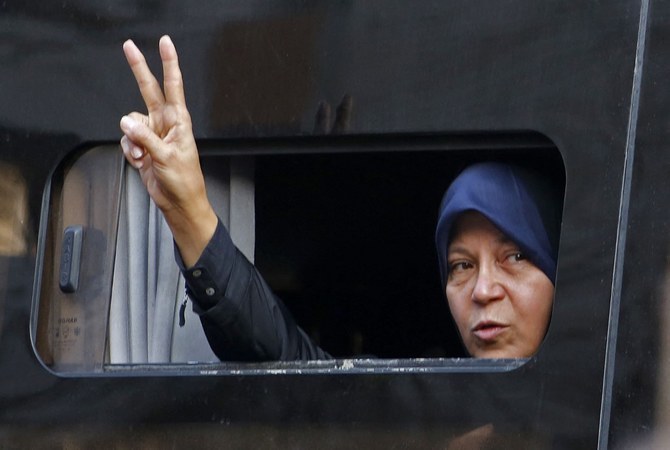
Faezeh Hashemi, the daughter of former President Akbar Hashemi Rafsanjani, has been arrested for ‘inciting riots’. (AFP file photo)
Short Url
Updated 11 October 2022
Follow

Iran ex-president’s daughter held, charged amid protests

  • Faezeh Hashemi, a former lawmaker and a women's rights activist, was arrested on September 27 in Tehran
  • “Ms. Hashemi has been accused of collusion, disruption of public order and propaganda against the Islamic republic”

TEHRAN: The daughter of Iran’s former president Akbar Hashemi Rafsanjani, arrested last month amid protests following the death of Mahsa Amini, has been charged with “propaganda” activity, the judiciary said Tuesday.
Faezeh Hashemi, 59, a former lawmaker and a women’s rights activist, was arrested on September 27 in the capital Tehran for reportedly inciting residents to take part in demonstrations.
Her arrest came amid a continuing wave of unrest that has rocked Iran since 22-year-old Amini, a Kurdish Iranian woman, died on September 16 after her arrest by the morality police in Tehran for allegedly violating the Islamic republic’s strict dress code for women.
“Ms. Hashemi has been accused of collusion, disruption of public order and propaganda against the Islamic republic,” judiciary spokesman Massoud Setayeshi told reporters.
In July, she had previously faced separate charges of carrying out propaganda activity against the country and blasphemy in social media comments.
In March, she was “sentenced to 15 months in prison and two years of additional punishment such as a ban on Internet activities,” said Setayeshi, without elaborating.
In 2012, she was sentenced to six months in jail on charges of “propaganda against the Islamic republic.”
Hashemi’s late father, president between 1989 and 1997, who died in 2017, was considered a moderate who advocated improved ties with the West and the United States.
Iran says dozens of people have been killed in the protests triggered by Amini’s death, including 18 security personnel, and hundreds have been arrested at what it calls “riots.”


UN says 3.3 million war-displaced Sudanese return home

Updated 5 sec ago
Follow

UN says 3.3 million war-displaced Sudanese return home

  • International Organization for Migration reports that three-quarters of those returning came from internal displacement sites
  • At its peak, the war has displaced around 14 million people both internally and across borders
KHARTOUM: More than three million Sudanese people displaced by nearly three years of war have returned home, the United Nations migration agency said on Monday, even as heavy fighting continues to tear through parts of the country.
Since April 2023, Sudan has been locked in a devastating war pitting the regular army against the paramilitary Rapid Support Forces (RSF).
The conflict has killed tens of thousands of people and created what the UN describes as the world’s largest displacement and hunger crisis. At its peak, the war had displaced around 14 million people both internally and across borders.
In a report released on Monday, the International Organization for Migration (IOM) said an estimated 3.3 million displaced Sudanese had made their way back home by November of last year.
The rise in returns follows a sweeping offensive launched by the Sudanese army in late 2024 to retake central regions seized earlier in the conflict by the RSF.
The campaign culminated in the recapture of Khartoum in March 2025, prompting many displaced families to try to go back.
According to the IOM, more than three-quarters of those returning came from internal displacement sites, while 17 percent traveled back from abroad.
Khartoum saw the largest number of returns — around 1.4 million people — followed by the central state of Al-Jazira, where roughly 1.1 million have gone back.
Earlier this month, the army-backed government announced plans to return to the capital after nearly three years of operating from the Red Sea city of Port Sudan in the country’s east.
Reconstruction work in Khartoum has been underway since the army retook the city.
Although Khartoum and several army-held cities in central and eastern Sudan have seen a relative lull in fighting, the RSF has continued to launch occasional drone strikes, particularly targeting infrastructure.
Elsewhere, violence remains intense.
In the country’s south, RSF forces have pushed deeper into the Kordofan region after seizing the army’s final stronghold in Darfur last October.
Reports of mass killings, rape, abductions and looting emerged after El-Fasher’s paramilitary takeover, and the International Criminal Court launched a formal investigation into “war crimes” by both sides.