

Nobel laureate Malala Yousafzai returns to Pakistan to visit flood-hit areas

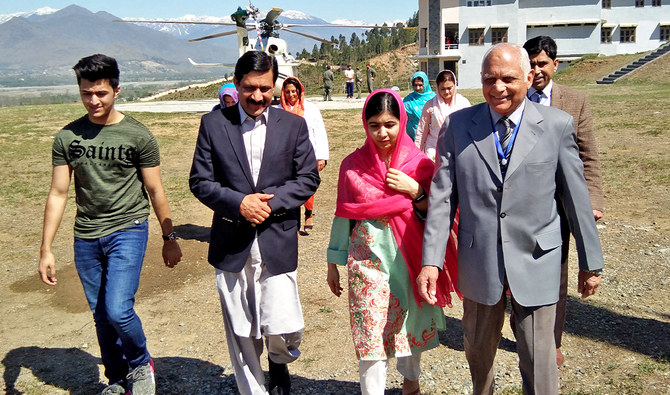
Pakistani activist and Nobel Peace Prize laureate Malala Yousafzai (C), arrives along with her father Ziauddin Yousafzai (2L), brother Atal Yousafzai (L) and the principal of all-boys Swat Cadet College Guli Bagh, during her hometown visit on March 31, 2018. (AFP/File)
Short Url
Updated 11 October 2022
Follow

Nobel laureate Malala Yousafzai returns to Pakistan to visit flood-hit areas

  • Yousafzai was shot in the head by a Pakistani Taliban in 2012 in her native town of Swat for campaigning for girls’ education
  • The details of her visit to Pakistan are still not clear, though her arrival in Karachi was confirmed by the Civil Aviation Authority

ISLAMABAD: Pakistan’s Nobel Peace Prize winner Malala Yousafzai returned to her country on Tuesday, confirmed the Civil Aviation Authority (CAA), to visit flood-hit areas and raise international awareness about the extent of the massive calamity.

Yousafzai was shot in the head by a Pakistani Taliban in 2012 in her native town of Swat for campaigning for girls’ education.

Soon after that, she was flown to the United Kingdom where she received medical treatment and continues to reside.

“Malala Yousafzai arrived in Karachi at 01:45 AM [Tuesday] on Qatar Airways flight 604,” the CAA confirmed in a brief statement.
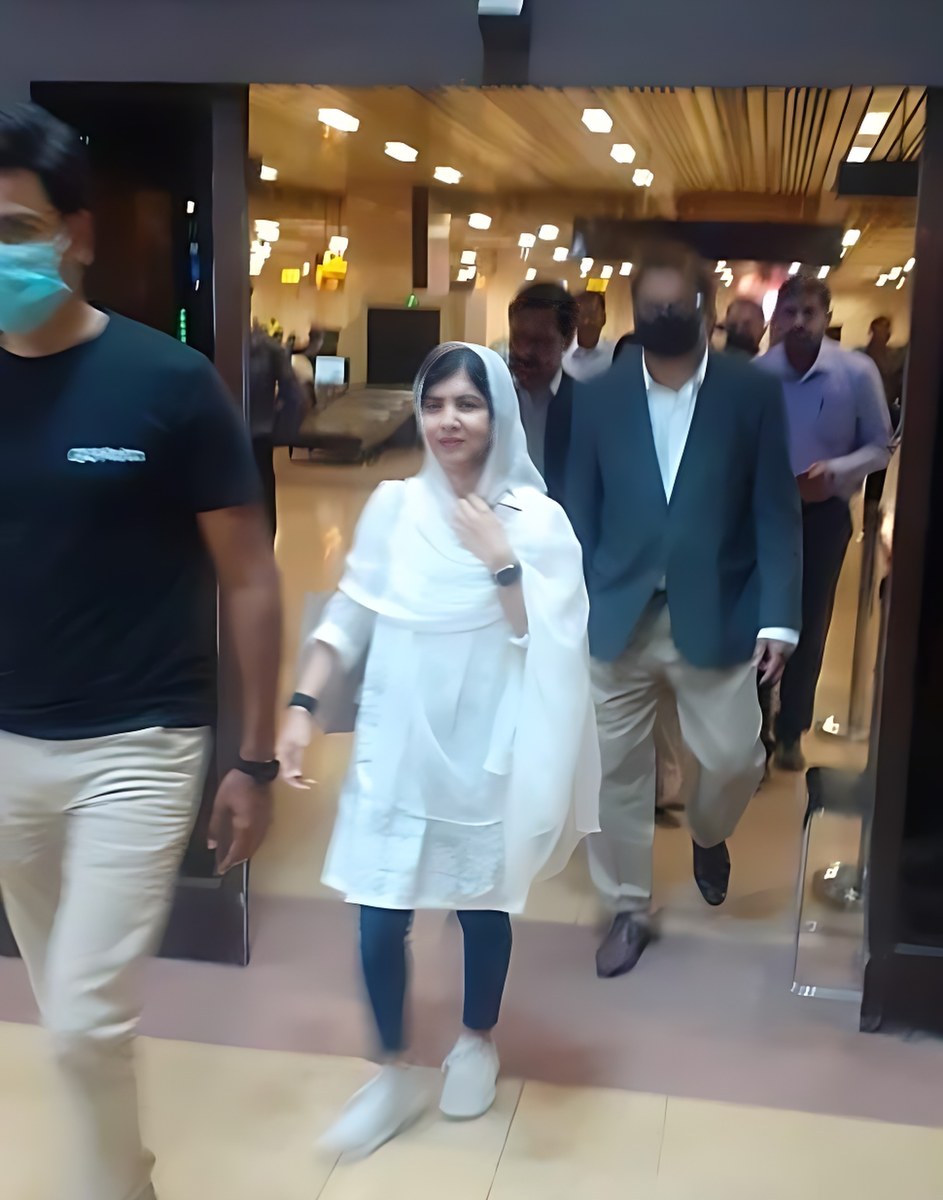


Pakistan’s Nobel Peace Prize winner Malala Yousafzai (center) is pictured at Jinnah International Airport in Karachi, Pakistan, on October 11, 2022. (Civil Aviation Authority)

According to the local media, the young Nobel laureate is expected to visit flood-affected areas in her country, though the details of her stay in Pakistan have yet not been revealed.

Torrential rains and melting glaciers triggered massive floods in Pakistan that swept away homes, key infrastructure, livestock and crops while affecting the lives of over 33 million people since mid-June.

Pakistan’s Sindh and Balochistan provinces have suffered the most due to the rains and floods.

The erratic weather pattern this year has been widely attributed to the challenge of global climate change.

According to official estimates, Pakistan has lost billions of dollars in the wake of the floods and will need significant international support to carry out the rehabilitation activities.

The United Nations General Assembly recently expressed solidarity with the country while asking the international community to increase aid to support its long-term recovery.

UN chief António Guterres, who also visited Pakistan and witnessed all the devastation, warned in a recent statement the situation was “going from bad to worse” since the country was “on the verge of a public health disaster” after the recent climate catastrophe.


Pakistan denies role in Afghan regime change, says military operation will continue

Updated 6 sec ago
Follow

Pakistan denies role in Afghan regime change, says military operation will continue

  • Pakistan, Afghanistan have been embroiled in military conflict since last week after Afghan forces launched retaliatory attacks against Islamabad
  • Pakistan not targeting indiscriminate sites but specific infrastructure, installations being used to support “terrorist groups,” says security official

ISLAMABAD: Islamabad is not seeking a regime change in Afghanistan, state media reported this week quoting a senior security official, who vowed that Pakistan’s military operation against Afghan forces will continue until the Taliban government stops facilitating militants. 

The statement comes in response to the ongoing military conflict between Afghanistan and Pakistan, which began after Afghan forces on Thursday launched attacks in retaliation for Pakistani airstrikes earlier this month.

Since then, Pakistan has carried out military operations along the border, with Information Minister Attaullah Tarar claiming the killing of 435 Afghan forces and the capture of 31 Afghan positions. Afghanistan, on the other hand, has also claimed capturing several Pakistani military posts along the border and carrying out strikes targeting military bases in Pakistan. Arab News could not independently verify these claims.

“He clarified that Pakistan has nothing to do with any change of government in Afghanistan, calling it an internal choice of the Afghan people,” state broadcaster Radio Pakistan reported on Monday, citing a senior security official who spoke on condition of anonymity.

Islamabad accuses the Afghan Taliban government of sheltering militants, particularly the Tehreek-e-Taliban Pakistan (TTP) in Afghanistan and facilitating their attacks against Pakistan.

Afghanistan has denied these charges and urged Pakistan to focus on resolving its security challenges internally without blaming Kabul.

The official said the Afghan Taliban will have to either pick sides between Pakistan or the “terrorist groups” operating from their soil.

“A senior Pakistani security official has said that ‘Operation Ghazab Lil-Haq’ will continue until the Afghan Taliban government provides verifiable assurances to Pakistan that it will stop facilitating Fitna Al-Khwarij and Fitna Al-Hindustan,” Radio Pakistan reported.

Pakistan’s government and military use the terms “Fitna Al-Khwarij” for the TTP and “Fitna Al-Hindustan” for separatist militant outfits that operate mostly in southwestern Balochistan province. Islamabad accuses its chief rival India of supporting these militant groups, charges that New Delhi has always denied. 

The security official rejected Afghanistan’s claims Pakistan has killed numerous civilians in its operations. 

“He stressed that Pakistan is not targeting indiscriminate sites but only specific infrastructure and installations being used to support terrorist groups,” the state broadcaster said. 

The latest cross-border fighting ended a ceasefire brokered by Qatar and Turkiye in October. The two sides failed to reach a permanent agreement during talks in Istanbul.

Despite the ongoing tensions, Pakistan’s President Asif Ali Zardari on Monday reiterated Islamabad’s calls for talks with Afghanistan. 

“We have never walked away from dialogue,” he said.