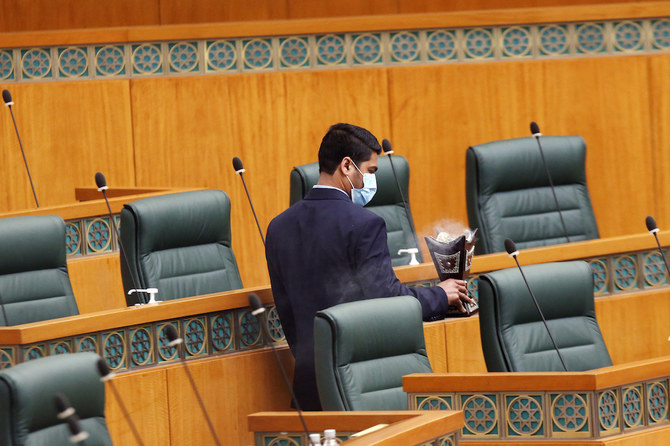
LONDON: Kuwait has postponed convening the first parliament session after elections to Oct. 18, the state news agency reported on Saturday.
“The National Assembly’s first regular session of the 17th legislative term is adjourned until Oct. 18, head of Kuwait’s Center for Government Communication and spokesman Tareq Al-Mizrem said Saturday,” KUNA said in a statement.
“This came in line with Article 106 of the constitution, Al-Mizrem wrote on CGC’s Twitter account,” it added.
The Gulf state’s crown prince re-appointed Sheikh Ahmed Nawaf Al-Sabah as prime minister on Wednesday and later approved a new Cabinet following legislative polls.
The government has not taken the constitutional oath because of the objection of more than 40 members of parliament. Local media said ministers of the old cabinet had resigned.
(With Reuters)

Kuwait postpones first parliament session to Oct. 18
https://arab.news/9u5hw
Kuwait postpones first parliament session to Oct. 18
Israel attacking Lebanon every 4 hours on average: Research
- Independent conflict monitoring organization recorded 1,846 Israeli attacks since start of ceasefire
- UN has recorded more than 10,000 violations, killings of 127 Lebanese civilians
LONDON: Israel is attacking Lebanon at a rate equal to one strike every four hours despite the reaching of a ceasefire more than a year ago, new data has shown.
ACLED, the independent conflict monitoring organization, recorded 1,846 Israeli attacks on Lebanon since the beginning of the ceasefire with Hezbollah.
Only two days each month since then has not seen an Israeli attack on average, Sky News reported.
In recent weeks, Israeli has ramped up cross-border strikes, with December seeing an average of six per day, or one every four hours. It is the fastest pace of attacks by Israel since May.
The UN Interim Force in Lebanon said the ceasefire has been violated more than 10,000 times, or once every 53 minutes on average.
That figure includes more than 2,500 ground activities by the Israel Defense Forces and more than 7,800 violations of Lebanese airspace.
UNIFIL has discovered more than 360 weapon and ammunition caches south of the Litani river. These are reported as ceasefire violations.
The discovery of the caches is proof that Hezbollah is seeking to rearm in the south, Israel has claimed.
But Kandice Ardiel, UNIFIL’s deputy spokesperson, said: “None of these weapon caches were guarded. They had no obvious signs of recent use and were presumably abandoned. Many were even destroyed already, or half-destroyed.”
According to UN figures, at least 127 civilians in Lebanon have been killed by Israeli strikes since the beginning of the ceasefire.
Israel has argued that the ceasefire agreement stipulates Hezbollah’s complete disarmament, not only in southern Lebanon.
Hezbollah disputes this, and has conditioned its disarmament on Israel’s complete withdrawal from Lebanese territory.
Israel was supposed to withdraw from Lebanon by Jan. 27 this year, with a later extension to Feb. 18.
But Israel has instead ramped up its presence in Lebanon, constructing a new base in February. Four other bases are held by Israel in Lebanon, on hilltops across the south.
The Lebanese government has raised objections to the Israeli bases with the UN, which found that two sections of Israel’s new border wall cross into Lebanese territory.
More than 64,000 Lebanese remain displaced from their homes. One resident of the now-destroyed town of Aita Al-Shaab said: “Anyone who comes to rebuild is attacked (by Israel).”


