

Pakistan’s Afridi to be fit for World Cup opener — cricket board chief

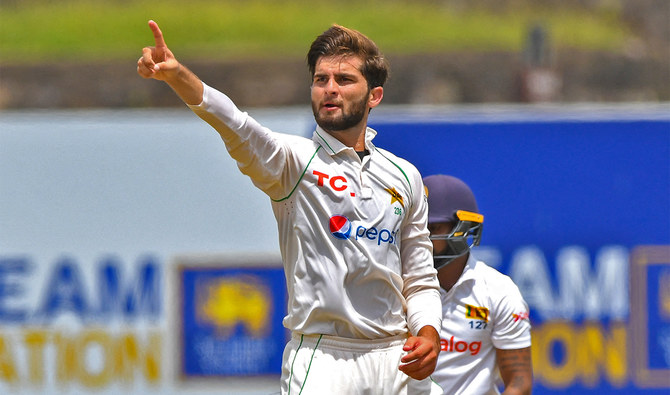
Pakistan’s Shaheen Shah Afridi celebrates after taking the wicket of Sri Lanka's Niroshan Dickwella (R) during the first day of the first cricket Test match between Sri Lanka and Pakistan at the Galle International Cricket Stadium in Galle on July 16, 2022. (AFP/File)
Short Url
Updated 07 November 2022
Follow

Pakistan’s Afridi to be fit for World Cup opener — cricket board chief

  • Fast bowler has made rapid progress from a knee injury, Paksitan’s cricket board chief Ramiz Raja says
  • Afridi has been sidelined since sustaining a ligament injury to his right knee during a test match in Sri Lanka in July 

LAHORE: Pakistan fast bowler Shaheen Afridi has made rapid progress from a knee injury and will be “battle-ready” for their Twenty20 World Cup opener against arch-rivals India this month, the country’s cricket board chief, Ramiz Raja, said. 

Afridi has been sidelined since sustaining a ligament injury to his right knee during a test match in Sri Lanka in July and missed the Asia Cup as well as the home series against England. 

“I had a chat with Shaheen ... and he said he hasn’t felt this good in ages. So, the progress is very good,” Raja told Dawn news. 

“He said he’d be battle-ready soon, it’s great news for us.” 

The 22-year-old has been Pakistan’s pace spearhead, whose express speed and ability to generate bounce and bowl pin-point yorker make him such a feared bowler. 

Raja said they did not want to rush the left-arm bowler back into action considering how serious knee injuries could get. 

“A knee injury is quite technical and a delicate issue,” the former Pakistan captain said. 

“We were of the view that we won’t take the risk until he was 110 percent fit. 

“When we spoke, Shaheen said, ‘I’m already 110 percent, so don’t worry. I’ll play practice matches too and will be ready for the match against India.’” 


Punjab expands Pakistan-India Wagah border arena with museum, partition-themed park

Updated 4 sec ago
Follow

Punjab expands Pakistan-India Wagah border arena with museum, partition-themed park

  • The border crossing, near eastern city of Lahore, is the primary land route between Pakistan and India and one of the most recognizable symbols of their often-tense relations
  • The site is best known for its daily flag-lowering ceremony, a choreographed military ritual performed by border forces from both countries that draws thousands of spectators

ISLAMABAD: Maryam Nawaz, chief minister of Pakistan’s Punjab province, on Thursday inaugurated the newly constructed arena at Wagah border cross between Pakistan and India, which includes a museum and a partition themed park.

The Wagah border crossing, located near the eastern city of Lahore, is the primary land route between Pakistan and India and one of the most recognizable symbols of the often-tense relationship between the two neighbors. It serves as a key point for prisoner exchanges and limited movement of travelers, while remaining tightly regulated due to security considerations.

The site is best known for its daily flag-lowering ceremony, a choreographed military ritual performed by border forces from both countries that draws thousands of spectators. Over the years, the ceremony has evolved into a popular tourist attraction, blending displays of nationalism with public spectacle and making it one of Pakistan’s most visited landmarks, which connects with India’s Attari.

Flanked by military officials, CM Nawaz visited the crossing and inaugurated the new arena, with its seating capacity increased from 7,500 to 25,000 spectators, the state-run Radio Pakistan broadcaster reported. The chief minister also visited the martyrs’ monument and offered her respects.

“In addition to the arena’s expansion, several new constructions have been added at the Joint Check Post Wagah. These new developments include a theme park depicting the partition of the Subcontinent, featuring models of a railway station, military equipment and a Martyrs’ Memorial,” the broadcaster reported.

“A Pakistan Museum has also been established within the arena, showcasing the country’s history and culture from the Freedom Movement to the present day.”

In August 1947, Britain divided the Indian Sub-continent, its former colony, into two countries — Hindu-majority India and Muslim-majority Pakistan.

Excitement over independence was quickly overshadowed by some of the worst bloodletting that left up to 1 million people dead as gangs of Hindus and Muslims slaughtered each other.

Creating two independent nations also tore apart millions of Hindu and Muslim families in one of the world’s largest peacetime migrations, which displaced at least 15 million people.

The fate of Kashmir, then a princely state, was left undecided. The Himalayan territory continues to remain a flashpoint in relations between the neighbors, who have fought multiple wars over it.