

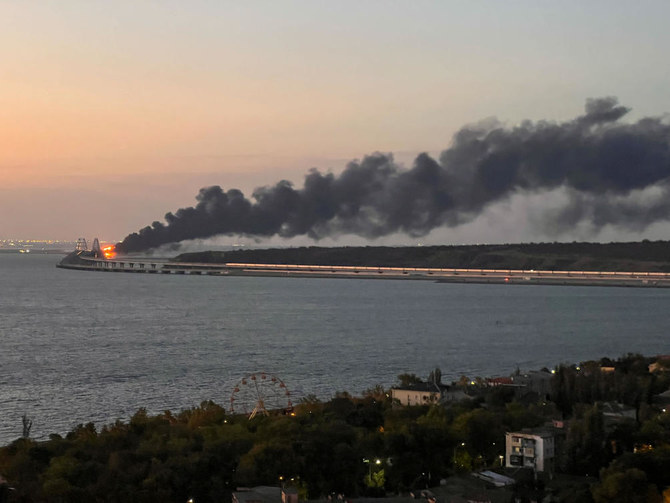

CRIMEA: Russia on Saturday said three people were killed in after a truck exploded on its bridge linking Crimea — a symbol of its annexation of the peninsula — without immediately blaming Ukraine.
On the same day, after Moscow suffered a series of setbacks on the battlefield that triggered unprecedented criticism of its army at home, Moscow appointed a new general to lead its Ukraine offensive.
The blast ripped through the 19-kilometer bridge more than seven months into Moscow’s Ukraine offensive, although local authorities said it had reopened to motor traffic with vehicles subject to stringent screening.
Dramatic social media footage showed the bridge on fire with parts plunging into the water.
Russian investigators said three people were killed and that two bodies — a man and a woman — were pulled out of the water after the bridge had partially collapsed.
They were likely to be passengers of a car that was driving near the exploded truck and that their identities were being established, Moscow said.
It had also identified the owner of the truck as a resident of Russia’s southern Krasnodar region, saying his place of residence was being searched.
Russia said the blast — which occurred just after 6 am local time — set ablaze seven oil tankers transported by train and collapsed two car lanes of the giant road and rail structure.
Russian President Vladimir Putin on Saturday ordered tighter security for the bridge as well as the infrastructure supplying electricity and natural gas to the peninsula, Interfax said.
In a decree issued hours after the bridge was damaged by a blast, Putin said the FSB security service would be responsible for strengthening protection measures.
The bridge, personally inaugurated by Putin in 2018, is a vital transport link for carrying military equipment to Russian soldiers fighting in Ukraine.
It is hugely important to the Kremlin, and Moscow had maintained the bridge crossing was safe despite the fighting.
While some in Moscow hinted at Ukrainian “terrorism,” state media continued to call it an “emergency situation.”
Ukraine’s presidential adviser Mykhailo Podolyak earlier took to Twitter posting a picture of a long section of the bridge half-submerged.
“Crimea, the bridge, the beginning,” he wrote.
“Everything illegal must be destroyed, everything stolen must be returned to Ukraine, everything occupied by Russia must be expelled.”
The Ukrainian post office announced it was preparing to print stamps showing the “Crimean bridge — or more precisely, what remains of it.”
The Kremlin’s spokesman said Putin had ordered a commission to be set up to look into the blast on the bridge which is hugely symbolic and logistically crucial for Moscow.
Officials in Moscow stopped short of blaming Kyiv.
But a Russian-installed official in Crimea pointed the finger at “Ukrainian vandals.” Another in the neighboring Kherson region said repairs could “take two months.”
And the spokeswoman of Russia’s foreign ministry said that Kyiv’s reaction to the blasts showed its “terrorist nature.”
Some officials in Moscow and in Russian-occupied Ukraine called for retaliation.
“There is an undisguised terrorist war against us,” Russian ruling party deputy Oleg Morozov told the RIA Novosti news agency.
A Russian-installed official in the occupied Ukrainian Kherson region, Kirill Stremousov, said: “Everyone is waiting for a retaliatory strike and it is likely to come.”
There have been several explosions at Russian military installations in the Crimean peninsula.
If it is established that Ukraine was behind the latest blast, alarm bells may sound with the bridge so far from the frontline.
Authorities in Crimea appeared to downplay the blasts and tried to calm fears of food and fuel shortages in Crimea, which is fully reliant on the Russian mainland since Moscow annexed it in 2014.
At around 1400 GMT, Moscow-appointed head of the peninsula, Sergei Askyonov, said car traffic had resumed on the bridge but that all vehicles were being inspected.
“Road traffic has begun on the Crimea bridge,” he said on Telegram.
The blasts come after Ukraine’s recent lightning territorial gains in the east and south that have undermined the Kremlin’s claim that it annexed Donetsk, neighboring Lugansk and the southern regions of Zaporizhzhia and Kherson.
After several weeks of crushing military defeats, Moscow on Saturday announced that a new general — Sergei Surovikin — would take over its forces in Ukraine.
The decision — made public in an unusual move — comes after the setbacks on the battlefield led to growing discontent among the elite toward the army’s leadership.
This month, Chechen leader Ramzan Kadyrov had called for a top general to be fired in Ukraine after Russian forces lost control of the key city of Lyman.
Senior Russian lawmaker Andrei separately urged officers to stop “lying” about the situation on the battlefield.
Surovikin previously led Russia’s forces in southern Ukraine. He has combat experience in the 1990s conflicts in Tajikistan and Chechnya, as well as, more recently, in Syria.
Also on Saturday, the governor of Russia’s Belgorod region that borders Ukraine said Kyiv’s forces had fired at a Russian border village, injuring a teenage girl.
But Russian forces had made some gains in eastern Ukraine this week.
On Friday, Moscow said its forces had captured ground in Donetsk in east Ukraine, their first claim of new gains since a Kyiv counter-offensive rattled Moscow’s military campaign.
The Donetsk region, which has been partially controlled by Kremlin-backed separatists for years, is a key prize for Russian forces, which sent troops to Ukraine in February.
(With AFP and Reuters)


