

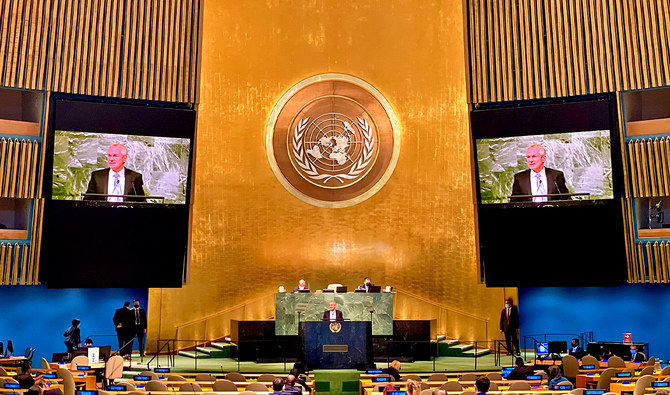
UN passes resolution, urges support for flood-battered Pakistan

United Nations General Assembly President Csaba Kőrösi addresses UN session in New York, US, on October 7, 2022. (@UN_PGA/Twitter)
Short Url
Updated 08 October 2022
Follow

UN passes resolution, urges support for flood-battered Pakistan

  • UN chief says Pakistan is on the verge of a public health disaster and severe hunger is spiking in country
  • This is a tragedy of epic proportions and needs immediate interventions, says UN General Assembly president

ISLAMABAD: The United Nations General Assembly (UNGA) on Friday passed a resolution to express solidarity with flood-battered Pakistan and called on the international community to increase aid to the South Asian country. 

Pakistan and the United Nations this week jointly launched a humanitarian appeal of $816 million, revising it up five-fold from $160 million, as water-borne diseases and fear of growing hunger pose new dangers after weeks of unprecedented flooding in Pakistan that has left 33 million people struggling to survive. 

Csaba Korosi, President of the 77th session of the United Nations General Assembly, said the UNGA unanimously adopted Resolution 77/1 which will “strengthen the coordination of @UN.” 

“The food situation in the flood-affected parts of the country [Pakistan] is already an undeclared emergency. This is a tragedy of epic proportions,” Korosi said in his address on Friday. 

“Without immediate interventions, its consequences will take us down a path of permanent emergency.” 

Korosi said time was of the essence and the price the world was paying for delays rose each day. “The times are hard, but I am confident that we can rebuild better. And to do that, we must rebuild together,” he added. 

The deluges have killed at least 1,700 people, affected 33 million, washed away crops and caused losses worth an estimated $30 billion since August. 

According to official figures, 632 of the 1,700 killed so far in the floods have been children. In the aftermath, as flood waters begin to recede, which officials say may take two to six months, the regions have become infested with diseases including malaria, dengue fever, diarrhea and skin problems. 

On Saturday, UN Secretary-General António Guterres said Pakistan was on the verge of a public health disaster and urged the world to support the South Asian nation. 

Guterres, who saw some of the damages for himself during a visit to Pakistan last month, reminded the UNGA of the losses and the scale of the destruction. 

“Pakistan is on the verge of a public health disaster & severe hunger is spiking. While the rains may have ceased, the effects of the floods will linger for years to come,” Guterres said in a tweet, urging donors and relevant organizations to support rehabilitation and reconstruction efforts. 

“Massive needs require massive support. We are working with the Government of Pakistan to convene a pledging conference to bring together donors at the highest level to provide concrete support for rehabilitation and reconstruction efforts,” he said in his remarks to the General Assembly on Friday. 


UN says 270,000 Afghans have returned from Iran, Pakistan this year

Updated 10 March 2026
Follow

UN says 270,000 Afghans have returned from Iran, Pakistan this year

  • UNHCR says 110,000 Afghans returned from Iran while 160,000 returned from Pakistan since start of 2026
  • Return numbers seem to have risen since Gulf war erupted on Feb. 28, says UNHCR official in Afghanistan

GENEVA: Some 270,000 Afghans have returned to their country from Pakistan and Iran so far this year, the UN said Tuesday, warning that the escalating Middle East war risked pushing the numbers higher.

UNHCR, the United Nations’ refugee agency, said that 110,000 Afghans had returned from Iran and another 160,000 had returned from Pakistan since the start of 2026.

And the numbers seem to have risen since the Middle East erupted on February 28, with the United States and Israel unleashing a barrage of strikes on Iran, and Tehran responding with drone and missile strikes on Israeli and US interests across the region.

Since then, there have been some 1,700 returns from Iran to Afghanistan each day, Arafat Jamal, UNHCR’s representative in Afghanistan, told reporters in Geneva.

Speaking from Islam Qala, on the Afghan-Iranian border, he said the situation there was “deceptively calm.”

“Returns are orderly but freighted with tension and apprehension,” he said, adding that with the hostilities elsewhere escalating, “I do fear there is more to come.”

“We are preparing for massive returns.”

He pointed out that Afghanistan was “facing the ramifications of what is happening with Iran,” while clashes have erupted along the Afghan border with Pakistan.

The new Middle East war, he warned, was “layering itself on top of an existing war on another frontier,” Jamal said.

UNHCR highlighted that the latest crises came after returns to Afghanistan had already been “exceptionally high” in recent years.

More than five million Afghans had returned from neighboring countries in the past two years, including 1.9 million returning from Iran last year alone.

Jamal warned that “many Afghan families are now facing cycles of displacement: first forced to flee Afghanistan, later displaced again inside Iran due to conflict, and now returning once more to Afghanistan.”

“And upon return in Afghanistan, the triply-displaced enter a spiral of precarity and uncertainty.”
Returns from Pakistan had meanwhile stabilized in recent weeks, as the main crossing point at Torkham remained closed due to the tensions there, Jamal said.

But he warned that “movements could increase sharply once the border reopens.”

UNHCR and the UN children’s agency UNICEF said Tuesday they were working to strengthen their capacity to operate at the borders and within Afghanistan.

But “given the scale of returns and the financial constraints facing humanitarian operations, additional support will be needed if arrivals increase,” UNHCR said, without specifying the amount needed.