

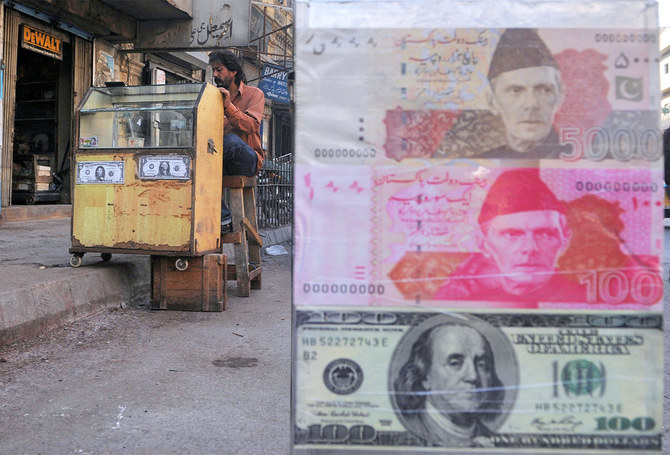

KARACHI: Pakistan’s national currency continued its upward trajectory against the US dollar on Friday, closing on a bullish note for the second consecutive week, with dealers and analysts crediting it to a change in command at the Ministry of Finance.
The rupee closed the weekend trading session at Rs219.92, posting a weekly appreciation of Rs7.37 against the greenback, as per figures by the State Bank of Pakistan (SBP). The currency has recouped its value by 7.2 percent or Rs17.10 during the last two weeks.
The rupee bounced back after Prime Minister Shehbaz Sharif’s coalition government decided to replace former Finance Minister Miftah Ismail with Ishaq Dar. Pakistan’s new finance minister enjoys the reputation of a man who is known for keeping the rupee stable.
The rupee continued to gain strength even a day after Moody’s downgraded Pakistan’s credit rating to Caa1 from B3, keeping its outlook negative.
“The rupee’s appreciation was because of the fear of Dar,” Zafar Paracha, general secretary of the Exchange Companies Association of Pakistan (ECAP), told Arab News.
“Otherwise, the currency would have lost its value by a minimum of Rs5 after Moody’s downgrading of Pakistan,” he added.
Paracha said during the last 11 trading sessions, the rupee gained its value by around Rs20 and Rs23 in the interbank and the open market because “sentiments have changed after the arrival of Dar, otherwise Pakistan has [still] not received foreign inflows.”
However, analysts said the currency market remained bullish as Moody’s action was already factored in by investors.
“Apart from Dar’s arrival due to his previous background, the rupee’s stability comes from better trade deficit numbers, the expectation of monetary inflows from multilateral institutions including World Bank, Asian Development Bank and some relaxation from conditions of International Monetary Fund (IMF),” Samiullah Tariq, director of research at the Pakistan Kuwait Investment Company, told Arab News.
As the rupee rebounds against the greenback, currency dealers also link it to the ongoing investigation of banks against their alleged involvement in manipulating the exchange rate for institutional gain.
“Banks were involved in exchange rate manipulation as they would buy dollars from exporters at lower rates and sell to importers at higher rates,” Paracha said. “The difference was around Rs20 between buying and selling,” he added.
“We would suggest that banks involved in exchange rate manipulation should be heavily fined and the bankers involved should be given exemplary punishment under anti-state laws,” he added.
Pakistan’s central bank is already investigating eight banks, including one state-owned bank for their role in the exhange rate manipulation. The outcome of the probe is pending.
Though Pakistan’s currency market did not respond to the negative rating action by Moody’s, stocks closed on a bearish note on the further downgrading of the South Asian country’s economy.
Stocks witnessed bearish activity on investor concerns for Moody’s sovereign credit rating downgrade to Caa1 with worsening economic outlook,” Ahsan Mehanti, chief executive officer of the Arif Habib Corporation, said.
“Investor concerns over the economic impact of flash flood losses and record surge in Pakistan dollar bond yields near to default calls after the finance minister’s hints to reduce interest rates played a catalyst role in the bearish close.”
Following Moody’s report, the key stock index closed the weekend trading session, down by 75.32 points to settle at the 42,085 level.
Moody’s has revised Pakistan’s GDP growth estimates as the South Asian country continues to bear the economic brunt of the floods and may yet undergo further economic deprivation.
Pakistan’s economic outlook in the near and medium term has deteriorated sharply as a due to the floods. The government’s preliminary estimates put the economic cost of the floods at about $30 billion (10 percent of GDP), far above the estimated $10 billion economic cost of the 2010 floods, which was until now the country’s worst flooding episode, according to Moody’s.
Moody’s has lowered Pakistan’s real GDP growth to 0-1 percent for fiscal 2023 (the year ending in June 2023), from a pre-flood estimate of 3-4 percent.


