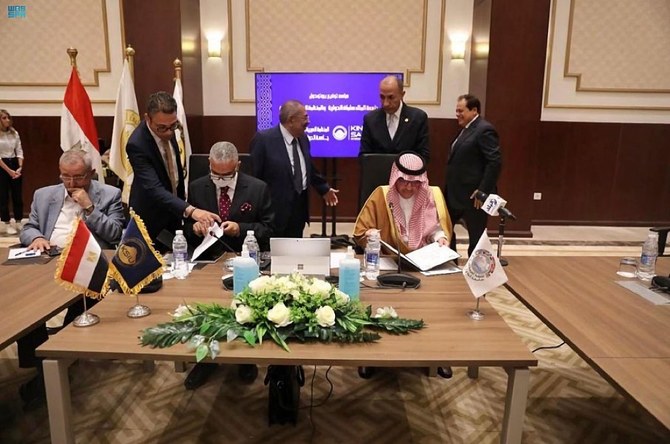
Arab Tourism Organization, King Salman International University sign agreement
Updated 07 October 2022
SPA
JEDDAH: The Arab Tourism Organization and King Salman International University signed a cooperation agreement aimed at improving tourism on Thursday in Sharm El-Sheikh.
Dr. Bandar bin Fahd Al-Fahid, president of the ATO, and Dr. Ashraf Saad Hussein, president of the university, signed the agreement in the presence of other officials.
The agreement stipulates that the ATO shall accredit KSIU’s College of Tourism and Hospitality as a regional hub for training Arab youth, in addition to approving programs and courses in the tourism field and managing reservations and sales for travel agencies.
Al-Fahid said that the organization is proud to sign this agreement, especially as the university bears the name of King Salman, whose government is keen to support and develop joint Arab action in all fields.
KSIU is a private university located in Sinai, Egypt, and includes a College of Tourism and Hospitality that offers distinguished academic and professional programs to train qualified participants according to the needs of the local and regional labor market.
Red Sea Global unveils scientific model for regenerative tourism worldwide
The report details the model’s rollout at “The Red Sea” and “AMAALA” destinations, backed by studies covering 8 marine habitats
Updated 26 February 2026
Arab News
TABUK: Red Sea Global (RSG) has unveiled a science-based model aimed at achieving a 30 percent net positive conservation benefit across its tourism destinations by 2040.
The framework is now available for global adoption, according to a statement released by RSG.
Owned by Saudi Arabia’s Public Investment Fund (PIF), Red Sea Global is the multi-project developer behind ambitious regenerative tourism destinations like “The Red Sea” and “AMAALA.”
As a cornerstone of the Kingdom’s Vision 2030, the company aims to diversify the national economy while setting new global benchmarks for sustainable, nature-positive development.
CEO John Pagano stated that openly sharing this detailed approach will help elevate the global tourism sector and secure a healthier environment for future generations.
Map showing the boundaries of the Red Sea Zone. (Graphic from the RSG report)
The cornerstone of this initiative is the proprietary SIIG Model, a four-step framework:
• Survey: Establish biodiversity baselines and monitor long-term changes.
• Identify: Assess risks to priority habitats and species.
• Intervene: Execute evidence-based actions, such as regulating fishing and enhancing natural habitats.
• Gain: Measure and verify biodiversity improvements.
The report details the model’s rollout at “The Red Sea” and “AMAALA” destinations, backed by extensive 2022–2023 environmental baseline studies covering eight marine habitats and priority species groups during 2022 and 2023.
A major intervention is the 5,015-square-kilometer Fishery Management Area in Al-Wajh Lagoon. The plan reserves 38 percent of the area for priority conservation—protecting 62 percent of local coral reefs—while allocating 61 percent for sustainable fishing.
According to scientific modeling, eliminating fishing in high-protection zones could increase reef fish populations by 113 percent, sharks and rays by 72 percent, and marine mammals by 24 percent. These measures are expected to boost coral resilience, support ecosystem recovery, and protect vulnerable species like sea turtles and seabirds.
Ihab Kindi, RSG’s Red Sea Destination Executive Director, called the data-driven model a practical roadmap for large-scale marine recovery. The complete methodology is available in the new report, “The SIIG Model: A Roadmap Toward Achieving Measurable Conservation Gains.”