DUBAI: Police fire tear gas into a crowd of soccer fans, who panic and rush for the exits.
There are so many trying to escape and some of the gates are locked. The stadium becomes a death trap.
People are trampled in the desperation. Others suffocate, crushed by the weight of bodies around them.
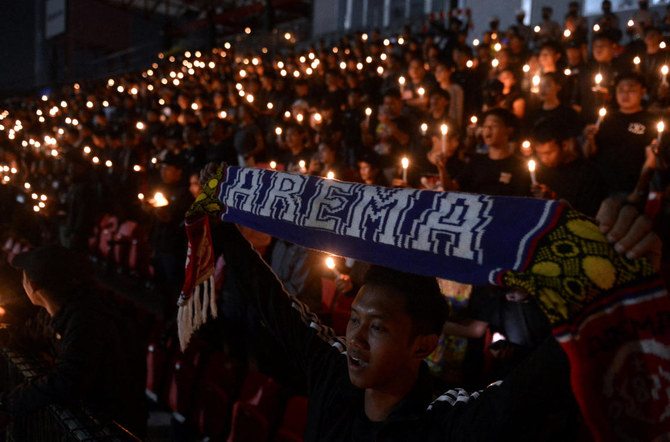
They are the details of last weekend’s soccer game in Malang, Indonesia, where 131 people, some of them children, died in a crush after police fired tear gas at fans of home team Arema FC.
It’s also the story of the Estadio Nacional disaster in Lima, Peru, in 1964, when 328 died in a panic sparked by tear gas. It was the same in Accra, Ghana, in 2001, when 126 died.
Soccer’s three worst stadium tragedies occurred over a 60-year span but are so strikingly similar that its clear lessons haven’t been learned.
The world’s most popular game has historic problems of hooliganism, and Indonesia has its share of team rivalries that have led to violence. But Arema had the only fans in the stadium. Just them and the police.
“Not a single rival supporter. How can that match kill more than 100 people?” said a sobbing Gilang Widya Pramana, the president of Arema.
The blame has landed at the feet of the police, like it did in Lima, and Accra, and elsewhere.
Some Arema supporters rushed the field in anger at their team’s loss. Yet, major soccer tragedies have almost always been caused, experts say, by a heavy-handed overreaction by police and poor stadium safety. Firing tear gas in enclosed stadiums is universally condemned by security experts. Locking exits goes against all safety regulations.
“Actually, fans killing other fans is an incredibly rare thing,” said Prof. Geoff Pearson of the University of Manchester, an expert on the policing of soccer fans. “When we look at pretty much all the major (soccer) tragedies, I can’t think of an exception off the top of my head, all of these have been caused by unsafe stadiums or practices, or inappropriate policing.”
Indonesia, a country of 273 million, is due to host next year’s Under-20 World Cup. It is soccer’s “sleeping giant,” said James Montague, a journalist and author who traveled there to watch games with fans.
Montague found a passion for soccer that matches, even outstrips, the game’s leading countries. He said he also found “largely decrepit” stadiums, corruption and mismanagement everywhere and the kind of police that would “smash me in the face with a baton just because I’m standing there watching a football match.”
Soccer was believed to have reached a turning point 33 years ago with the Hillsborough disaster, where 97 Liverpool fans died as a result of a crush at a stadium in Sheffield, England, in 1989. Police were eventually found to have been to blame for letting fans into an already overcrowded section but it took 27 years before the police’s lies and coverups — blaming drunken fans for the deaths — were fully exposed.
Hillsborough led to sweeping reforms in English soccer, making stadiums safer and demanding police change.
That echoes in Indonesia this week. So do calls for justice. Indonesian authorities have laid charges against six people for the crush, three of them police officers.
But a lack of ultimate accountability — “the state closes ranks,” Montague said — has also been a repeat feature.
A BBC report on the 50th anniversary of the Lima disaster found that only one police officer had been sentenced for soccer’s deadliest stadium tragedy, getting 30 months in prison. More than 30 years after Hillsborough, one official has been convicted of a safety offense and fined. Police were acquitted after Africa’s worst sports disaster in Accra despite an inquiry that blamed them for the reckless firing of tear gas and rubber bullets.
Soccer authorities stand helpless. FIFA, the governing body of world soccer based in Switzerland, has recommendations that tear gas should never be used in stadiums. But soccer bodies can’t dictate the tactics used by a country’s security forces, even if it’s at a soccer game.
“It is all down to the organized culture of the police,” said Ronan Evain, executive director of Football Supporters Europe, a group that represents fans’ interests.
Soccer’s inability to interfere in domestic security matters is underlined by the situation in Egypt, where a 2012 stadium riot that killed 74 people came amid a decade of harsh crackdowns on fans by security forces. Dozens of fans have been killed in encounters with police at and away from games, and some fan groups were declared terrorist organizations because they were critical of the Egyptian government, which has been widely accused of human rights violations.
The African soccer body is even based in Cairo but has no authority to intervene.
It’s the police, Pearson said, who have to be “willing to admit their mistakes and learn from their mistakes.” But that kind of institutional change is grudging.
Hillsborough did bring effective reform for England, but it stands almost alone. Lessons were lost after Lima and Accra, and the same can happen again after Indonesia.
Only days after last weekend’s tragedy, police fired tear gas and rubber bullets at soccer fans outside a stadium in Argentina and one person died in the chaos.
George Lawson worked at the Ghana Broadcasting Corporation when he raced to the unfolding tragedy at Ohene Djan Stadium in Accra 21 years ago. He remembered being stunned by the sight of dozens of bodies lying on the ground. He recalled his country coming to a standstill.
But while an inquiry demanded the stadium be totally upgraded, the only lasting change has been a bronze statue erected outside as a memorial, with the inscription: “I am my brother’s keeper.”
“When things happen like this, there’s a hullabaloo,” Lawson said. “And after some time people forget about it.”


![]()

Soccer’s worst disasters: Same mistakes by police, fans die
Short Url
https://arab.news/my5m3
Soccer’s worst disasters: Same mistakes by police, fans die
- Soccer’s three worst stadium tragedies occurred over a 60-year span but are so strikingly similar that its clear lessons haven’t been learned
- Soccer was believed to have reached a turning point 33 years ago with the Hillsborough disaster


Latest updates


Recommended


© 2026 SAUDI RESEARCH & PUBLISHING COMPANY, All Rights Reserved And subject to Terms of Use Agreement.