

Rights watchdogs condemn Taliban for latest media crackdown

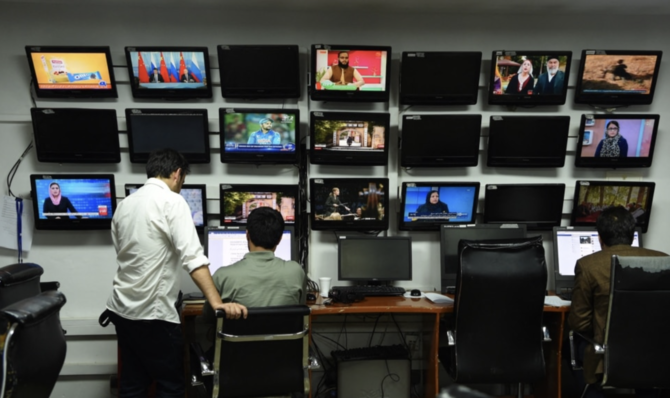
Although four new media outlets have been created since August 2021, Afghanistan has lost 219 of the 547 media outlets it used to have operating in the country. (AFP)
Short Url
Updated 06 October 2022
Follow

Rights watchdogs condemn Taliban for latest media crackdown

  • Hasht-e Subh Daily and Zawia News shuttered for ‘propaganda’
  • Afghanistan ranks 156 out of 180 countries on Press Freedom Index

LONDON: The Committee to Protect Journalists and Reporters Without Borders condemned the Taliban on Wednesday for shutting down two news websites in Afghanistan and urged the group to stop censoring the media.

“The Taliban must restore full online access to Hasht-e Subh Daily and Zawia News,” said CPJ’s Asia Program Coordinator Beh Lih Yi.

“More than ever, Afghans and the world need to know what is happening in Afghanistan. The Taliban must stop suppressing the media.”

Meanwhile, the RSF said in a statement: “In addition to the Taliban’s continuous restriction of the media, the closure of the websites of Hasht-e-Subh (8am) and Zawia Media, marks the start of a new phase in the Taliban’s war on media freedom.”

“They have used violence and regulations to restrict and censor the media, but for the first time they have gone so far as to directly violate media freedom by closing the websites of two Afghan newspapers,” the statement added.

On Monday, the Taliban’s Ministry of Telecommunications and Information Technology shut down the websites of Hasht-e Subh Daily and Zawia News reportedly due to “false propaganda” against the Taliban.

The Hasht-e Subh Daily and Zawia News sites are two prominent independent media outlets that have been operated by Afghan journalists reporting from exile since the Taliban took over the country in August 2021.

The award-winning Hasht-e Subh Daily newspaper has operated in Afghanistan since 2007 and moved its operations entirely online after the Taliban took control of Afghanistan. It has nearly 2.75 million combined followers on Facebook and Twitter.

Meanwhile, Zawia News is part of Zawia Media, which, according to its website, describes itself as a “pioneer” of digital media in Afghanistan and covers “untold realities” about the country.

According to Reporters Without Borders, Afghanistan ranks 156 out of 180 countries on the 2022 Press Freedom Index. In the first three months after the Taliban takeover in August 2021, 43 percent of Afghan media outlets disappeared.

According to the RSF, although four new media outlets have been created since August 2021, Afghanistan has lost 219 of the 547 media outlets it used to have operating in the country.


Israel arrests 2 Turkish CNN journalists over live broadcast outside IDF HQ

Updated 03 March 2026
Follow

Israel arrests 2 Turkish CNN journalists over live broadcast outside IDF HQ

  • Police said reporter Emrah Cakmak and cameraman Halil Kahraman were detained on suspicion of filming a sensitive security facility
  • Since the Gaza war began, restrictions have expanded significantly, including tighter limits on filming soldiers on duty and sensitive or strategic sites

LONDON: Israeli police have arrested two Turkish CNN journalists who were broadcasting live outside the Israel Defense Forces’ headquarters in Tel Aviv.

Police said the pair were detained on suspicion of filming a sensitive security facility, according to the Israel Police Spokesperson’s Unit.

Reporter Emrah Cakmak and cameraman Halil Kahraman, from the network’s Turkish-language channel, had been reporting near the IDF’s Kirya military headquarters on Tuesday after Iran launched another missile barrage at Tel Aviv and other parts of central Israel.

During the live broadcast, two men believed to be soldiers approached the crew and seized the reporter’s phone, according to initial reports and a video circulating online that could not be independently verified.

Police said officers were dispatched after receiving reports of two people carrying cameras and allegedly broadcasting in real time for a foreign outlet.

Israel’s long-standing military censorship system, overseen by the IDF Military Censor, has long barred journalists and civilians from publishing material deemed harmful to national security.

Since the Gaza war began, restrictions have expanded significantly, including tighter limits on filming soldiers on duty and sensitive or strategic sites.

After a series of similar incidents involving foreign media — most of them Palestinian citizens of Israel working for Arab-language and international media, along with foreign journalists — during the 12-Day War, Israeli police halted live international broadcasts from missile impact sites, citing concerns that exact locations were being revealed.

The Government Press Office later imposed a blanket ban on live coverage from crash and impact areas.

Communications Minister Shlomo Karhi and National Security Minister Itamar Ben-Gvir subsequently ordered that all foreign journalists obtain prior written approval from the military censor before broadcasting — live or recorded — from combat zones or missile strike locations.

Police said that when officers asked the CNN Turk crew to identify themselves, they presented expired press cards and were taken in for questioning.

Burhanettin Duran, head of Turkiye’s Directorate of Communications, condemned the arrests as an attack on the press and said Ankara is working to secure the journalists’ release.