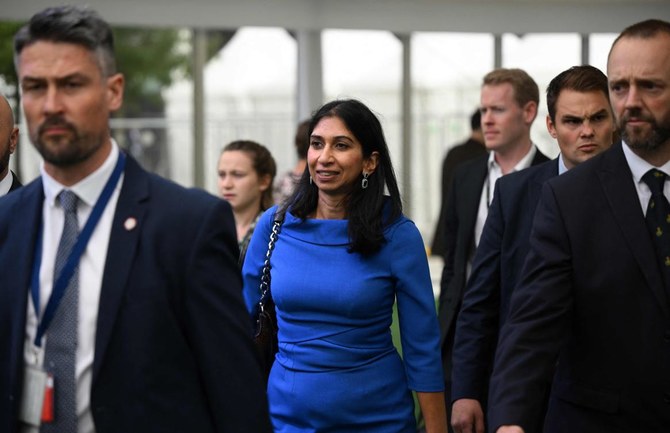
BIRMINGHAM, United Kingdom: Britain’s new interior minister on Tuesday vowed to prevent migrants from claiming asylum if they arrive through an “illegal” route, and stop small boat crossings across the Channel from France.
Suella Braverman said the situation, in which criminal gangs were exploiting vulnerable migrants, had “gone on for far too long.”
Irregular migration is a thorny political issue for the UK government, which promised to tighten borders after the country left the European Union.
But a partnership deal with Rwanda signed earlier this year under the premiership of Boris Johnson to send some migrants to the African country for resettlement has so far failed.
Deportation flights have been stymied by a series of legal challenges in the UK courts and at the European Court of Human Rights.
Braverman said Britain needed to “find a way to make the Rwanda scheme work” and denounced the intervention of the ECHR, describing it as a “closed process with an unnamed judge and without any representation by the UK.”
“I will commit to look to bring forward legislation that the only route to the United Kingdom is through a safe and legal route,” she told the ruling Conservative party’s annual conference.
“If you deliberately enter the United Kingdom from a safe country you should be swiftly removed to your home country or relocated to Rwanda. That is where your asylum claim will be considered,” she said.
Reacting to Braverman’s speech, the PCS trade union which represents civil servants responsible for implementing the policy, said she did not “appear to understand the UK’s international obligations under the Geneva Convention.”
“Time and again we have called upon the government to use the expertise of our members in the Home Office to develop a solution to this crisis through safe passage,” PCS general secretary Mark Serwotka said.
“Instead, it chooses to continually demonize refugees to deflect from its hopeless inability to address the cost of living crisis facing the people of this country.”
Official government figures last month showed more migrants had crossed the Channel to the UK from northern France so far this year than in the whole of 2021, when 28,526 made the journey.
More than 33,500 people have now arrived in Britain.
Braverman’s speech played into Prime Minister Liz Truss’s right-wing agenda, urging police to stop “virtue signalling” on issues such as race and gender.
She promised to empower officers to stop “the mob” of direct-action protesters who use “guerilla tactics” to bring “chaos and misery” to the public.
“Whether you’re Just Stop Oil, Insulate Britain or Extinction Rebellion, you cross a line when you break the law and that’s why we’ll keep putting you behind bars,” she added.
On Tuesday, the Metropolitan Police said it had arrested 54 Just Stop Oil protesters on suspicion of “wilful obstruction of the highway” after a demonstration blocked traffic in central London.


![]()

UK interior minister vows to stop migrant ‘small boats’
Short Url
https://arab.news/4zh5v
UK interior minister vows to stop migrant ‘small boats’
- Irregular migration is a thorny political issue for the UK government
- Deportation flights have been stymied by a series of legal challenges in the UK courts and at the European Court of Human Rights


Latest updates


© 2026 SAUDI RESEARCH & PUBLISHING COMPANY, All Rights Reserved And subject to Terms of Use Agreement.