

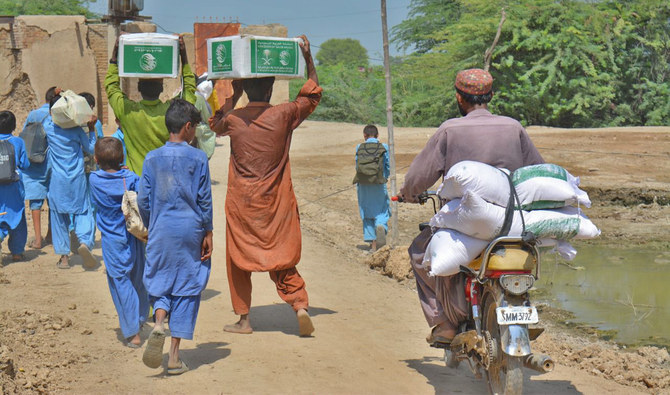
Saudi Arabia’s KSrelief distributes over 1,300 food packages in flood-hit Pakistan

Flood-affected people carry food packages distributed by Saudi Arabia’s King Salman Humanitarian Aid and Relief Center in Pakistan's Punjab province on October 1, 2022. (@KSRelief_EN/Twitter)
Short Url
Updated 04 October 2022
Follow

Saudi Arabia’s KSrelief distributes over 1,300 food packages in flood-hit Pakistan

  • Saudi Arabia last month established an air-bridge to deliver relief goods to the South Asian country
  • UN and humanitarian partners continue to scale up response and have reached over 1.6 million affectees

ISLAMABAD: Saudi Arabia’s King Salman Humanitarian Aid and Relief Center (KSrelief) continued its relief activities and distributed more than 1,300 food packages in flood-hit areas of Pakistan, the Saudi Press Agency (SPA) reported on Monday. 

Deadly floods, triggered by unusually high monsoon rains, have killed at least 1,696 people, including 630 children and 340 women, and affected more than 33 million in Pakistan since August. The deluges have inundated a third of the country, causing damages up to $30 billion. 

On Monday, the United Nations humanitarian agency warned that outbreaks of vector-borne and water-borne diseases were a growing concern in the southern Sindh and southwestern Balochistan provinces, where many districts remain inundated by floodwaters. 

A number of countries, including Saudi Arabia, the United Arab Emirates, as well as UN agencies have sent more than 130 flights carrying aid for flood survivors in Pakistan. 

“The team of King Salman Humanitarian Aid and Relief Center (KSrelief) continued to distribute various relief aid to people affected by the floods in the Islamic Republic of Pakistan,” an SPA report read on Monday. 

“As many as 1,360 food baskets were distributed yesterday in the Islamic Republic of Pakistan, benefiting 9,520 people.” 

KSrelief last month launched a campaign to support flood-affected people in Pakistan as the administration in the Pakistani capital of Islamabad called for more international aid to deal with the situation. 

In recent weeks, Saudi Ambassador Nawaf bin Said Al-Malki and KSrelief Director Dr. Khalid Al-Thmani also visited the flood-hit area of Sehwan Sharif in Sindh and distributed rations and other necessary items among people. 

Meanwhile, United Nations Office for the Coordination of Humanitarian Affairs (UNOCHA) said UN agencies and their humanitarian partners “continue to scale up the response and have reached more than 1.6 million people directly affected by the floods.” 

According to the UNOCHA, some 598,000 Pakistanis are currently living in temporary relief camps at more than 7,000 schools. 

“Over 2 million houses have been impacted by the heavy rains and floods, with more than 1.2 million houses partially destroyed and nearly 825,000 fully destroyed,” the UN humanitarian agency said. 

Pakistan is reeling from the aftermath of extremely heavy monsoon rains and floods, with officials and experts blaming them on climate change. 

International aid continues to pour into Pakistan since August, with Saudi Arabia and the UAE establishing air bridges to deliver relief goods to affected people in the South Asian country. 

At least 10 planes carrying Saudi humanitarian aid have arrived in Pakistan since last month. 


Security forces kill four militants in Pakistan’s volatile southwest, military says

Updated 13 January 2026
Follow

Security forces kill four militants in Pakistan’s volatile southwest, military says

  • Balochistan, Pakistan’s largest province by land area bordering Iran and Afghanistan, has long been the site of a low-level insurgency
  • The Balochistan government has recently established a threat assessment center to strengthen early warning, prevent ‘terrorism’ incidents

ISLAMABAD: Pakistani security forces gunned down four militants in an intelligence-based operation in the southwestern Balochistan province, the military said on Tuesday.

The operation was conducted in Balochistan’s Kalat district on reports about the presence of militants, according to the Inter-Services Public Relations (ISPR), the Pakistani military’s media wing.

The “Indian-sponsored militants” were killed in an exchange of fire during the operation, while weapons and ammunition were also recovered from the deceased, who remained actively involved in numerous militant activities.

“Sanitization operations are being conducted to eliminate any other Indian-sponsored terrorist found in the area,” the ISPR said in a statement.

There was no immediate response from New Delhi to the statement.

Balochistan, Pakistan’s largest province by land area bordering Iran and Afghanistan, has long been the site of a low-level insurgency involving Baloch separatist groups, including the Balochistan Liberation Army (BLA) and the Balochistan Liberation Front (BLF).

Pakistan accuses India of supporting these separatist militant groups and describes them as “Fitna Al-Hindustan.” New Delhi denies the allegation.

The government in Balochistan has also established a state-of-the-art threat assessment center to strengthen early warning and prevention against “terrorism” incidents, a senior official said this week.

“Information that was once scattered is now shared and acted upon in time, allowing the state to move from reacting after incidents to preventing them before they occur,” Balochistan Additional Chief Secretary Hamza Shafqaat wrote on X.

The development follows a steep rise in militancy-related deaths in Pakistan in 2025. According to statistics released by the Pakistan Institute for Conflict and Security Studies (PICSS) last month, combat-related deaths in 2025 rose 73 percent to 3,387.

These included 2,115 militants, 664 security forces personnel, 580 civilians and 28 members of pro-government peace committees, the think tank said.