

Saudi Arabia’s KSrelief distributes over 1,300 food packages in flood-hit Pakistan

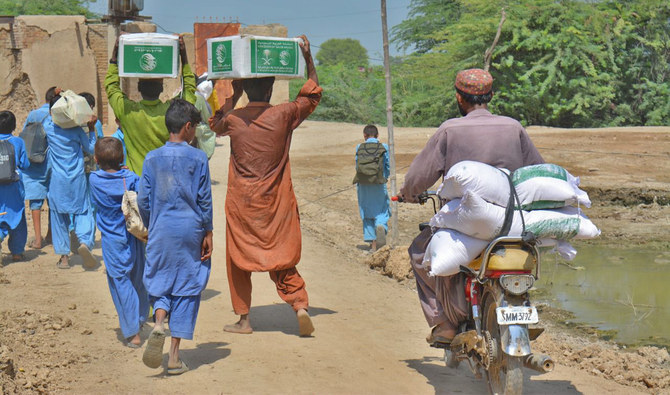
Flood-affected people carry food packages distributed by Saudi Arabia’s King Salman Humanitarian Aid and Relief Center in Pakistan's Punjab province on October 1, 2022. (@KSRelief_EN/Twitter)
Short Url
Updated 04 October 2022
Follow

Saudi Arabia’s KSrelief distributes over 1,300 food packages in flood-hit Pakistan

  • Saudi Arabia last month established an air-bridge to deliver relief goods to the South Asian country
  • UN and humanitarian partners continue to scale up response and have reached over 1.6 million affectees

ISLAMABAD: Saudi Arabia’s King Salman Humanitarian Aid and Relief Center (KSrelief) continued its relief activities and distributed more than 1,300 food packages in flood-hit areas of Pakistan, the Saudi Press Agency (SPA) reported on Monday. 

Deadly floods, triggered by unusually high monsoon rains, have killed at least 1,696 people, including 630 children and 340 women, and affected more than 33 million in Pakistan since August. The deluges have inundated a third of the country, causing damages up to $30 billion. 

On Monday, the United Nations humanitarian agency warned that outbreaks of vector-borne and water-borne diseases were a growing concern in the southern Sindh and southwestern Balochistan provinces, where many districts remain inundated by floodwaters. 

A number of countries, including Saudi Arabia, the United Arab Emirates, as well as UN agencies have sent more than 130 flights carrying aid for flood survivors in Pakistan. 

“The team of King Salman Humanitarian Aid and Relief Center (KSrelief) continued to distribute various relief aid to people affected by the floods in the Islamic Republic of Pakistan,” an SPA report read on Monday. 

“As many as 1,360 food baskets were distributed yesterday in the Islamic Republic of Pakistan, benefiting 9,520 people.” 

KSrelief last month launched a campaign to support flood-affected people in Pakistan as the administration in the Pakistani capital of Islamabad called for more international aid to deal with the situation. 

In recent weeks, Saudi Ambassador Nawaf bin Said Al-Malki and KSrelief Director Dr. Khalid Al-Thmani also visited the flood-hit area of Sehwan Sharif in Sindh and distributed rations and other necessary items among people. 

Meanwhile, United Nations Office for the Coordination of Humanitarian Affairs (UNOCHA) said UN agencies and their humanitarian partners “continue to scale up the response and have reached more than 1.6 million people directly affected by the floods.” 

According to the UNOCHA, some 598,000 Pakistanis are currently living in temporary relief camps at more than 7,000 schools. 

“Over 2 million houses have been impacted by the heavy rains and floods, with more than 1.2 million houses partially destroyed and nearly 825,000 fully destroyed,” the UN humanitarian agency said. 

Pakistan is reeling from the aftermath of extremely heavy monsoon rains and floods, with officials and experts blaming them on climate change. 

International aid continues to pour into Pakistan since August, with Saudi Arabia and the UAE establishing air bridges to deliver relief goods to affected people in the South Asian country. 

At least 10 planes carrying Saudi humanitarian aid have arrived in Pakistan since last month. 


New PIA owner plans more GCC flights, lower airfares

Updated 57 min 38 sec ago
Follow

New PIA owner plans more GCC flights, lower airfares

  • New management will focus on religious tourism to Makkah, Madinah and other sites to expand global reach
  • Owner Arif Habib says airfares will be rationalized to make PIA flights affordable for low-income Pakistanis

KARACHI: Pakistan’s recently privatized national carrier, the Pakistan International Airlines (PIA), plans to increase its flights to the Gulf Cooperation Council (GCC) region as part of its post-privatization business strategy to achieve 7.5% annual revenue growth, its new owner said this week.

A Pakistani consortium, led by Arif Habib Group, clinched a 75% stake in PIA for Rs135 billion ($482 million) on Dec. 23 after a competitive bidding process, in a deal that valued the airline at Rs180 billion ($643 million).

The sale marked Pakistan’s most ambitious effort in decades to reform the debt-ridden airline that had accumulated over Rs784 billion ($2.8 billion) in losses. The government said it aimed to end decades of state-funded bailouts and support the airline’s revival.

In an exclusive interview with Arab News, Arif Habib, chairman of Arif Habib Group, shared that he aims to attract around 70 million Pakistanis, who travel annually via different airlines, by making airfares more affordable.

“That [GCC region] is our biggest market... We would definitely try to increase the frequency of flights, increase the number of planes there, and try to capture more market share in that area,” Habib told Arab News on Monday.

“So, there we see a lot of opportunity.”

The new management of PIA, which currently caters to 4 million passengers annually, aims to target religious tourism, which Habib called a “captive market” in Pakistan and the Middle East.

According to PIA spokesperson Abdullah Hafeez Khan, the airline runs around 20 flights daily to the Middle East.

Habib plans to invest around Rs112 billion ($400 million) in PIA to turn the airline around, implementing short- and long-term improvements ranging from upgrading seats to tripling the 19-aircraft fleet, and engaging a foreign airline as a technical partner through strategic divestment over the next seven to eight years.

The group also intends to reduce PIA fares to make air travel more affordable for passengers from Pakistan’s low-income groups.

“Yes, we have been advised that in order to increase our market share, we will have to rationalize the airfares,” Habib said. “That is in the plan, and we will unfold it as it comes.”

The new owners have engaged a global advisory firm, Seabury Aviation Partners, to identify viable markets for the newly privatized airline and expand its presence both locally and internationally.

Habib aims for up to 7.5% annual growth in PIA’s operational revenues to make it profitable and the new management is targeting European and North American markets, particularly routes to and from the United Kingdom, the United States and Canada, for this purpose.

“The UK is the most lucrative market where I think there is a lot of demand,” he said, adding they would also be seeking more flight destinations. “Even for USA there is demand there.”

Habib, however, said the airline would take time to deliver “reasonable” returns to its investors, including AKD Group Holdings, Fatima Fertilizer Company, City Schools, Lake City Holdings and Fauji Fertilizer Company, a publicly listed firm owned by Pakistan’s military.

“In initial period of one to two years, we may see some losses but into medium term, I think, that would be turned around,” he concluded.

PIA posted a pre-tax profit of Rs11.5 billion ($41 million) for the January–June 2025 period, its first such profit for this timeframe in nearly two decades, according to a Reuters report in September. The airline recorded losses during the same period in 2024.

Once considered one of Asia’s leading carriers, PIA struggled with chronic mismanagement, political interference, overstaffing, mounting debt, and operational issues that led to a 2020 ban on flights to the European Union, the UK, and the US following a pilot licensing scandal. The EU and UK have since lifted their bans, giving the airline renewed momentum, while the US ban remains in place.

On Tuesday, PIA announced that the airline will be expanding its UK operations and will operate four weekly flights from Islamabad to London starting Mar. 29.

“The flights are being resumed after a long gap of six years,” PIA spokesman Khan said in a statement. “PIA is already operating three weekly flights to Manchester.”