Saudi Arabia to host the 2029 Asian Winter Games at NEOM

Trojena, a mountain destination in NEOM, is due to be completed in 2026. (NEOM)
Short Url
Updated 05 October 2022
Follow

Saudi Arabia to host the 2029 Asian Winter Games at NEOM

  • NEOM is Crown Prince Mohammed bin Salman’s most ambitious project under the Kingdom’s Vision 2030

JEDDAH: Saudi Arabia was chosen on Tuesday to host the 2029 Asian Winter Games at Trojena, a year-round winter sports complex being built in the northwest of the Kingdom as part of the futuristic NEOM megacity.

“The deserts and mountains of Saudi Arabia will soon be a playground for winter sports,” the Olympic Council of Asia said after the Saudi bid was “unanimously approved” at its general assembly meeting in Phnom Penh.

Trojena, which is due to be completed in 2026, is in an area of NEOM where winter temperatures drop below zero and year-round temperatures are generally 10 degrees cooler than the rest of the region.

One of 10 regions within NEOM, it is about 50 km inland from the Gulf of Aqaba in an area that, like much of the rest of the Kingdom, receives very little rainfall. The site spans 60 square kilometers, at an elevation of between 1,500 and 2,600 meters.

The complex will have year-round skiing, chalets, mansions, ultra-luxury hotels and a five-meter-deep manmade lake filled with desalinated sea water.

Saudi Crown Prince Mohammed bin Salman has said that Trojena “will redefine mountain tourism for the world by creating a place based on the principles of ecotourism, highlighting our efforts to preserve nature and enhance the community’s quality of life.”
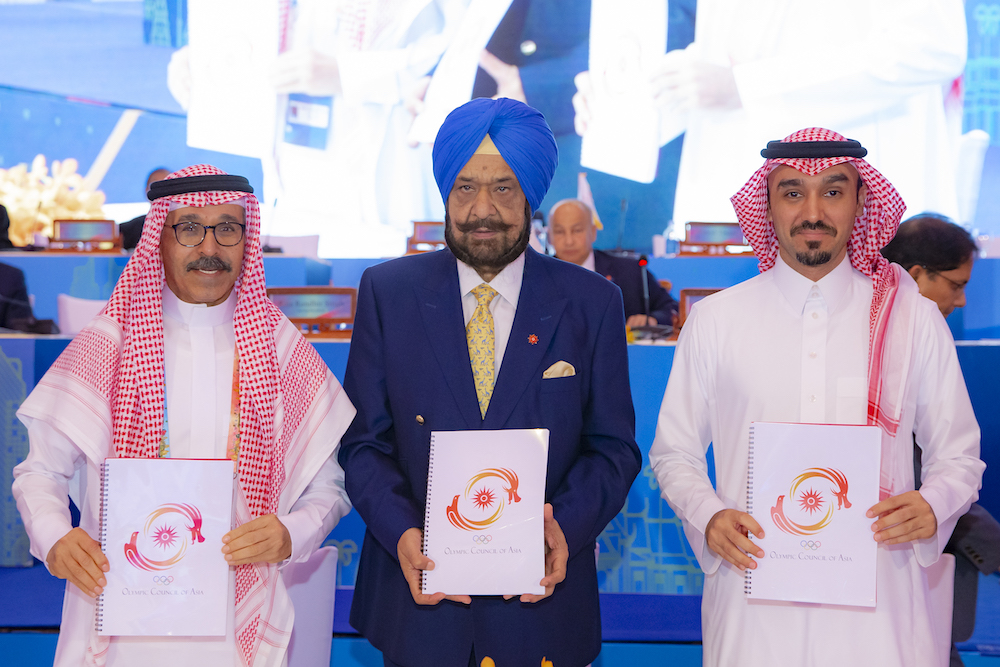


Sports Minister Prince Abdulaziz bin Turki Al-Faisal (R) at the ceremony OCA ceremony in Cambodia. (Supplied)

Among those on the successful Saudi bid team for the Games was alpine skier Fayik Abdi. “I never believed I would ski in my homeland,” he said.

There will be 47 events at the Trojena Games — 28 on snow and 19 on ice — including competitions for skiing, snowboarding, ice hockey and figure skating.

Prince Abdulaziz bin Turki Al-Faisal, president of the Saudi Olympic and Paralympic Committee, said the success of the Saudi bid to host the Games was “a great victory for the Saudi nation and the people of the Gulf countries.”

He said: “The Saudi sports sector significantly contributes to … the objectives of Saudi Vision 2030.”

The successful bid “also shed light on the enormous potential and the outstanding infrastructure of Saudi Arabia to host and organize international-level sports competitions and games successfully.”

Committee vice president Prince Fahd bin Jalawi said the Saudi leadership was “sparing no effort to push Saudi sports forward alongside the most advanced countries in the world.”

NEOM chief executive Nadhmi Al-Nasr said Trojena would have “suitable infrastructure to create the winter atmosphere in the heart of the desert, to make the Winter Games in Trojena an unprecedented global event.”


A Cup of Gahwa
The taste and traditions of Saudi coffee

Enter


keywords


How international academies are shaping Saudi football’s next generation

Updated 19 sec ago
Follow

How international academies are shaping Saudi football’s next generation

  • Building a unified national footballing philosophy in Saudi Arabia is no simple task

Saudi Arabia’s football transformation has been impossible to ignore since the arrival of Cristiano Ronaldo at the end of 2022. An influx of global stars followed, and with it, unprecedented attention on the Saudi Pro League.

Yet beneath the spotlight, a more pressing question emerged amongst domestic fans: “What is the long-term strategy for developing local players?”

Building a unified national footballing philosophy in Saudi Arabia is no simple task. The sheer size of the Kingdom presents logistical challenges unlike those faced by smaller neighbouring nations, making grassroots development harder to centralize. In this landscape, the work of individual institutions can contribute significantly to the broader football ecosystem.

One such contributor is Juventus Academy Saudi Arabia, an official extension of one of world football’s most historic clubs, operating under the umbrella of Al-Shoaibi Group. Arab News spoke to head of public relations at Juventus Academy, Malak Al-Awami, based in Alkhobar, to understand how the academy fits into the Kingdom’s long-term football vision.

“Saudi Arabia is experiencing a transformational moment under Vision 2030, prioritizing youth development and active lifestyles,” Al-Awami explained. “The  academy arrives at a perfect time to contribute to a world-class methodology while helping nurture the next generation of Saudi footballers.”

At Juventus Academy, success is deliberately defined beyond results and trophies.

“We’re not just training players,” Al-Awami said. “We’re shaping future leaders for the Kingdom.”

That philosophy has been reflected in how the academy balances Juventus’ global philosophy with local Saudi culture. While all coaches undergo Juventus’ training standards, cultural understanding remains a priority.

“All of our coaches are guided to respect Saudi values, culture and communication styles,” Al-Awami said. “Technical excellence matters, but the coach’s character is just as important as their certification.”

One of the academy’s defining features has been its inclusivity and cultural awareness. Players can join as young as four years old and continue until the age of 18, with programs open to both boys and girls.

That inclusivity has had a tangible impact. Juventus Academy played a role in the formation of Khobar FC, a women’s team that competed in the inaugural season of the SAFF Women’s Second Division League.

“We even used the same kit style as Juventus, getting approval from the club itself,” revealed Al-Awami.

Operating as an extension of the academy, the team finished just a few points behind established clubs like Al-Nahda and Al-Fateh in their regional group.

Al-Awami noted that the group is also exploring complementary initiatives aimed at elite player development beyond the academy itself. Among them is the planned Superior Striker Project, a specialized program designed to bring international attacking expertise to Saudi Arabia through short-term clinics for youth and professional players.

It is this broader contribution that highlights the growing importance of international academies in Saudi Arabia. Beyond providing structured training, they are helping build communities, instil values and strengthen the foundations of the domestic football pyramid. 

When asked about what success would look like for Juventus Academy in 5-10 years, Al-Awami was clear. “It is definitely not about trophies or big contracts,” he said, before adding, “it is the legacy we leave behind. If, in 10 years we see confident young Saudi players competing at elite levels, local coaches growing through our programs, and families trusting football as a tool for personal development, then we will know that we have truly succeeded.”

Juventus Academy Saudi Arabia builds on Al-Shoaibi Group’s original ambition in 2018: to create meaningful football opportunities for families in the Kingdom. Today, that ambition has evolved into a structured pathway contributing to Saudi football future, blending global expertise with local identity to help shape the next generation.