

Palestinian activists turn to TikTok amid Israeli anger over ‘propaganda videos’

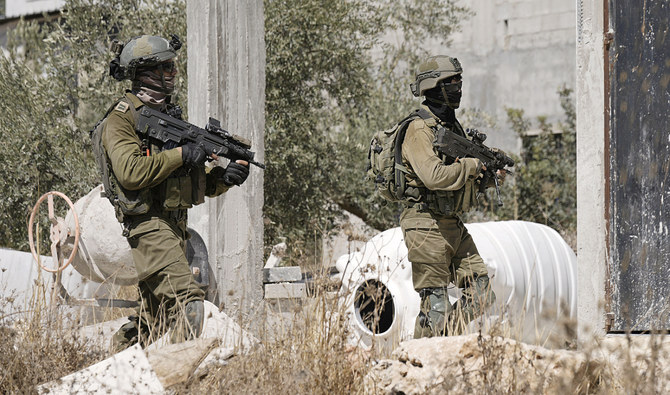
Israeli security forces conduct a search operation. experts say the number of Palestinian TikTok users highlighting Israeli brutal activities is growing rapidly. (AP)
Short Url
Updated 02 October 2022
Follow

Palestinian activists turn to TikTok amid Israeli anger over ‘propaganda videos’

  • After Facebook, Instagram clamp down on content, Chinese-owned platform sees user surge

RAMALLAH: Palestinian activists are turning to TikTok to rally against activities by Israel, which accused the social media platform of igniting the security situation in the Middle East in recent weeks.

Israel had successfully pushed Meta to block thousands of Palestinian accounts and content from its social media platforms, such as Facebook and Instagram, in addition to limiting Palestinian content through Twitter and Snapchat. However, TikTok, owned by Chinese company ByteDance, has rejected the Israeli allegations and refused to change its policies.

Thousands of Palestinian social media activists switched to TikTok during the past few weeks to enjoy online freedom and bypass Facebook’s restrictions.

Amer Hamdan, a Palestinian political activist, told Arab News that he recently switched from Facebook to Tiktok after suffering from restrictions imposed by the former, which he said flags the use of words including martyr, resistance and occupation.

Hamdan, who had 200,000 followers on his Facebook page, added that his account was closed because he published a picture of Khalil Al-Wazir, the Palestinian leader who Israel assassinated in Tunisia in 1988.

“Because Facebook is no longer the ideal platform for the Palestinians to spread their cause, the alternative is TikTok, which provides an adequate and sufficient space for the dissemination of media covering armed parades of Palestinian military groups and pictures of Palestinian resistance fighters with their weapons,” said Hamdan.

TikTok previously ranked third in Palestine — after Facebook and Instagram — in social media app usage. However, it jumped to second place during recent weeks, with Palestinian social media experts telling Arab News that though 3 million Palestinian accounts are on Facebook, more than 1 million Palestinians are on TikTok, with the number rapidly increasing.

Palestinian activists also see more technical flexibility while publishing on Tiktok compared to Facebook, with the platform allowing three-minute clips for all users, and 15-minute videos for users who have 1,000 followers or more.

“Within a year, TikTok will be the number one social media platform used by Palestinians,” Hamdan said.

Sam Bahour, an expert in business development affairs, said that social media is gaining “exceptional importance” for Palestinians by enabling them to communicate and bypass Israeli restrictions across the West Bank, Gaza Strip, as well worldwide through the diaspora.

Ahmed Al-Qadi, from a center that specializes in researching social media activities, told Arab News that after the violent events in the Palestinian territories last May and after Facebook, Instagram, WhatsApp and YouTube removed Palestinian content, people switched to TikTok.

On the other hand, Israeli political analyst Yoni Ben-Menachem told Arab News that TikTok is a “tool of dangerous influence” and incites violence through videos glorifying attacks against Israelis.

Ben-Menachem added that TikTok content targets young people, who are particularly vulnerable to misinformation and propaganda.

Last May, Israeli Defense Minister Benny Gantz met with senior officials from ByteDance, demanding that the company block Palestinian content. But Gantz’s appeal was denied, with the company only promising to pay more attention to published content.

Young Palestinians have filmed Israeli incursions into Palestinian cities and towns, house demolitions, arrests, killings, settler attacks and racist treatment, with the content going viral on TikTok.

Despite the Israeli government’s anger, officials do not expect TikTok to take any action against Palestinian accounts, whether based in the West Bank and Gaza Strip or abroad.

“Maybe TikTok will close a few Palestinian accounts, but thousands of accounts that incite against Israel will remain active, and whoever loses his account can open a new account under a pseudonym,” said Ben-Menachem, adding: “TikTok has become the most dangerous means of incitement against Israel.”


Gaza needs unrestricted access to aid, Qatar PM tells Davos

Qatar’s Prime Minister and Minister for Foreign Affairs Sheikh Mohammed bin Abdulrahman bin Jassim Al-Thani speaks during WEF.
Updated 14 sec ago
Follow

Gaza needs unrestricted access to aid, Qatar PM tells Davos

LONDON: Humanitarian aid for Gaza is still being restricted, and Qatar is working with its partners to ensure that changes, the country’s prime minister told Davos on Tuesday.

“The humanitarian situation (in Gaza) may be better than last year, but it still needs a lot of intervention. A lot of humanitarian aid is still not allowed to enter because of restrictions, and we need to have unrestricted access for humanitarian aid for the people,” Sheikh Mohammed bin Abdulrahman told President and CEO of the World Economic Forum Borge Brende.

“We are working together very closely with our colleagues in the United States, Egypt, and Turkiye in order to ensure that there is a mechanism that supports the technocratic government that’s just been established in Gaza, in order to enable them to help the people and deliver a better life for the people,” he said.

The premier’s comments come a week after US Envoy Steve Witkoff announced the start of phase two of President Donald Trump’s plan to end the war in Gaza, with a technocratic Palestinian government established in the territory.

The 15-member Palestinian body will be headed by Ali Shaath, a former deputy minister in the Palestinian Authority, according to a joint statement by mediators Egypt, Qatar and Turkiye.

On Friday, an official from the UN Office for the Coordination of Humanitarian Affairs said that the humanitarian crisis in Gaza is far from over.

“For the Palestinians in Gaza, their lives continue to be defined by displacement, trauma, uncertainty, and deprivation,” Olga Cherevko said.

She said that aid restrictions are preventing Gazans from accessing the help that they desperately need.

“Due to various impediments and restrictions placed on organizations operating in Gaza and specific types of supplies that could enter, we could basically only apply Band-Aids to a wound that can only be closed with proper care,” she said.

Restrictions on both aid agencies and critical supplies must be lifted, early recovery must be funded and enabled, and donor support must continue, Cherevko added.

Speaking about the situation in the Syrian Arab Republic, Sheikh Mohammed said that the country had been through a very difficult 15 years and that such turmoil would always have consequences.

“We know that it’s not easy to come to a country after a civil war and to start rebuilding the institutions, state and systems. It’s a difficult job, and the Syrian government needs help, and they’ve been asking for this help, and we are all trying to help them reach that stage,” he said.

“The beauty of Syria is its diversity, the social fabric of Syria that has been there for centuries, not something new. I believe that everyone in Syria wants to see a stable Syria, wants to ensure that they are treated equally and their rights are protected, and it’s their right.”

The prime minister said the international community should help the Syrian government build a state, institutions and an inclusive system that extends to all Syrians.

“You cannot build a state without building a proper institutional system that includes everybody,” he said.

On Tuesday, the Syrian government announced a new four-day truce after a previous ceasefire between government forces and the Kurdish-led Syrian Democratic Forces broke down.

In a statement carried by state media, the Syrian presidency said that “a joint understanding has been reached between the Syrian government and the Syrian Democratic Forces on a number of issues concerning the future of Hasakah province,” adding that the SDF has “four days for consultations to develop a detailed plan” for the area’s integration, beginning at 8:00 p.m. on Tuesday.

It said that if the agreement is finalized, Syrian forces “will not enter the city centers of Hasakah and Qamishli … and Kurdish villages.”

Turning to the Qatari economy, the prime minister said the country is uniquely positioned when it comes to the supply of energy.

“This revolution that you see in AI and technology will require (energy) to power data centers that they will need. Qatar is at the center of this progress and development,” he said.

He added that the country aims ‌to help domestic ‌companies compete globally and is planning new platforms to support this effort later this year.