

Ex-PM Khan calls audio leaks involving top Pakistani officials ‘massive security breach’ 

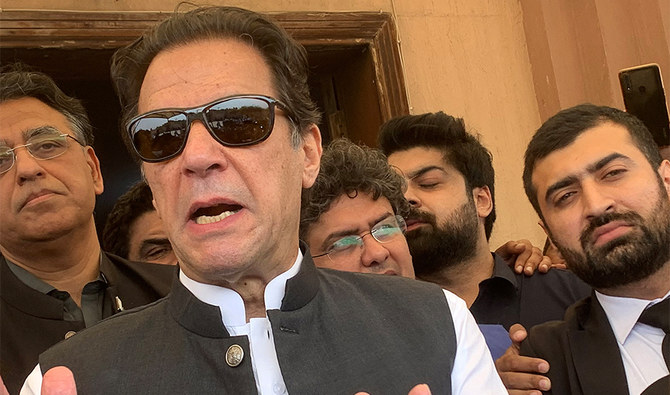
Pakistan's former prime minister Imran Khan speaks to media after appearing before the Anti-Terrorism Court in Islamabad on September 12, 2022. (AFP)
Short Url
Updated 02 October 2022
Follow

Ex-PM Khan calls audio leaks involving top Pakistani officials ‘massive security breach’ 

  • The latest audio clip revolves around a cypher Khan has used as basis of his anti-US narrative 
  • Khan says to protect foreign office’s secret code his government didn’t make the cypher public 

ISLAMABAD: Former Pakistan prime minister Imran Khan on Saturday said the recent leaks of audio clips featuring discussions between key government members, including himself, PM Shehbaz Sharif and others, were a “massive security breach.” 

A slew of audio clips, a couple featuring Khan himself, leaked online earlier this week, creating a political storm in the South Asian country. The latest audio clip emerged on Friday featuring Khan, his then principal secretary Azam Khan and two top aides, Shah Mahmood Qureshi and Asad Umar. 

The discussion revolved around a controversial cypher, based on a meeting between then Pakistani ambassador to the US Asad Majeed and State Department official Donald Lu, that Khan has used as a basis to accuse his opponents of ousting him via a Washington-backed “foreign conspiracy.” 

“Who and what are behind this, I do not know,” Khan said in an interview aired on Pakistan’s ARY News channel Saturday night. 

“I do know that this is a massive security breach. Think about it, the conversations that took place on the prime minister’s secure line became public.” 

Khan said the conversations must have taken place over the phone. 

“I haven’t heard the second audio clip, so I can’t comment on it,” he said, referring to the audio leak that involved Umar and Qureshi with him. 

“But obviously, if there are three to four people [in the conversation] then there would have to be a microphone [hidden] in the room.” 

Khan believed someone was tapping the secure line to the prime minister’s office and it got hacked. 

On Saturday, Finance Minister Ishaq Dar said Khan’s then principal secretary had admitted to handing the cypher to Khan. 

PM Sharif’s government on Friday said the cypher was “missing” from the records of the PM’s office. 

“I had [one copy] of it [the cypher] and it… went missing or what happened to it, I don’t know,” Khan told the anchorperson. 

He said another copy of the cypher was sent to President Arif Alvi, who had forwarded it to Pakistan’s chief justice. 

The ex-premier said one more copy of the diplomatic cable was sent from the foreign office to the then National Assembly speaker, who had invited the opposition to study its contents. 

“So, the cypher is available,” Khan said. 

“We didn’t make it public because there is a secret code and as soon as you make it public, the foreign office’s secret code becomes public. That’s why we didn’t do it.” 

About his plans to hold an anti-government march, Khan said his party would “give an idea” about their next course of action after seven days. 

When asked whether Punjab Chief Minister Chaudhry Parvez Elahi would support Khan’s march, he said, “Yes, he is our ally. He will be with us.” 


Pakistani, Bangladeshi officials discuss trade, investment and aviation as ties thaw

Updated 28 December 2025
Follow

Pakistani, Bangladeshi officials discuss trade, investment and aviation as ties thaw

  • Pakistan and Bangladesh were once one nation, but they split in 1971 as a result of a bloody civil war
  • Ties between Pakistan, Bangladesh have warmed up since last year and both nations have resumed sea trade

ISLAMABAD: Pakistan's High Commissioner to Bangladesh Imran Haider on Sunday met Chief Adviser Muhammad Yunus in Dhaka, the latter's office said on, with the two figures discussing trade, investment and aviation.

Pakistan and Bangladesh were once one nation, but they split in 1971 as a result of a bloody civil war, which saw the part previously referred to as East Pakistan seceding to form the independent nation of Bangladesh.

Ties between Pakistan and Bangladesh have warmed up since former prime minister Sheikh Hasina’s ouster as a result of a student-led uprising in August 2024. Relations remain frosty between Dhaka and New Delhi over India’s decision to grant asylum to Hasina.

Pakistan has attempted to forge closer ties with Bangladesh in recent months and both South Asian nations last year began sea trade, followed by efforts to expand government-to-government commerce.

"During the meeting, both sides discussed ways to expand cooperation in trade, investment, and aviation as well as scaling up cultural, educational and medical exchanges to further strengthen bilateral relations between the two South Asian nations," Yunus's office said in a statement on X.

In 2023-24 Pakistan exported goods worth $661 million to Bangladesh, while its imports were only $57 million, according to the Trade Development Authority of Pakistan. In Aug. this year, the Pakistani and Bangladeshi commerce ministries signed a memorandum of understanding to establish a Joint Working Group on Trade, aiming to raise their bilateral trade volume to $1 billion in the financial year that began in July.

The Pakistani high commissioner noted that bilateral trade has recorded a 20 percent growth compared to last year, with business communities from both countries actively exploring new investment opportunities, according to the statement.

He highlighted a significant increase in cultural exchanges, adding that Bangladeshi students have shown strong interest in higher education opportunities in Pakistan, particularly in medical sciences, nanotechnology, and artificial intelligence. Haider also said that Dhaka-Karachi direct flights are expected to start in January.

"Chief Adviser Professor Muhammad Yunus welcomed the growing interactions between the two countries and emphasized the importance of increased visits as well as cultural, educational and people-to-people exchanges among SAARC (South Asian Association for Regional Cooperation) member states," the statement read.

"Professor Yunus also underscored the need to further boost Bangladesh–Pakistan trade and expressed hope that during Mr. Haider’s tenure, both countries would explore new avenues for investment and joint venture businesses."