


LONDON: A small team of UK explorers have launched an expedition to retrace the 1,300-kilometer 1917 journey of British explorer and scholar, Harry St. John Philby, across Saudi Arabia, in the hope of impacting future generations.
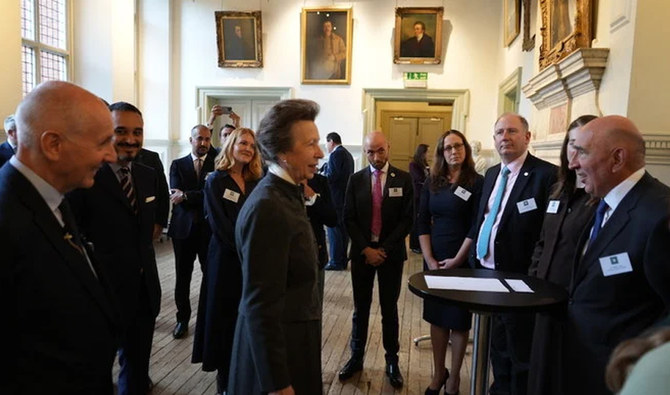
The Heart of Arabia expedition, named after Philby’s book about his journey, was launched on Tuesday at the Royal Geographical Society in London, which was held under the patronage of Britain’s Princess Anne, and with the attendance of Saudi ambassador to the UK Prince Khalid bin Bandar.
Speaking at her first public engagement since the death of her mother Queen Elizabeth II, she said: “The scope for finding more in this expedition is just enormous to add to that level of knowledge, and I think we all have something we can really look forward to, and possibly something that we will envy about those taking part in this expedition, which allows them to be part of that learning exercise.”
Omani-based British explorer Mark Evans MBE, leader of the expedition, said the team, who will be making the journey on foot, and with camels and four-wheel drives, consists of four people. The other members are Swiss photographer Ana-Maria Pavalache, regional expert Alan Morrissey, and Philby’s granddaughter, explorer Reem Philby.
“When Philby reached Riyadh in 1917, he met Abdulaziz ibn Saud and the two of them became almost lifetime companions (and) he and Ibn Saud spent hour on hour, day after day talking, and then he continued to Jeddah, so we will follow the same structure,” Evans told Arab News.
The first leg begins on Nov. 15 in Al-Uqair in the Eastern Province and will pass through Al-Ahsa Oasis, Al-Hadida/Rub Al-Khali, Hofuf, Ramlat Dahna, Abu Jifan and stop in the capital, Riyadh, on Nov. 30, where they will take a short break. The second leg will begin on Jan. 15 with a visit by Princess Anne to the Kingdom, where she will see the team off as they continue to Dhurma, Halban, Qahqa, Taif, Darb Zubaydah, and conclude in the western city of Jeddah on Jan. 30.
“The journeys are incomparable really, because in Philby’s day, no one knew where he was, he had no way of communicating other than by sending back messages via camels, whereas we will have satellite technology, social media, we’ll be doing live Instagram posts from the middle of the biggest desert on Earth, so life is so much easier today,” he said.
Evans added that some of the challenges of the past would not be an issue this time, with regards to finding water and food, but he said the biggest potential weak link may be the camels. They have to choose the right ones and “toughen them up” before the start.
“Camels have gone soft today like human beings, we have Deliveroo, camels have their Bedouin handlers who bring the food to them rather than having to wander to find the grass or water ... so camels are not working animals anymore,” he explained, whereas when Philby did his journey, camels would walk over 50 kilometers a day carrying heavy loads.
The aim of the expedition also differs from Philby’s due to its nature. He was sent for political reasons by British writer, traveler, political officer, administrator, and archaeologist Gertrude Bell from Baghdad to meet the future king in 1917 to stop the Ottomans smuggling guns across the central deserts of Arabia. However, their mission now is to “celebrate an extraordinary man and an extraordinary country,” while also collecting cultural, geographical, and scientific data.
“There’ll be young people joining us in all stages of the journey, so we want to inspire the next generation of Philbys to go out there and look and record and just add to our understanding of Arabia,” said Evans, who also heads the NGO Outward Bound Oman.
Reem, who has trekked across the Kingdom, as well as in Peru and climbed Mount Kilimanjaro, said the expedition was “completely down her alley” and it was “truly overwhelming” to trace the steps he walked over 100 years ago.
“Having that impact on the young generation is truly important, in my opinion. I am a strong believer of the importance of taking kids to the outdoors and having them experience being uncomfortable, step out of their comfort zones and their homes and their usual environments,” said the 42-year-old mother of two. “I know that it will shape truly humbled (and) strong adults in the future.”
Pavalache, who has been a mountain leader in the Swiss Alps, said it is important to tell the story of an incredible man, who brought enormous information to mapping the region. She thinks “it might be a challenge to get immersed in what he was doing, because today, Saudi Arabia is very modernized and to find that balance” between the past and present.
“We would have a couple of places where we will try to get the same images, but I think it is important for us to see how the environment changed today, and also the people who live in the desert and the community, and after we have three parts of research that we will follow within this context,” she said.
The data and observations generated by the team, in collaboration with King Abdullah University of Science and Technology, will support scientific specialists to advance human performance in extreme environments, understanding of pre-Islamic history, and insights into local biodiversity, specifically bats. There are around 30 species in the Kingdom with very little known on the populations, distribution and ecology.
UK ambassador to Saudi Arabia Neil Crompton said Philby was an important figure in the history of relations between Great Britain and the Kingdom, which was known as Arabia when he set out on his expedition, and where he lived most of his life and was an important adviser to Ibn Saud on many matters.
“It’s a chance to learn about his life and the role that he played in the development of relations between the two countries and in Saudi Arabia,” he said, lauding the “immensely strong” ties that exist between the two kingdoms.
“Saudi Arabia is opening up its tourism sector (and) Britons from many different walks of life are coming in, and it’s great to see the explorers came 100 years ago, but now they’re coming back, and so hopefully, we’ll see more of these sorts of things,” Crompton said. “I think that people-to-people links are ultimately the foundation of the relationship.”
He added: “I think the chance to see an expedition crossing the desert in this way will be very interesting to many people in Britain, and I hope encourage more people to visit the Kingdom in the way that so many Saudis come to the UK.”

keywords


