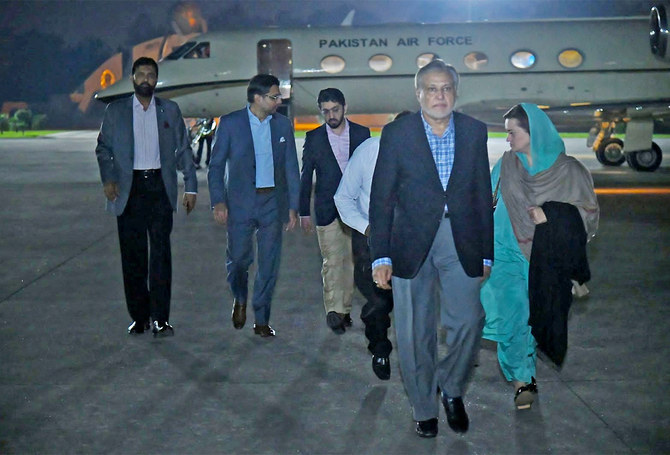

KARACHI: Senior leader of the ruling Pakistan Muslim League-Nawaz (PML-N) returned to Pakistan on Monday night, set to become finance minister of crisis-hit Pakistan, with investors pinning hopes that a new era of “Daronomics” would help to stabilize the rupee and tame record-high inflation.
Dar is a member of Prime Minister Shehbaz Sharif's ruling PMLN party and has already been finance minister four times. Dubbed Daronomics, his approach kept the rupee stable between Rs98 and Rs105 against the greenback during his last stint in office from 2013-2017 but he was also widely criticized for deliberately undervaluing the rupee by pumping dollars in the market.
The Pakistani rupee gained in value by 1.11% or Rs2.63 to close at Rs237.02 against the United States dollar in the interbank market on Monday, and gained Rs6.90 to trade at Rs237.50 in the open market following the reports of Dar’s return. Dar touched down in Islamabad on Monday night and is expected to take charge this week.
While media had reported ex-finance minister Miftah Ismail would remain part of the government’s economic team, the outgoing official told Arab News on Monday: “I will have no role in the government.”
“I will try my best that I can pull Pakistan out of the economic swamp it is trapped in,” Dar told media at the airport after returning to Pakistan from London where he has lived in exile since 2017 when he was disqualified from office by a court in a corruption case.
Dar takes over as the economy faces one of its worst balance of payments crises, and recent floods are estimated to have cost it nearly $30 billion.
Earlier this month, the government cut its GDP growth forecast below 3% from a 5% budgetary target for 2022-23.
“Ishaq Dar is known for keeping the exchange rate stable for stronger currency, that is why the currency market has strongly reacted to his return resultantly the rupee gain some strength,” Samiullah Tariq, Director Research at Pakistan Kuwait Investment Company, said.
Economists said Dar’s return would bring some "comfort" to the currency market and tame increasing inflation, which is at a 47-year high at 27.3%.
“Ishaq Dar is being brought back by the coalition government keeping in view his past track of keeping the exchange rate under control,” Dr Sajid Amin, Deputy Executive Director at the Sustainable Development Policy Institute (SDPI), told Arab News.
“The first priority of the coalition government is to bring stability in the value of rupee as the national currency has fast eroded its value against the US dollar despite International Monetary Fund (IMF) program revival,” he added.
Economists said the coalition government of PM Shehbaz Sharif had paid the political cost of much-needed measures taken by the outgoing finance minister, including the withdrawal of fuel subsidies and fast depreciation of the rupee.
“When the rupee depreciates, the public attributes it to the performance of the economic managers. As a political party this has been the discourse at some level and the decision to bring Dar has been taken in order to show economic performance and improve the image in the eyes of the public.”
The government’s decision to replace Ismail with the Dar reflected the coalition government’s need to immediately “showcase” performance “due to the short time available to the election next year,” Amin said.
“Government wants to go into the election with a new image, with a new market and public feelings that it has improved things … exchange rate and inflation, two key indicators,” he added.
But many economists said Dar’s return would have little effect.
“Changing faces may have limited impacts as we are facing both global and domestic recessions,” Khurram Schehzad, CEO at Alpha Beta Core, a startup investment advisory platform, told Arab News. “Options are limited and the economic situation is challenging. So expecting something extraordinarily different from another person would not be prudent.”
Pakistani industrialists said the incoming finance minister would have to deal with a plethora of issues, chief among them political instability.
“Pakistan is facing a very difficult time at the time when Ishaq Dar is coming back … current account deficit, trade deficit, debt repayments, high inflation, and rupee dollar parity are among them,” Zubair Motiwala, chairman of the Businessmen Group at the Karachi Chamber of Commerce and Industry (KCCI), told Arab News.
“The big problem is political stability ... instability is the mother of all economic evils in Pakistan so he will have to deal with it. Our best wishes are with him and we pray for the speedy improvement of the issues the country is facing right now.”
Pakistan stocks closed bullish with the benchmark KSE100 index settling at 41,151 level, up by 531 points or 1.31%.
“Bullish activity witnessed on strong rupee recovery amid decision over the appointment of a new finance minister, which is likely to stabilise economic uncertainty,” Ahsan Mehanti, CEO of Arif Habib Corporation, said.