

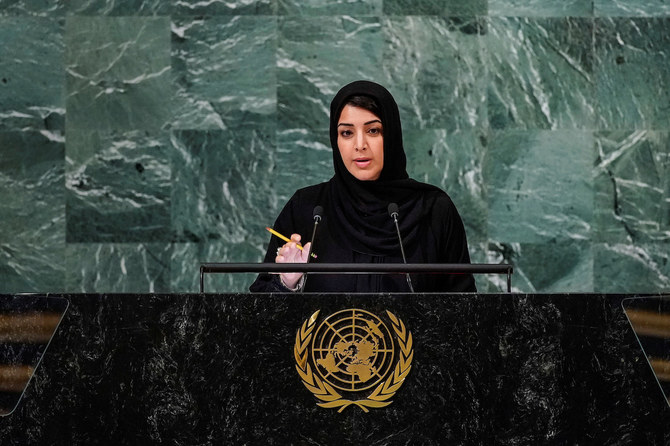

NEW YORK: The United Arab Emirates on Saturday urged Iran to return to the Gulf state the three islands it had been illegally occupying for the past five decades.
In an address before the General Debate of the 77th United Nations General Assembly in New York City, Reem Al Hashimy, UAE's Minister of State for International Cooperation, said Iran's occupation of the three islands was a violation of her country's sovereignty.
"We renew our demand for an end to Iran's occupation of the three UAE islands: Greater Tunb, Lesser Tunb, and Abu Musa – the UAE’s sovereignty over which is proven by history and international law," Hashimy said.
Iran seized the three islands in November 1971 shortly after British forces were pulled out. The islands are all located in the Strait of Hormuz between the Arabian Gulf and the Gulf of Oman.
"Despite the UAE’s sincere calls to peacefully resolve this conflict over the past five decades, we stress here that Iran has not responded. We will never relent in voicing our claim to these islands either through direct negotiations or through the International Court of Justice, as is our legitimate right," Hashimy said.
Iran has been accused by its Arab neighbors and members and the West of seeking to destabilize the region by funding and arming its proxy militias, including the Hezbollah of Lebanon, the Houthis of Yemen, and other militants in the Palestinian territories and in Iraq.
The UAE’s demand comes amid violent unrest in Iran triggered by the death of a young Kurdish wom- an in police custody.
On Sunday, the UAE’s Foreign Minister Sheikh Abdullah bin Zayed Al Nahyan met with his Iranian counterpart Hossein Amir-Abdollahian on the sidelines of the UN General Assembly in New York.
During the meeting, Sheikh Abdullah bin Zayed called for strengthening international cooperation to achieve stability and peace in the region and achieve the aspirations of people, according to a statement on the Emirates News Agency (WAM).
Both officials discussed bilateral relations and ways to enhance cooperation between the two countries to achieve their common interests. They also exchanged views on regional and international developments and reviewed several issues on the agenda of the General Assembly.


