

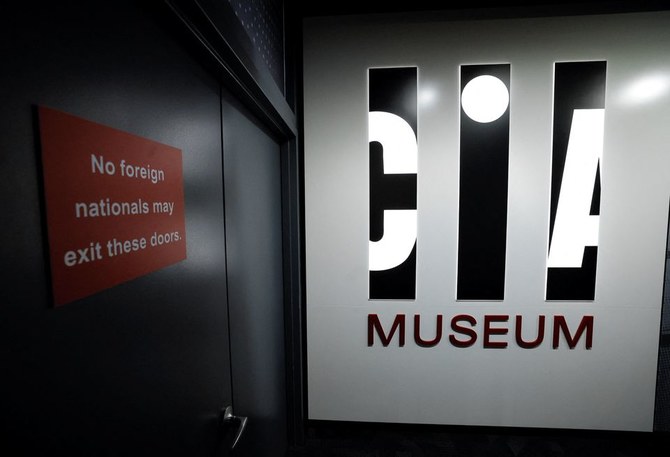
US CIA’s in-house museum adds new spy exhibits 

A view shows the newly revamped Central Intelligence Agency museum, while still closed to the public, as it's revealing some newly declassified artifacts from the spy agency's most storied operations since it's founding 75 years ago, at CIA headquarters in McLean, Virginia, U.S., September 24, 2022. (REUTERS)
Short Url
Updated 25 September 2022
Follow

US CIA’s in-house museum adds new spy exhibits 

  • Top among artifacts is a 30.5cm model of Kabul compound used to brief Biden before the strike that killed Ayman Al-Zawahiri 
  • The items are part of effort to expand public outreach by the agency, known as much for scandals as for intelligence successes 

LANGLEY: They like to call it ‘the greatest museum you’ll never see.’ 

Tucked away in the corridors of its Langley, Virginia, headquarters, the revamped Central Intelligence Agency museum – while still closed to the public – is revealing some newly declassified artifacts from the spy agency’s most storied operations since its founding 75 years ago. 

Top among them: a slightly more than foot-long (30.5 cm) scale model of the compound in Kabul, Afghanistan, that was used to brief President Joe Biden before the drone strike that killed Al-Qaeda leader Ayman Al-Zawahiri just two months ago. 
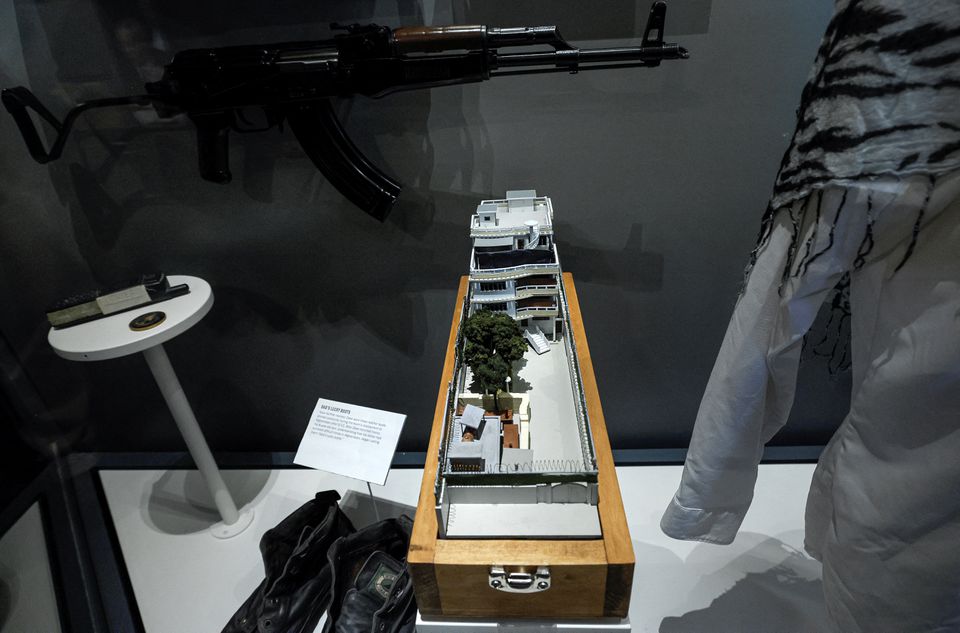


A model of Al-Zawahiri compound which was used to brief U.S. President Joe Biden on the mission that killed Al Qaeda's leader Ayman al-Zawahiri, is on display at the newly revamped Central Intelligence Agency museum, which is revealing some newly declassified artifacts from the spy agency's most storied operations since it's founding 75 years ago, at CIA headquarters in McLean, Virginia, U.S., September 24, 2022. (REUTERS)

“It’s very unusual for something to get declassified that quickly,” said Janelle Neises, the museum’s deputy director. 

“We use our artifacts to tell our stories. It’s a way to be really honest and transparent about the CIA, which is sometimes hard,” said Neises, who joined the museum’s director Robert Byer on Saturday in leading a media on a tour of renovated exhibits. 
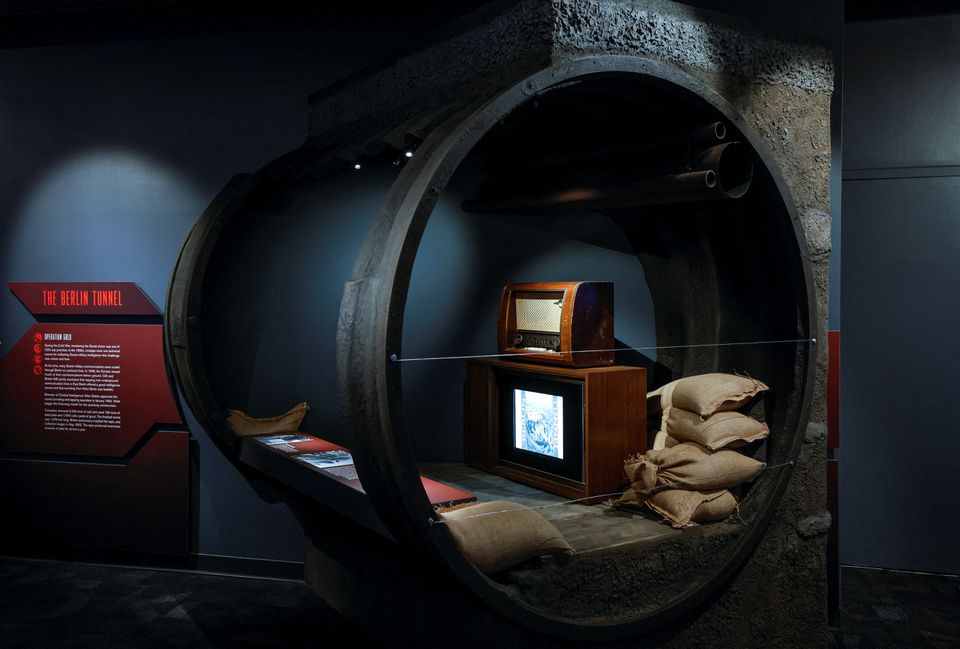


A replica of the tunnel that spanned West to East Berlin, jointly built by CIA and the British Secret Intelligence Service (MI-6) during the Cold War, is on display at the revamped Central Intelligence Agency museum at CIA headquarters in McLean, Virginia, U.S., September 24, 2022. (REUTERS)

The items, some of which are available to view online, are part of a broader effort to expand public outreach and recruitment by the legendary but secretive agency, known as much in some quarters for its scandals as for intelligence successes. 

CIA officials often say that the agency’s successes are secret but its failures sometimes public. 
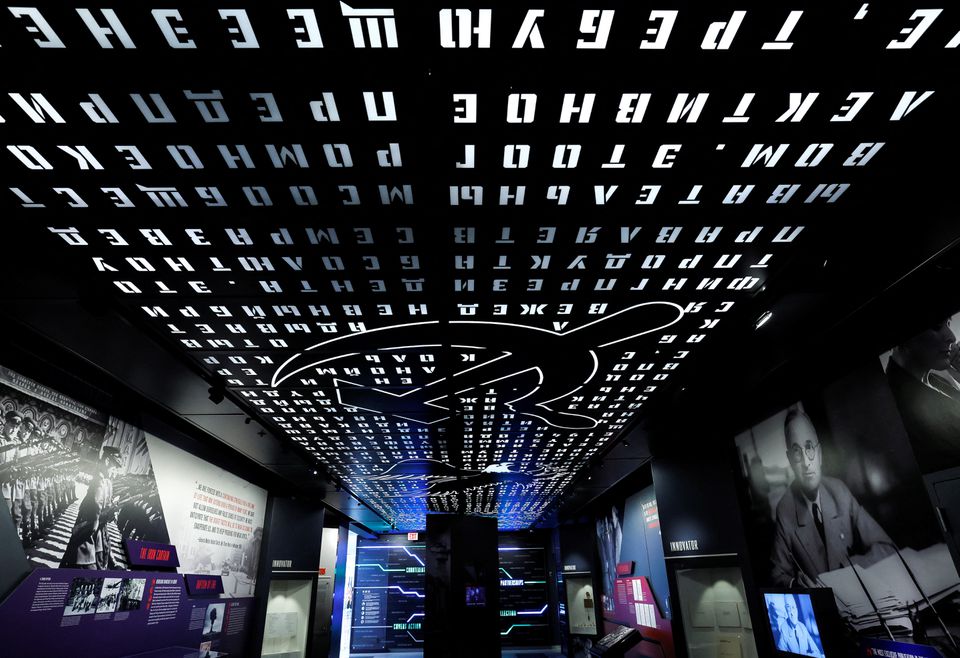


The newly revamped Central Intelligence Agency museum, while still closed to the public, features a ceiling with hidden messages, at CIA headquarters in McLean, Virginia, U.S., September 24, 2022. (REUTERS)

The outreach effort includes the launch earlier this week of the CIA’s first public podcast on which Director William Burns said the agency sought to “demystify” its work at a time when “trust in institutions is in such short supply.” 

The hundreds of museum items, some of which have been on display since the 1980s, are all declassified. Neises said the agency does from time to time loan some to presidential libraries and other non-profit museums. 
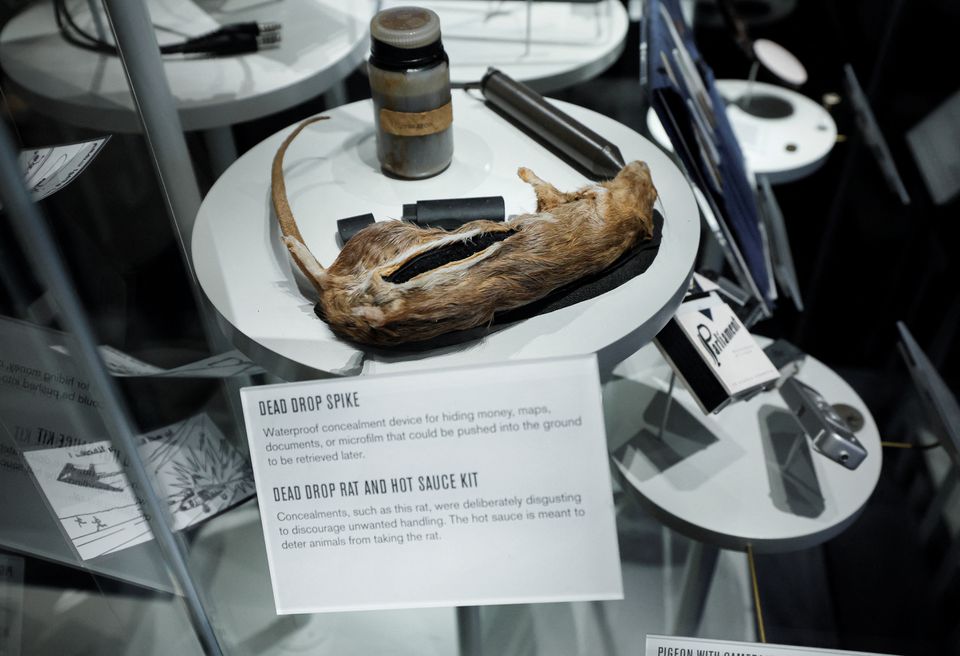


A dead drop rat and other tools used in spycraft are on display at the newly revamped Central Intelligence Agency museum, at CIA headquarters in McLean, Virginia, U.S., September 24, 2022. (REUTERS)

On view for those cleared to visit: the AKM assault rifle toted by Osama bin Laden the night US Navy SEALs killed him in a raid of his Abbottabad, Pakistan, compound in 2011, and a leather jacket found with former Iraqi president Saddam Hussein when he was captured in 2003. 

Other exhibits range from flight suits worn by pilots of Cold War-era U-2 and A-12 spy planes to a wood-framed saddle, similar to those used by members of CIA’s Team Alpha as they navigated Afghanistan’s mountainous terrain by horseback shortly after the Sept. 11, 2001 attacks on the United States. 
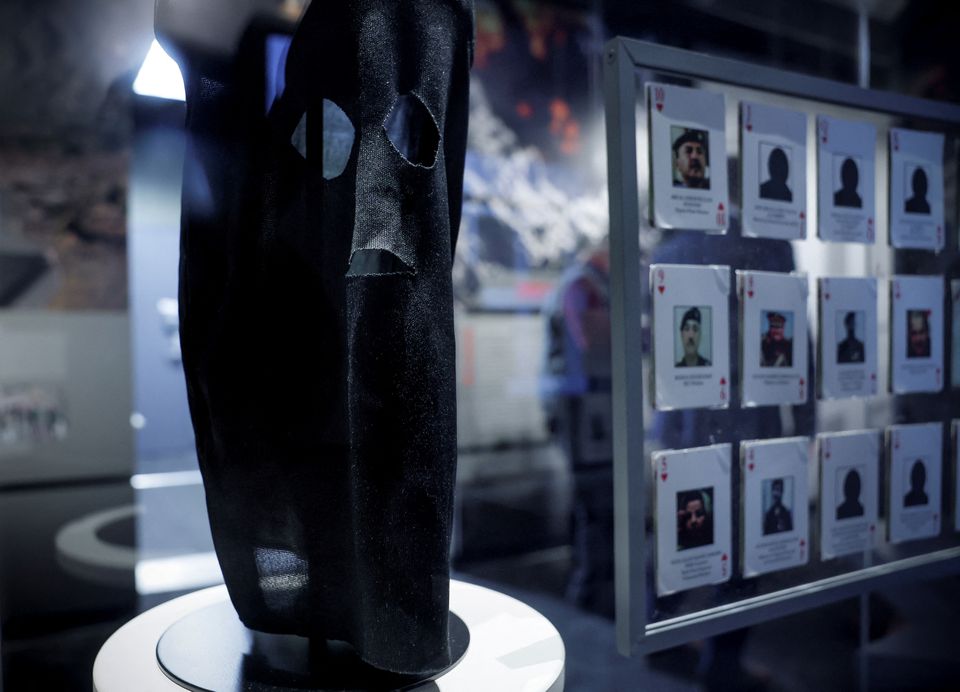


Artifacts from Iraq including playing cards of the most-wanted members of Saddam Hussein's government are on display at the newly revamped Central Intelligence Agency museum, which is revealing some newly declassified artifacts from the spy agency's most storied operations since it's founding 75 years ago, at CIA headquarters in McLean, Virginia, U.S., September 24, 2022. (REUTERS)

None of the items, all of which are considered US government heritage assets, have been assessed for value. 

“Our museum is operational,” Neises said. “It’s here for our workforce to learn from our successes and failures.” 


India, Arab League target $500bn in trade by 2030

Updated 54 min ago
Follow

India, Arab League target $500bn in trade by 2030

  • It was the first such gathering of India–Arab FMs since the forum’s inauguration in 2016
  • India and Arab states agree to link their startup ecosystems, cooperate in the space sector

NEW DELHI: India and the Arab League have committed to doubling bilateral trade to $500 billion by 2030, as their top diplomats met in New Delhi for the India–Arab Foreign Ministers’ Meeting. 

The foreign ministers’ forum is the highest mechanism guiding India’s partnership with the Arab world. It was established in March 2002, with an agreement to institutionalize dialogue between India and the League of Arab States, a regional bloc of 22 Arab countries from the Middle East and North Africa.

The New Delhi meeting on Saturday was the first gathering in a decade, following the inaugural forum in Bahrain in 2016.

India’s Foreign Minister S. Jaishankar said in his opening remarks that the forum was taking place amid a transformation in the global order.

“Nowhere is this more apparent than in West Asia or the Middle East, where the landscape itself has undergone a dramatic change in the last year,” he said. “This obviously impacts all of us, and India as a proximate region. To a considerable degree, its implications are relevant for India’s relationship with Arab nations as well.”

Jaishankar and his UAE counterpart co-chaired the talks, which aimed at producing a cooperation agenda for 2026-28.

“It currently covers energy, environment, agriculture, tourism, human resource development, culture and education, amongst others,” Jaishankar said.

“India looks forward to more contemporary dimensions of cooperation being included, such as digital, space, start-ups, innovation, etc.”

According to the “executive program” released by India’s Ministry of External Affairs, the roadmap agreed by India and the League outlined their planned collaboration, which included the target “to double trade between India and LAS to US$500 billion by 2030, from the current trade of US$240 billion.”

Under the roadmap, they also agreed to link their startup ecosystems by facilitating market access, joint projects, and investment opportunities — especially health tech, fintech, agritech, and green technologies — and strengthen cooperation in space with the establishment of an India–Arab Space Cooperation Working Group, of which the first meeting is scheduled for next year.

Over the past few years, there has been a growing momentum in Indo-Arab relations focused on economic, business, trade and investment ties between the regions that have some of the world’s youngest demographics, resulting in a “commonality of circumstances, visions and goals,” according to Muddassir Quamar, associate professor at the School of International Studies, Jawaharlal Nehru University.

“The focus of the summit meeting was on capitalizing on the economic opportunities … including in the field of energy security, sustainability, renewables, food and water security, environmental security, trade, investments, entrepreneurship, start-ups, technological innovations, educational cooperation, cultural cooperation, youth engagement, etc.,” Quamar told Arab News.

“A number of critical decisions have been taken for furthering future cooperation in this regard. In terms of opportunities, there is immense potential.”