

Death toll continue to rise in Lebanon migrant shipwreck off Syria

1 / 3
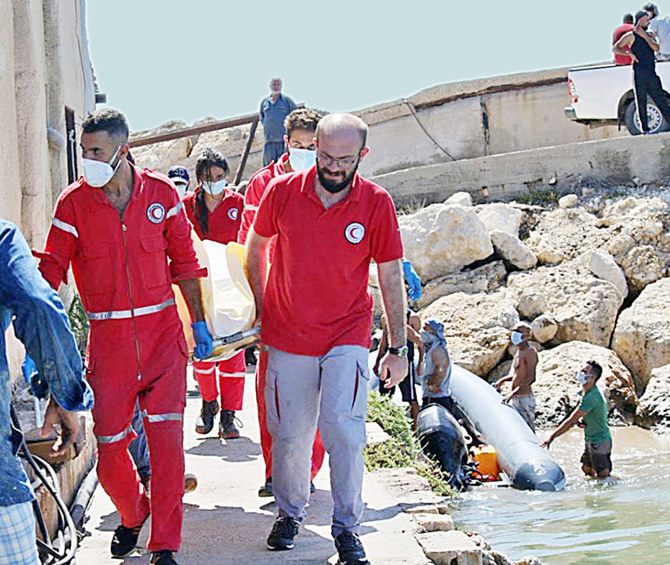
Syria’s health minister says several people have been killed from a boat that sank migrants from Lebanon off Syria’s coast. (AP)
2 / 3
the Syrian red Crescent crew carry the body of a victim in tartous after a boat transporting illegal migrants from Lebanon sank off the Syrian coast. (AFP)
3 / 3
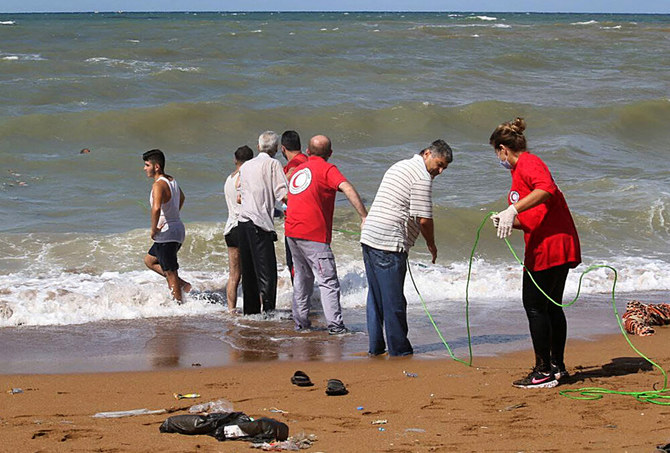
A handout picture released by the Syrian Red Crescent on Friday shows rescuers pulling out the body of a drowning victim on the coast of Syria’s southern port City of Tartus, after a boat transporting migrants from Lebanon sank off the Syrian coast. (AFP)
Short Url
Updated 24 September 2022
Follow

Death toll continue to rise in Lebanon migrant shipwreck off Syria

  • Lebanon has become a starting point for illegal migration
  • ‘Death boats’ set off every day from the northern coast of Lebanon

BEIRUT: Eighty-nine bodies have been recovered since a boat carrying migrants from Lebanon sunk off Syria’s coast, Syrian state media said Saturday, as the Lebanese army said it arrested a suspected smuggler behind one of the deadliest recent shipwrecks in the eastern Mediterranean.
The Syrian Observatory meanwhile reported the casualties were at 88, with 50 passengers still unaccounted for.
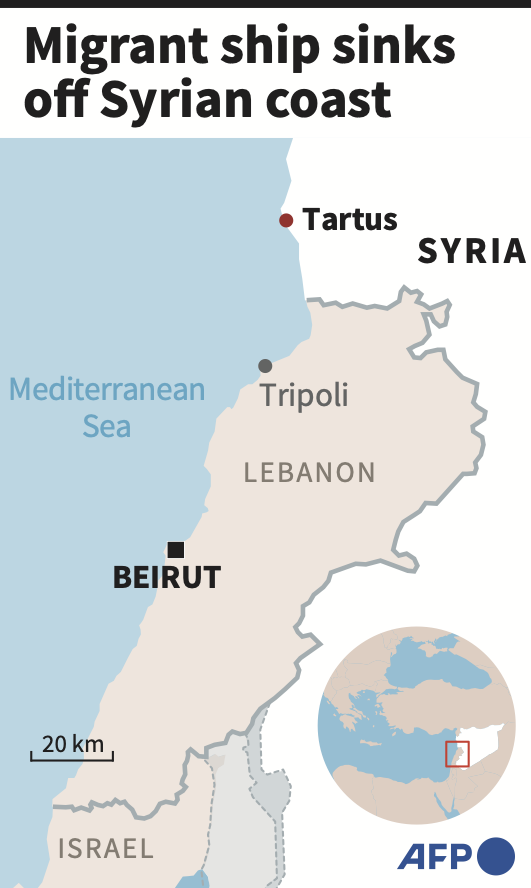
Around 150 people, mostly Lebanese and Syrians, were on board the small vessel that went down on Thursday off the Syrian city of Tartous.
Lebanon has become a starting point for illegal migration, with its citizens joining Syrian and Palestinian refugees clamoring to leave their homeland.
Illegal “death boats” set off every day from the northern coast of Lebanon. Some succeed in reaching their destination, a few are rescued by the coast guards of the countries in whose territorial waters their boats capsize, and the rest are swallowed up by the sea.
Former Tripoli MP Mustafa Alloush told Arab News: “People have completely lost hope that the situation in Lebanon could improve and there are mafias exploiting this.”
He said 95 percent of such illegal trips succeed in reaching their destinations, and those people who make it to Europe encourage their relatives and acquaintances to make the same journey.
He added: “The Lebanese authorities know who these smugglers organizing such trips are. They get huge sums of money. Security officers are paid off to facilitate such journeys or turn a blind eye.
“Why did this boat head toward Syria? Is it not to escape UNIFIL (the UN Interim Force in Lebanon), which patrols Lebanese waters?
“Drug trafficking is illegal, but remains active given the amounts of money paid to dealers and distributors.
“The same goes for human trafficking and smuggling. Money is paid, specifically to those who are supposed to protect people in this country.”
Caretaker Minister of Public Works Ali Hamieh said: “This type of boat was not made for such trips and cannot carry that many people. It turned out that it was recently imported and arrived in Lebanon two months ago.”
Most passengers were residents of northern Lebanon, some were Palestinian refugees from the Nahr Al-Bared camp, but the majority were Syrians, from Idlib, Aleppo and Latakia.
These Syrians had illegally made their way into Lebanon to escape by sea through the north of the country.
Among the victims were two girls who were buried in Akkar, north Lebanon, after being transported there by car from Tartous.
The mayor of Qarqaf, in Akkar, said: “The mother of the two girls drowned, as did her two sons. The father is still alive, but he is in a hospital in Syria.”
The boat had embarked from Lebanon’s northern Minyeh region, with passengers paying $3,000 for children and $7,000 per adult for the trip.
Lebanon’s Secretary-General of the Arab Socialist Ba’ath Party Ali Hijazi, who traveled to Tartous on Friday, said survivors had informed him the boat “left from Minyeh on Tuesday morning and experienced a technical malfunction. It capsized due to the waves on Thursday morning.”
The Lebanese Army announced it has arrested eight suspected smugglers. The tragedy coincided with the announcement on social media of another boat that left the northern coast of Lebanon bound for Italy and broke down between Greece and Turkey. Its passengers were rescued and are currently in Turkey.

with AFP


Foreign women linked to Daesh group in Syrian camp hope for amnesty after government offensive

Updated 30 January 2026
Follow

Foreign women linked to Daesh group in Syrian camp hope for amnesty after government offensive

  • Many of the women are either wives or widows of Daesh fighters who were defeated in Syria
  • “There were changes in the behavior of children and women. They became more hostile,” the camp’s director said

ROJ CAMP, Syria: Foreign women linked to the Daesh group and living in a Syrian camp housing more than 2,000 people near the border with Iraq are hoping that an amnesty may be on the horizon after a government offensive weakened the Kurdish-led force that guards the camp.
The women spoke to The Associated Press on Thursday in northeast Syria’s Roj camp, where hundreds of mostly women and children linked to Daesh have been held for nearly a decade.
The camp remains under control of the Kurdish-led Syrian Democratic Forces, which until recently controlled much of northeastern Syria. A government offensive this month captured most of the territory the group previously held, including the much larger Al-Hol camp, which is holding nearly 24,000 mostly women and children linked to Daesh.
Many of the women are either wives or widows of Daesh fighters who were defeated in Syria in March 2019, marking the end of what was once a self-declared caliphate in large parts of Iraq and Syria.
The most well-known resident of the Roj camp, Shamima Begum, was 15 when she and two other girls fled from London in 2015 to marry Daesh fighters in Syria. Begum married a Dutch man fighting for Daesh and had three children, who all died.
Last month, Begum lost her appeal against the British government’s decision to revoke her UK citizenship. Begum refused to speak to AP journalists at the camp.
The director of the Roj camp, Hakmiyeh Ibrahim, said that the government’s offensive on northeast Syria has emboldened the camp residents, who now tell guards that soon they will be free and Kurdish guards will be jailed in the camp instead.
“There were changes in the behavior of children and women. They became more hostile,” the camp’s director said. “It gave them hope that the Daesh group is coming back strongly.”
Since former Syrian President Bashar Assad was toppled in a lightning rebel offensive in December 2024, the country’s new army is made up of a patchwork of former insurgent groups, many of them with Islamist ideologies.
The group led by now-interim President Ahmad Al-Sharaa was once linked to Al-Qaeda although Al-Sharaa’s group and Daesh were rivals and fought for years. Since becoming president, Al-Sharaa — formerly known by the nom de guerre Abu Mohammed Al-Golani — has joined the global coalition against Daesh.
Camp residents hope for amnesty
One woman from Tunisia who identified herself only as Buthaina, pointed out that Al-Sharaa was removed from the UN and US lists of terrorists.
“People used to say that Al-Golani was the biggest terrorist. What happened to him later? He became the president of Syria. He is not a terrorist any more,” she said. “The international community gave Al-Golani amnesty. I should be given amnesty too.”
She added, “I did not kill anyone or do anything.”
The camp director said more than 2,300 people are housed in the Roj camp. They include a small number of Syrians and Iraqis, but the vast majority of them — 742 families — come from nearly 50 other countries, the bulk of them from states in the former Soviet Union.
That is in contrast to Al-Hol camp, where most residents are Syrians and Iraqis who can be more easily repatriated. Other countries have largely been unwilling to take back their citizens. Human rights groups have for years cited poor living conditions and pervasive violence in the camps.
The US military has begun moving male Daesh detainees from Syrian prisons to detention centers in Iraq, but there is no clear plan for the repatriation of women and children at the Roj Camp.
“What is happening now is exactly what we have been warning about for years. It is the foreseeable result of international inaction,” said Beatrice Eriksson, the cofounder of the children rights organization Repatriate the Children in Sweden. “The continued existence of these camps is not an unfortunate by-product of conflict, it is a political decision.”
Some women don’t want to go home
Some of the women interviewed by the AP said they want to go back home, while others want to stay in Syria.
“I did not come for tourism. Syria is a Muslim country. Germany is all infidels,” said a German woman who identified herself only as Aysha, saying that she plans to stay.
Another woman, a Belgian who identified herself as Cassandra, said she wants to get out of the camp but would like to stay in the Kurdish-controlled area of Syria.
She said that her French husband was an Daesh fighter killed in the northern city of Raqqa, once considered the de facto capital by Daesh. She said Belgium has only repatriated women who had children, unlike her. She was 18 when she came to Syria, she said.
Cassandra added that when fighting broke out between government forces and Kurdish fighters, she started receiving threats from other camp residents because she had good relations with the Kurdish guards.
Future of the camps in limbo
The government push into northeast Syria led to chaos in some of the more than a dozen detention centers where nearly 9,000 members of Daesh have been held for years.
Syrian government forces are now in control of Al-Aqtan prison near Raqqa as well as the Shaddadeh prison near the border with Iraq, where more than 120 detainees managed to flee amid the chaos before most of them were captured again.
Part of an initial ceasefire agreement between Damascus and the SDF included the Kurdish-led group handing over management of the camps and detention centers to the Syrian government.
Buthaina, the Tunisian citizen, said her husband and her son are held in a prison. She said her husband worked in cleaning and did not fight, while her son fought with the extremists.
She has been in Roj for nine years and saw her other children grow up without proper education or a childhood like other children.
“All we want is freedom. Find a solution for us,” Buthaina said.
She said the Tunisian government never checked on them, but now she hopes that “if Al-Golani takes us there will be a solution.”
She said those accused of crimes should stand trial and others should be set free.
“I am not a terrorist. The mistake I made is that I left my country and came here,” she said. “We were punished for nine years that were more like 90 years.”