‘All hell’ to break loose without debt deal, PM Sharif says after catastrophic floods

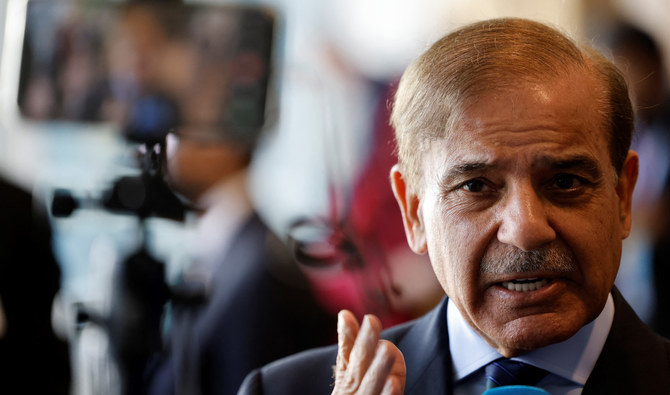
Pakistani Prime Minister Shehbaz Sharif speaks to media at the 77th United Nations General Assembly at UN headquarters in New York City on September 20, 2022. (AFP)
Short Url
Updated 23 September 2022
Follow

‘All hell’ to break loose without debt deal, PM Sharif says after catastrophic floods

  • Pakistani PM says had spoken to European and other leaders to get debt moratorium
  • Sharif says has requested World Bank for immediate debt relief, would begin talks with China

ISLAMABAD: Pakistani Prime Minister Shehbaz Sharif on Friday made an urgent appeal for debt relief from rich nations as catastrophic floods exacerbated by climate change have killed 1,600 and displaced millions of people in the South Asian nation, with the government estimating damages above $30 billion.

A historic monsoon brought about three times as much rain this year as Pakistan’s three-decade average. Combined with glacial melt, this caused unprecedented flooding that has affected nearly 33 million people in a nation of 220 million, sweeping away homes, crops, bridges, roads and livestock.

In an interview with Bloomberg Television in New York, the Pakistani PM said Pakistan had debt obligations in the next two months and his government had just signed an agreement with the International Monetary Fund with “very tough conditionalities” that included taxes on petroleum and electricity.

“We have spoken to European leaders and other leaders to help us in the Paris Club to get us moratorium,” Sharif said in the interview, referring to a group of rich creditor nations. “Unless we get substantial relief how can the world expect from us to stand on our own feet? It is simply impossible.”

He noted a “yawning gap” between what Pakistan was asking for and what was available, warning that the nation was facing the imminent threat of epidemics and other dangers.

“God forbid this happens, all hell will break,” Sharif said.

In August, Pakistan secured a $1.1 billion loan from the IMF, part of a $6 billion program signed in 2019. Sharif said he had spoken to the World Bank about immediate debt relief and would begin talks with China after the Paris Club. Pakistan owes $30 billion to China, or about a third of its total external debt.

The floods have come as the Pakistan rupee is on the verge of a record low. The economy is forecast to slow amid floods, policy tightening and efforts to tackle fiscal and external imbalances, according to the Asian Development Bank, which cut growth forecasts to 3.5 percent from 4.5 percent for the 2023 fiscal year this week.

“Things will not come back to normal,” Sharif warned. “I need to put our economy back on trail. I need to put our millions of people back in the rooms, busy again with the ordinary life in agriculture, in industry and getting jobs back.”

“Time is running, and we’re racing against time,” the PM added. “Please help us avoiding this disaster.”


Rating firm S&P says it won’t rush Iran war downgrades, sees risks for countries like Pakistan

Updated 12 March 2026
Follow

Rating firm S&P says it won’t rush Iran war downgrades, sees risks for countries like Pakistan

  • Agency says it is monitoring indebted energy importers as higher oil prices strain finances
  • Gulf economies seen better placed to weather shock, though Bahrain flagged as vulnerable

LONDON: S&P Global ‌said it would not make any knee-jerk sovereign rating cuts following the outbreak of war in the ​Middle East, but warned on Thursday that soaring oil and gas prices were putting a number of already cash-strapped countries at risk.

The firm’s top analysts said in a webinar that the conflict, which has involved US and Israeli strikes ‌against Iran and Iranian ‌strikes against Israel, ​US ‌bases ⁠and Gulf ​states, ⁠was now moving from a low- to moderate-risk scenario.

Most Gulf countries had enough fiscal buffers, however, to weather the crisis for a while, with more lowly rated Bahrain the only clear exception.

Qatar’s banking sector could ⁠also struggle if there were significant ‌deposit outflows in ‌reaction to the conflict, although there ​was no evidence ‌of such strains at the moment, they ‌said.

“We don’t want to jump the gun and just say things are bad,” S&P’s head global sovereign analyst, Roberto Sifon-Arevalo, said.

The longer the crisis ‌was prolonged, though, “the more difficult it is going to be,” he ⁠added.

Sifon-Arevalo ⁠said Asia was the second-most exposed region, due to many of its countries being significant Gulf oil and gas importers.

India, Thailand and Indonesia have relatively lower reserves of oil, while the region also had already heavily indebted countries such as Pakistan, Bangladesh and Sri Lanka whose finances would be further hurt by rising energy prices.

“We ​are closely monitoring ​these (countries) to see how the credit stories evolve,” Sifon-Arevalo said.