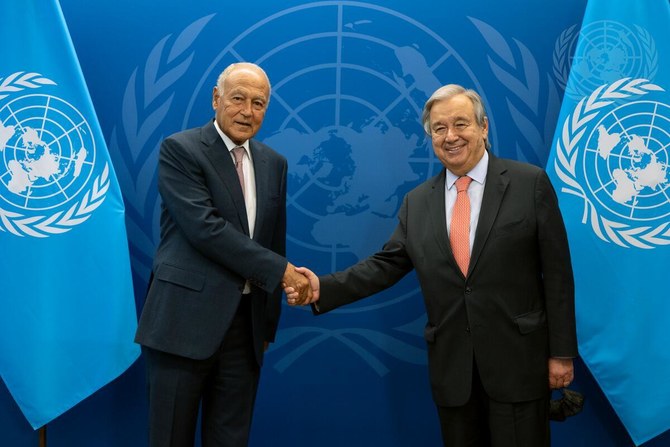
Leaders of UN and Arab League discuss Palestinian cause in New York

UN Secretary-General Antonio Guterres, left, and Arab League Secretary-General Ahmed Aboul Gheit. (Twitter: @arableague_gs)
Short Url
Updated 22 September 2022
Follow

Leaders of UN and Arab League discuss Palestinian cause in New York

  • The issue was one of several Antonio Guterres and Ahmed Aboul Gheit talked about on the sidelines of the 77th session of the UN General Assembly

CAIRO: The Palestinian cause was among the topics discussed when Ahmed Aboul Gheit, secretary-general of the League of Arab States, and Antonio Guterres, secretary-general of the UN, met on Wednesday on the sidelines of the 77th session of the UN General Assembly.

Their representatives said the two officials talked about a number of matters related to international crises, along with the latest developments in the Middle East.

A spokesperson for Aboul Gheit said the Arab League chief expressed to Guterres his appreciation of the important role the UN leader has played during the conflict between Russia and Ukraine. Guterres reportedly spoke about the current situation in the Middle East and the role of the UN in Somalia, Yemen and Syria.

Aboul Gheit also highlighted the great frustration Palestinians feel as a result of the number of political obstructions to their cause. Both men agreed that the Palestinian issue remains a priority in efforts to achieve stability and prosperity in the region.

They expressed their commitment to working together as part of a coordinated approach to seek political solutions to the crises facing some countries in the region.

In a message posted on Twitter, Aboul Gheit wrote: “We agreed on the danger of ignoring the serious efforts to settle the Palestinian issue and the importance of continuing our joint work for this purpose.

“The international situation is very difficult and thorny, yet Guterres is working tirelessly on various political, environmental, developmental, and other fronts.”

Aboul Gheit also met Ian Borg, Malta’s minister of foreign and European affairs and trade on Wednesday, and congratulated him on his country earning a non-permanent seat on the UN Security Council for 2023-2024. He said the Arab League is counting on Malta’s support for Arab issues on the council’s agenda during that time, especially those related to the Palestinian cause.

Last week, Aboul Gheit called on Spain to support Palestine’s bid for full membership of the UN, amid preparations for a new diplomatic drive for recognition. Palestine is currently afforded observer status by the UN. Mahmoud Abbas, the Palestinian president, is due to speak at the General Assembly on Sept. 23 and highlight the campaign for full membership.

A spokesperson said Abou Gheit leader had met Spanish Foreign Minister Jose Manuel Albares in Madrid to discuss issues of common interest and ways to enhance bilateral relations.


January settler attacks cause record West Bank displacement since Oct 2023: UN

A photograph shows Israeli flags and a Gush Etzion council flag at the newly built Israeli settler outpost of “Yatziv.”
Updated 49 min 22 sec ago
Follow

January settler attacks cause record West Bank displacement since Oct 2023: UN

  • At least 694 Palestinians were forcefully driven from their homes last month, according OCHA figures
  • OHCHR said in late January that settler violence has become a key driver of forced displacement in the West Bank

RAMALLAH: Israeli settler violence and harassment in the occupied West Bank displaced nearly 700 Palestinians in January, the United Nations said Thursday, the highest rate since the Gaza war erupted in October 2023.
At least 694 Palestinians were forcefully driven from their homes last month, according to figures from the UN’s humanitarian agency OCHA, which compiles data from various United Nations agencies.
The UN Human Rights Office (OHCHR) said in late January that settler violence has become a key driver of forced displacement in the West Bank.
January’s displacement numbers were particularly high in part due to the displacement of an entire herding community in the Jordan Valley, Ras Ein Al-Auja, whose 130 families left after months of harassment.
“What is happening today is the complete collapse of the community as a result of the settlers’ continuous and repeated attacks, day and night, for the past two years,” Farhan Jahaleen, a Bedouin resident, told AFP at the time.
Settlers in the West Bank, which Israel has occupied since 1967, use herding to establish a presence on agricultural lands used by Palestinian communities and gradually deny them access to these areas, according to a 2025 report by Israeli NGO Peace Now.
To force Palestinians out, settlers resort to harassment, intimidation and violence, “with the backing of the Israeli government and military,” the settlement watchdog said.
“No one is putting the pressure on Israel or on the Israeli authorities to stop this and so the settlers feel it, they feel the complete impunity that they’re just free to continue to do this,” said Allegra Pacheco, director of the West Bank Protection Consortium, a group of NGOS working to support Palestinian communities against displacement.
She pointed to a lack of attention on the West Bank as another driving factor.
“All eyes are focused on Gaza when it comes to Palestine, while we have an ongoing ethnic cleansing in the West Bank and nobody’s paying attention,” she told AFP.
West Bank Palestinians are also displaced when Israel’s military destroys structures and dwellings it says are built without permits.
In January, 182 more Palestinians were displaced due to home demolitions, according to OCHA.
Excluding Israeli-annexed east Jerusalem, the West Bank is home to more than 500,000 Israelis living in settlements and outposts considered illegal under international law.
Around three million Palestinians live in the West Bank.