

Taxing oil companies will not solve global energy crisis: Aramco CEO

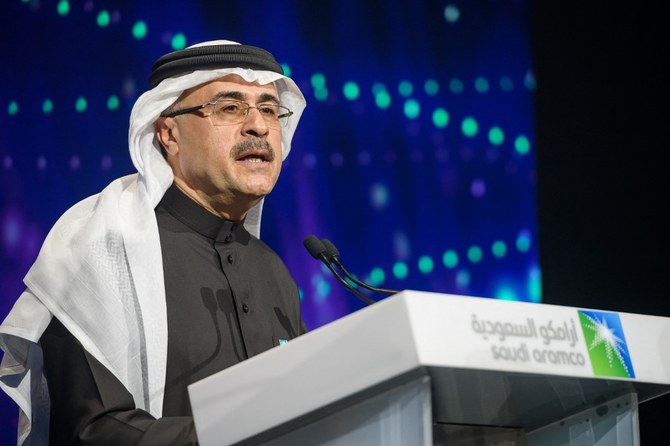
Saudi Aramco CEO Amin Nasser warned about the lack of investments in the sector. (AFP)
Short Url
Updated 20 September 2022
Follow

Taxing oil companies will not solve global energy crisis: Aramco CEO

RIYADH: Taxing oil companies and capping energy bills are not long-term solutions to the global energy crisis, according to Saudi Aramco CEO Amin Nasser, as he warned about the lack of investments in the sector.

Governments across Europe have plowed hundreds of billions of euros into tax cuts, handouts and subsidies to tackle an energy crisis that is driving up inflation, forcing industries to shut production and hiking bills ahead of winter.

Under EU plans announced last week, excessive profits from energy companies would be skimmed off and redistributed to ease the burden on consumers.

Nasser, who heads the world's largest exporter of oil, said continuing underinvestment in the hydrocarbons sector at a time when alternatives to fossil fuels were still not readily available was among the root causes of the problem.

“Freezing or capping energy bills might help consumers in the short term, but it does not address the real causes and is not the long-term solution,” Nasser told a forum in Switzerland.

“And taxing companies when you want them to increase production is clearly not helpful.”

He added: “Even if the conflict in Ukraine ended today, the energy crisis will not end. The real cause of energy insecurity is underinvestment in oil and gas.”

Aramco has been investing to raise Saudi Arabia’s oil capacity to 13 million barrels per day by 2027, but Nasser warned that globally investments in hydrocarbons were still, “too little, too late, too short term.”

The underinvestment comes at a time when spare capacity is thin and demand is “fairly healthy” despite strong economic headwinds.

“When the global economy recovers, we can expect demand to rebound further, eliminating the little spare oil production capacity out there,” Nasser said, adding: “That is why I am seriously concerned.”

Nasser, however, noted that capping energy bills might help consumers in the short term.

He added that global climate goals should not change because of this investment crisis.

“Investing in conventional sources does not mean that alternative energy sources and technologies should be ignored. But the world deserves a much better response to this crisis,” he said. 

Nasser further added: “We are working to lower our upstream carbon intensity, our gas flaring, and our methane intensity, which are already among the lowest in the world.” 

Last month, a report released by King Abdullah Petroleum Studies and Research Center revealed that a substantial rise in investments in the oil industry is necessary to guarantee energy security from 2025 and beyond, as the pandemic made the investment problem in the industry more evident. 

According to the KAPSARC report, investment projections for 2022 are not optimistic. 

The report estimated that global oil and gas investments, which include both midstream and downstream, will increase by just $26 billion this year, much lower than the $140 billion increase needed in upstream capex by 2025.

The report added that climate change “misconceptions” is one of the crucial factors that lead investors to turn away from the oil sector. 

“The oil and gas industry has suffered from external discreditation through climate and social misconceptions, generating stigmas that have affected its investment attractiveness,” said KAPSARC in the report. 

The report noted that the four key challenges that negatively impact investments in the sector are price volatility, uncertainties due to significantly diverging long-term forecasts, increasing climate change concerns, and the lack of regulation on environmental, social, and governance.


Saudi ports brace for cargo surge as shipping lines reroute

Updated 09 March 2026
Follow

Saudi ports brace for cargo surge as shipping lines reroute

RIYADH: Preliminary estimates suggest that several global shipping lines could reroute part of their operations to Saudi Arabia’s Red Sea ports, potentially adding 250,000 containers and 70,000 vehicles per month, according to Rayan Qutub, head of the Logistics Council at the Jeddah Chamber of Commerce, in an interview with Al-Eqtisadiah.

“Any disruption in the Strait of Hormuz not only affects maritime traffic in the Arabian Gulf but could also reshape global trade routes,” Qutub said, highlighting the strait’s status as one of the world’s most critical maritime chokepoints for energy and goods transport.

With rising regional tensions, international shipping companies are reassessing their routes, adjusting shipping lines, or exploring alternative sea lanes. This signals that the current challenges extend beyond the Arabian Gulf, impacting the global supply chain as a whole.

Limited impact on US, European shipments

The effects of these developments will not be uniform across trade routes. Qutub noted that goods from China and India, which rely heavily on routes through the Arabian Gulf, are most vulnerable to disruption. In contrast, shipments from Europe and the US typically traverse western maritime routes via the Suez Canal and the Red Sea, making them less susceptible to regional disturbances.

Saudi Arabia’s strategic location, he emphasized, strengthens the resilience of regional trade. The Kingdom operates an integrated network of Red Sea ports — including Jeddah, Rabigh, Yanbu, and Neom — that have benefited from substantial infrastructure upgrades and technological enhancements in recent years, boosting their capacity to absorb increased cargo volumes.

Red Sea bookings

Several major carriers, including MSC, CMA CGM, and Maersk, have already opened bookings to Saudi Red Sea ports, signaling a shift in operational focus to these strategically positioned hubs.

However, Qutub warned that rerouted shipments could increase sailing times. Cargo from Asia, which normally takes 30-45 days, might now require longer voyages via the Cape of Good Hope and the Mediterranean, potentially extending transit to 60-75 days in some cases.

These changes are also reflected in rising shipping costs, driven by longer routes, higher fuel consumption, and increased insurance premiums — a typical response when global trade patterns shift due to geopolitical pressures.

Qutub emphasized that Saudi Arabia’s transport and logistics sector is managing these developments through coordinated government oversight. The Ministry of Transport and Logistics, the Logistics National Committee, and the Logistics Partnership Council recently convened to evaluate the impact on trade and supply chains. Regular weekly meetings have been established to monitor developments and implement solutions to safeguard the stability of supplies and continuity of trade.

He noted that the Kingdom’s logistical readiness is the result of long-term strategic investments, encompassing ports, airports, road networks, rail systems, and logistics zones. Today, Saudi logistics integrates maritime, land, rail, and air transport, enabling a resilient response to global disruptions.

Qutub also highlighted the need for the private sector to continuously review logistics and crisis management strategies, develop alternative plans, and manage strategic stockpiles. Such measures are essential to mitigate temporary fluctuations in global trade and ensure smooth supply chain operations.