

Pakistan urges OIC to push for appointment of UN envoy on Islamophobia

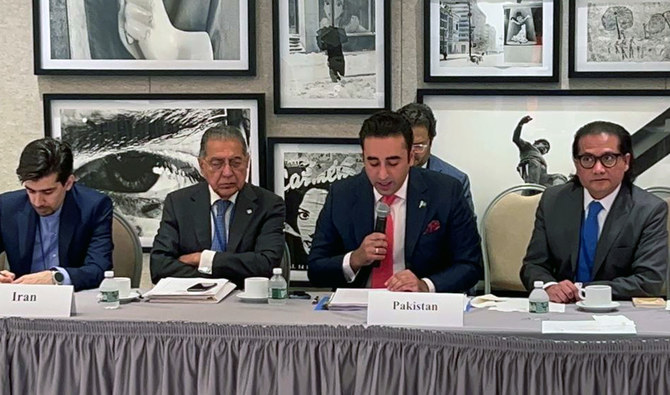
Pakistan's Foreign Minister Bilawal Bhutto-Zardari (2nd R) speaks at the OIC Contact Group on Muslims in Europe on the sidelines of the 77th UNGA session on September 19, 2022 in New York. (MOFA)
Short Url
Updated 20 September 2022
Follow

Pakistan urges OIC to push for appointment of UN envoy on Islamophobia

  • OIC in November 2020 unanimously adopted resolution initiated by Pakistan designating March 15 as Islamophobia Day
  • Pakistan last year joined OIC member states to observe for the first time the International Day to Combat Islamophobia

ISLAMABAD: Pakistan’s Foreign Minister Bilawal Bhutto-Zardari on Monday urged the Organization of Islamic Cooperation (OIC) to approach the UN Secretary-General to appoint a special envoy or focal person on Islamophobia, which he said had reached an “alarming level worldwide, especially in Europe.”

The 47th session of the OIC Council of Foreign Ministers, held in Niamey, Niger, in November 2020, unanimously adopted a resolution initiated by Pakistan for the designation of March 15 as the International Day to Combat Islamophobia. Pakistan last year joined OIC member states to observe for the first time the International Day to Combat Islamophobia.

The Muslim group has been working with the international community to commemorate the day at the global level.

“What is most worrisome is that Islamophobia continues to find strong resonance in political spheres in Europe, ultimately leading to the institutionalization of Islamophobia through new legislations and policies such as discriminatory travel bans and visa restrictions,” the foreign minister said at a meeting of the OIC Contact Group on Muslims in Europe held on the sidelines of the UN General Assembly’s 77th session.

Speaking about what he called a rise in hate crimes against Muslims in Europe, the Pakistani foreign minister said:

“The gender aspect of Islamophobia is also gaining prominence, with Muslim girls and women being targeted due to mode of their dress and the general notion that Muslim women are oppressed and thus must be ‘liberated’.”

He proposed that the OIC strengthen the OIC observatory to monitor all incidents of discrimination and hate crimes in Europe and other parts of the world, and called on the UN High Commissioner for Human Rights and the Human Rights Commissioner of the Council of Europe to establish an observatory to monitor acts of religious hatred, hostility and violence against Muslims and report regularly to the relevant policy organizations;

“OIC should urge the UN Secretary-General to appoint a Special Envoy or at least a focal person on Islamophobia,” Bhutto-Zardari said. “The OIC member states, within the framework of their bilateral relations with European countries, should raise the challenges facing Muslims and make specific efforts to help in addressing those challenges.”


Sindh assembly passes resolution rejecting move to separate Karachi

Updated 21 February 2026
Follow

Sindh assembly passes resolution rejecting move to separate Karachi

  • Chief Minister Shah cites constitutional safeguards against altering provincial boundaries
  • Calls to separate Karachi intensified amid governance concerns after a mall fire last month

ISLAMABAD: The provincial assembly of Pakistan’s southern Sindh province on Saturday passed a resolution rejecting any move to separate Karachi, declaring its territorial integrity “non-negotiable” amid political calls to carve the city out as a separate administrative unit.

The resolution comes after fresh demands by the Muttahida Qaumi Movement (MQM) and other voices to grant Karachi provincial or federal status following governance challenges highlighted by the deadly Gul Plaza fire earlier this year that killed 80 people.

Karachi, Pakistan’s largest and most densely populated city, is the country’s main commercial hub and contributes a significant share to the national economy.

Chief Minister Syed Murad Ali Shah tabled the resolution in the assembly, condemning what he described as “divisive statements” about breaking up Sindh or detaching Karachi.

“The province that played a foundational role in the creation of Pakistan cannot allow the fragmentation of its own historic homeland,” Shah told lawmakers, adding that any attempt to divide Sindh or separate Karachi was contrary to the constitution and democratic norms.

Citing Article 239 of Pakistan’s 1973 Constitution, which requires the consent of not less than two-thirds of a provincial assembly to alter provincial boundaries, Shah said any such move could not proceed without the assembly’s approval.

“If any such move is attempted, it is this Assembly — by a two-thirds majority — that will decide,” he said.

The resolution reaffirmed that Karachi would “forever remain” an integral part of Sindh and directed the provincial government to forward the motion to the president, prime minister and parliamentary leadership for record.

Shah said the resolution was not aimed at anyone but referred to the shifting stance of MQM in the debate while warning that opposing the resolution would amount to supporting the division of Sindh.

The party has been a major political force in Karachi with a significant vote bank in the city and has frequently criticized Shah’s provincial administration over its governance of Pakistan’s largest metropolis.

Taha Ahmed Khan, a senior MQM leader, acknowledged that his party had “presented its demand openly on television channels with clear and logical arguments” to separate Karachi from Sindh.

“It is a purely constitutional debate,” he told Arab News by phone. “We are aware that the Pakistan Peoples Party, which rules the province, holds a two-thirds majority and that a new province cannot be created at this stage. But that does not mean new provinces can never be formed.”

Calls to alter Karachi’s status have periodically surfaced amid longstanding complaints over governance, infrastructure and administrative control in the megacity, though no formal proposal to redraw provincial boundaries has been introduced at the federal level.