

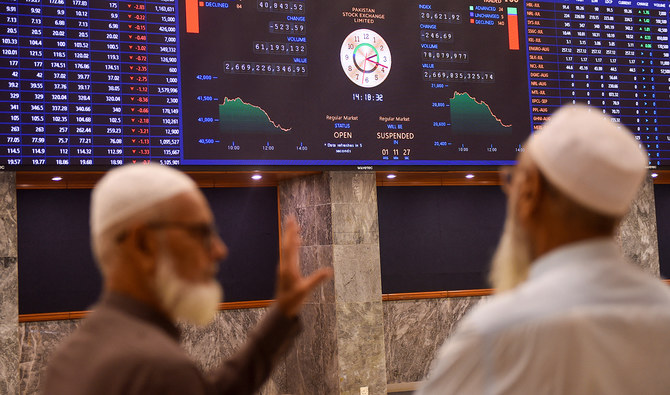

KARACHI: Pakistan’s currency and stock markets closed bearish despite early trading gains on Monday, traders and analysts said, following a rollover of $3 billion Saudi deposit and assurances by the finance minister that the country would not default on its debt obligations.
The Pakistani currency lost 0.45 percent of its value as the US dollar closed at Rs237.91 in the interbank market, where the demand of greenback for import payments continues to keep the rupee under pressure, according to the central bank data.
The greenback was trading at Rs245 in the open market as compared to the previous close of Rs241 on Friday, according to the Exchange Companies Association of Pakistan (ECAP).
Pakistan’s central bank on Sunday confirmed that the Saudi Fund for Development would extend a $3 billion deposit, currently placed in the State Bank of Pakistan’s (SBP) accounts, for one year, a move that provides breathing space to the South Asian economy to improve its debt profile.
The rupee remains under pressure due to higher demand of dollar for import payments despite Saudi confirmation, because the deposits are not utilized for daily parity settlement, according to analysts.
“On ground, the impact of Saudi deposit rollover is not visible because the dollar-rupee parity is determined on a daily basis and deposits are not for setting parity or finance imports. There is a shortage of dollars in the market,” Samiullah Tariq, a research director at the Pakistan Kuwait Investment Company, told Arab News.
“Rather the deposits are meant for boosting foreign exchange reserves in order to build confidence for debt maturity and country’s debt servicing credibility.”
The $3 billion deposit placed with the Pakistani central bank is part of $8.6 billion foreign exchange reserves the South Asian country held till September 9 and which could barely cover 40 days of import payments.
Analysts call for negotiating long-term deposit facilities to meet long-term external obligations of the South Asian country, grappling with a widening current account deficit and record inflation.
“These facilities are for only one year, so the government of Pakistan should negotiate with the Saudi government to get the tenure of this facility extended for at least three years, because it would meet our five-year requirement,” said Tahir Abbas, research head at the Karachi-based Arif Habib Limited brokerage firm.
The stock market also closed bearish on Monday, where the key index closed 158 points lower at 41,520.59 points after making some gains in the early session.
“Stocks closed lower on rupee uncertainty and global equity sell-off amid surging inflation. Gains were witnessed in the early session on finance minister’s assurances on unlikely debt default and Saudi Arabia confirming $3 billion deposit extension,” Ahsan Mehanti, chief executive officer (CEO) of the Arif Habib Corporation, told Arab News.
“Political uncertainty and concerns about falling forex reserves amid delays in support commitments from friendly nations played a catalyst role in the bearish close.”
Pakistan’s finance minister, Miftah Ismail, on Sunday assured that Pakistan would “absolutely not” default on debt obligations, despite catastrophic floods which have killed over 1,500 people and affected 33 million and submerged a third of the country.
Pakistani officials have said losses from the flood devastation could go as high as $40 billion.


