

PM Sharif among world leaders attending Queen Elizabeth's funeral in London

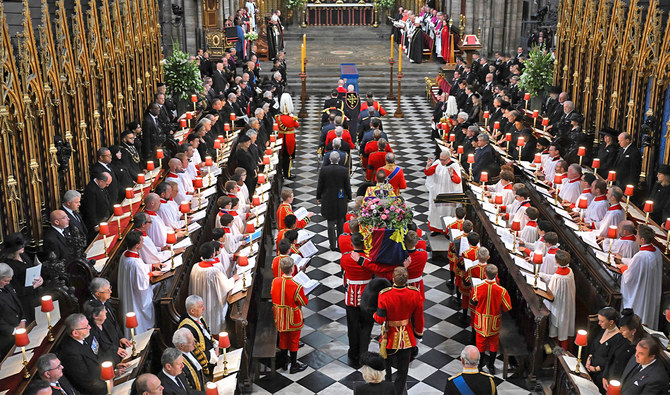
Gentlemen at Arms, the Queen's bodyguard take part in the funeral service of Queen Elizabeth II at Westminster Abbey in central London, on September 19, 2022. (AP)
Short Url
Updated 19 September 2022
Follow

PM Sharif among world leaders attending Queen Elizabeth's funeral in London

  • The Queen’s funeral will be held at Westminster Abbey today before her coffin is transported to Windsor Castle
  • The PM described her as ‘source of inspiration’ while inviting King Charles III to visit Pakistan at ‘earliest opportunity’

ISLAMABAD: Prime Minister Shehbaz Sharif on Sunday extended his condolences to King Charles III over the passing of his mother while attending a reception for foreign dignitaries who have gathered in the United Kingdom to attend the funeral of Queen Elizabeth II.

The Queen passed away at Balmoral Castle, the residence of the British royal family in Scotland, on September 8. She served as the sovereign of her country and head of the Commonwealth realms for over 70 years, making her the longest reigning monarch in the history of UK.

The prime minister is currently visiting London to attend the Queen’s funeral which is scheduled to take place at Westminster Abbey on Monday before her coffin is transported to St. George’s Chapel at Windsor Castle.
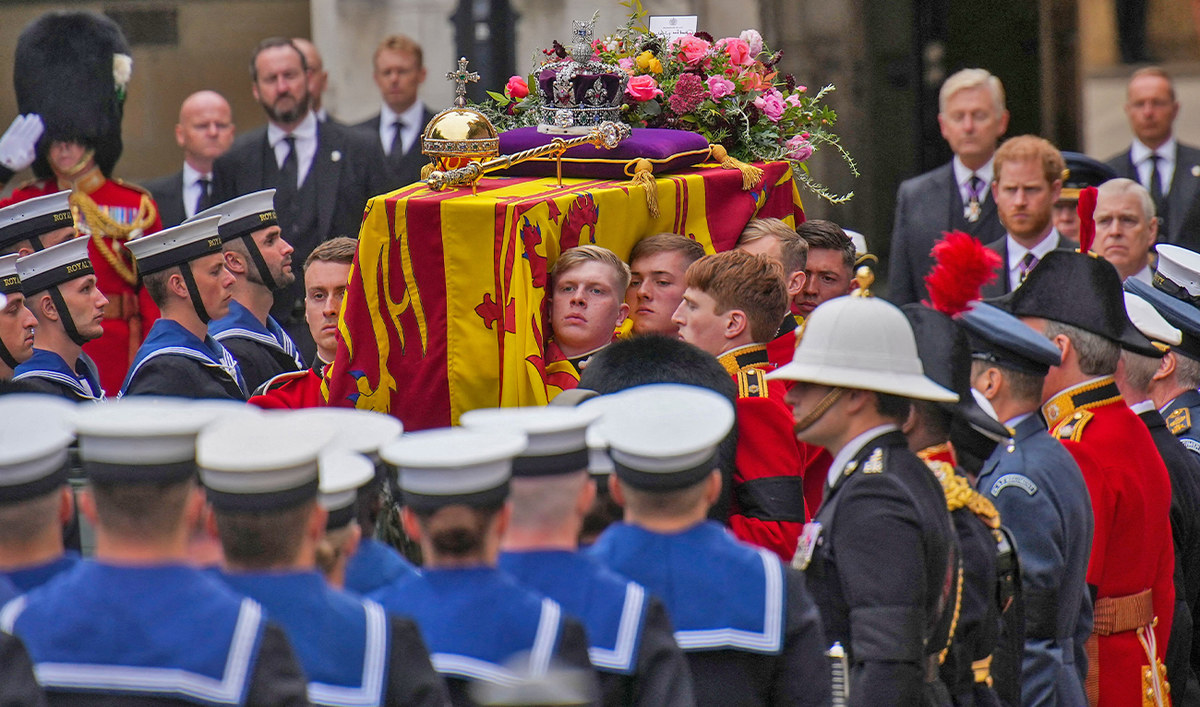


A Bearer Party of The Queen's Company, 1st Battalion Grenadier Guards places the coffin of Queen Elizabeth II, draped in the Royal Standard, onto the State Gun Carriage of the Royal Navy outside Westminster Hall, at the Palace of Westminster in London on September 19, 2022. (AFP)

Pakistan’s information minister Marriyum Aurangzeb said in a string of Twitter posts that the Pakistani premier described the late monarch as “a source of inspiration and strength for generations of Commonwealth citizens” in his conversation with the new King.

“The Prime Minister recalled that the people of Pakistan had fond memories of Her Majesty’s two visits to the country,” she continued. “The bond of affection between the Royal family and the Pakistani nation had only strengthened with time.”
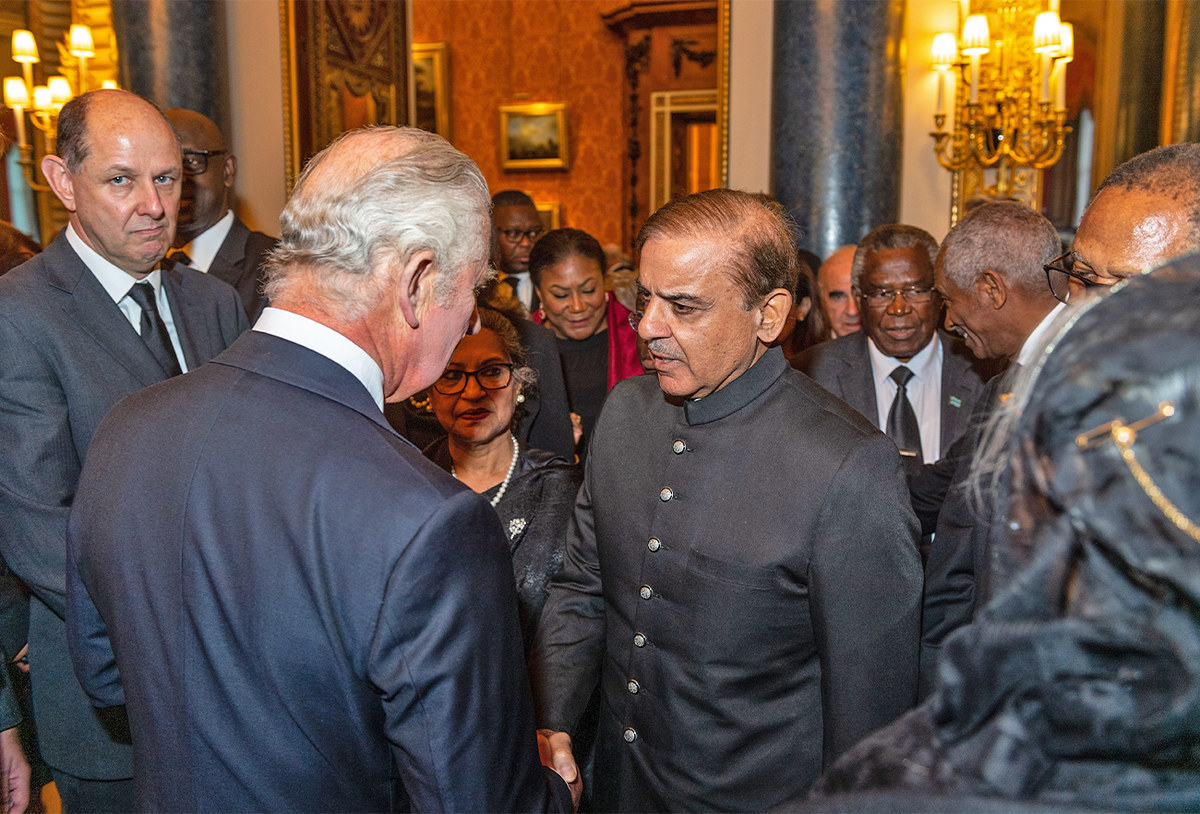


Pakistan PM Shehbaz Sharif (right) meets Britain’s King Charles III in London, England, on September 18, 2022. (Commonwealth/Flicker)

The Queen visited Pakistan as head of the Commonwealth in 1961, waving to crowds as she rode in a convertible through the streets of Karachi. During her second visit in 1997, she addressed a joint sitting of Pakistan’s parliament and spoke at a banquet hosted by former president Farooq Leghari.

The information minister said the prime minister conveyed best wishes to the King on behalf of the people and government of Pakistan on his ascension to the throne while expressing hope that he would carry on the legacy of his mother to further strengthen friendship among the Commonwealth nations.

He said the people of Pakistan held the new King of Britain in high esteem and looked forward to welcoming him to their country at the “earliest opportunity.”

The prime minister also thanked the monarch for the royal family’s expression of sympathy and support in the wake of the unprecedented floods in Pakistan.
He said the appeal for help and the response from both the British government and public were deeply appreciated in Pakistan.


Pakistan condemns Netanyahu’s ‘hexagon of alliances’ plan, says alert to growing India-Israel defense ties

Updated 26 February 2026
Follow

Pakistan condemns Netanyahu’s ‘hexagon of alliances’ plan, says alert to growing India-Israel defense ties

  • Israel’s Netanyahu last week proposed an alliance of countries in and around Middle East against its adversaries
  • Pakistan maintains “robust military preparedness” to deter any potential aggression, says foreign office spokesperson

ISLAMABAD: Pakistan’s foreign office spokesperson on Thursday condemned Israeli Prime Minister Benjamin Netanyahu’s recent statement about forming a “hexagon of alliances” within or around the Middle East, saying Islamabad was alert to growing defense ties between New Delhi and Tel Aviv. 

Netanyahu on Sunday outlined plans to form a new regional bloc, describing it as a “hexagon of alliances” that he said could include Israel, India, Greece and Cyprus, along with other unnamed Arab, African and Asian states. He said the grouping would collectively stand against what he described as “radical” adversaries.

His comments came days before Indian Prime Minister Narendra Modi arrived in Israel on Wednesday for a two-day trip to bolster ties. The two are expected to discuss cooperation in science and technology, innovation, agriculture, water management, technology, defense and security during the trip. 

The statement drew a sharp response from Pakistan’s Senate, which unanimously passed a resolution on Tuesday rejecting Netanyahu’s remarks.

“I would also like to draw your attention to the recent resolution adopted by the Senate of Pakistan that strongly condemned such remarks and attempts to undermine Muslim unity,” Foreign Office spokesperson Tahir Andrabi told reporters during a weekly press briefing.

“We continue to condemn these provocative steps and statements by the leadership of the occupying power that threaten regional peace and stability,” he added.

Netanyahu had also said Israel’s goal was to create an axis of nations that see eye to eye against what he described as the “radical Shia” and “radical Sunni” axis of nations. 

Andrabi said attempts to divide the Muslim world along sectarian lines were a “nefarious design” on Netanyahu’s part.

India is Israel’s largest arms buyer and second-largest trading partner in Asia, after China. In response to a question on India’s growing defense ties with Israel, Andrabi said Pakistan remained cognizant of the risks posed by such cooperation.

“Yes, we remain seized of the defense ties between Israel and India,” the spokesperson said, noting that certain “systems and platforms” may have been used by India against Pakistan in the past.

“We are alive to the threats they pose to our security, sovereignty and territorial integrity, as well as to regional peace and stability.”

Andrabi said Pakistan maintained “robust military preparedness” to deter any potential aggression from hostile forces.

‘UTMOST CAUTION EXERCISED’

Andrabi spoke about Pakistan’s recent strikes against alleged militant camps in Afghanistan, saying Islamabad had conducted them in self-defense and with extreme caution to avoid casualties. 

Pakistan said it carried out airstrikes in Afghanistan against militant camps and hideouts in three provinces on Saturday night, killing over 100 militants. Afghanistan accused Pakistan of violating its territorial sovereignty and killing dozens of civilians. Kabul has vowed to retaliate. 

Andrabi said the strikes were carried out to ensure protection for the lives of the people of Pakistan and to prevent “imminent terrorist attacks.”

“These actions were directed solely against identified terrorist camps and hideouts, and utmost caution was exercised to prevent harm to civilians,” he said. 

He warned Pakistan would take necessary measures under its right to self-defense against “terrorist threats” emanating from Afghan territory.

On the safety of Pakistani nationals in Afghanistan following the strikes, Andrabi said Islamabad had raised the issue with Afghan authorities, adding that Islamabad expected “foolproof security” for Pakistani diplomats and civilians.