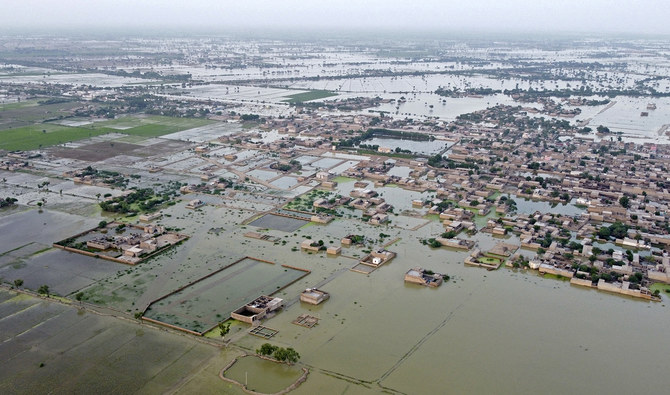

ISLAMABAD: The cost of reconstructing Pakistan’s infrastructure damaged by devastating floods could exceed $12 billion, twice the size of the country’s $6 billion loan program with the International Monetary Fund (IMF), and the process may take up to two years, construction and financial experts said on Sunday.
Record monsoon rains have caused flash floods to deal a severe blow to already cash-strapped Pakistan’s economy. The country has suffered huge damages to its infrastructure since mid-June, with over 1,500 casualties reported across Pakistan and swathes of crops destroyed by deluges.
The worst ever floods in Pakistan’s history have destroyed 13,0835 kilometers of roads, 375 bridges and 194,3978 houses. Of these, 778,560 houses have been fully damaged due to the floods, says Pakistan’s National Disaster Management Authority (NDMA).
Experts associated with Pakistan’s construction business estimate a whopping Rs 2.735 trillion ($12.32 billion) would have to be spent to rehabilitate and rebuild houses, roads and bridges.
“The average cost of repairing a house is Rs 900,000 while the reconstruction cost of a fully damaged house is estimated at Rs 1.5 million,” Saeed Ahmed Mughal, secretary information of Karachi Contractors Association, a representative body of companies mainly working on government projects, told Arab News on Sunday.
“The per kilometer road cost is Rs 32 million and the construction of a bridge would cost Rs 300 million, based on the current market rate,” Mughal disclosed. “These calculations are based on the tender prices of various similar projects currently going on in [various] parts of the country.”
The breakup of the total cost, through simple calculations based on current tender prices, show that the cost of 114,478 partially damaged houses would amount to Rs 1.030 trillion or $4.6 billion while the reconstruction of 778,560 fully damaged houses would amount to Rs 1.167 trillion or $5.2 billion.
Pakistan requires Rs 425 billion or $1.9 billion to reconstruct 13,083 kilometers of road network damaged by floods while Rs 112.5 billion or $507 million would be required to reconstruct 375 destroyed bridges.
Pakistani constructors and developers hope the country would be able to repair and reconstruct a major chunk of the damaged infrastructure within two years.
“Reconstruction activities will take at least two years to recoup some of the damages incurred after [devastation caused by] floods, particularly in the housing sector,” Hanif Memon, Chairman of the Association of Builders and Developers of Pakistan (ABAD), a body comprising builders and developers, told Arab News.
Memon said his organization was working on a project to provide basic shelter to flood victims in Pakistan’s southern Sindh province at the lowest rates. “Within a week we are going to launch moveable and immovable shelter houses for victims starting from Sindh. The cost is estimated to be between Rs 30,000 to around Rs 85,000 for each unit,” he added.
However, constructors fear prices of construction materials would go up after construction activities pick up.
“The biggest challenge is to maintain prices of construction materials currently when hoarding and artificial manipulation for financial gains goes on unchecked,” Memon said. “The government needs to come up with a legal framework to penalize hoarders of materials in such a painful situation,” Memon added.
Reeling from economic woes, Pakistan last month revived a $6 billion IMF loan program and had it extended till June 2023. Re-phasing and augmentation of the loan’s access by about $500 million would bring the total amount of funds to $6.5 billion, the Fund said.
The South Asian country still needs massive financial support from the world to recover from the damages, which U.N. Secretary-General Antonio Guterres and Pakistani officials have estimated, amounts to $30 billion.
However, economists doubt Pakistan would be able to amass huge financial support for its relief and rehabilitation efforts. “I don’t think the aid would reach even a couple of billion dollars,” Yousuf Nazar, a London-based Economist, told Arab News on Sunday.
“I fear that we may be headed for an eventual default if debt relief is not provided to Pakistan.”
Pakistan’s construction industry contributes around 14.2% to the overall economy of the country, as per fiscal year 2021 estimates. Stakeholders from the construction sector hope the share would increase after rebuilding activities begin.