

Children aged five to 12 now eligible for coronavirus vaccination in Pakistan – NIH

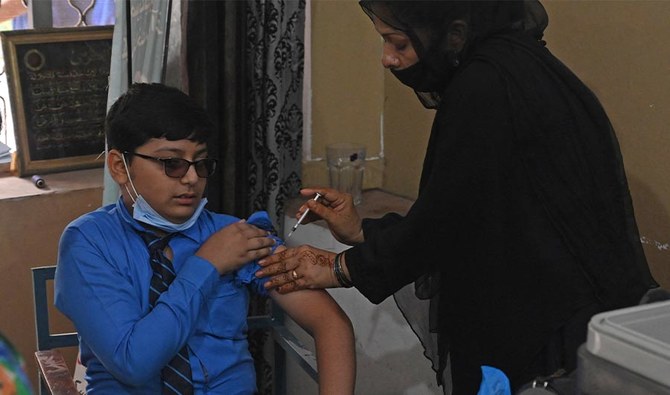
A health worker inoculates a student with a dose of Pfizer vaccine against the Covid-19 coronavirus at a school in Lahore on October 1, 2021.(AFP/FILE)
Short Url
Updated 18 September 2022
Follow

Children aged five to 12 now eligible for coronavirus vaccination in Pakistan – NIH

  • Pakistan launched its vaccination drive in February 2021, though it was limited to frontline health workers and elderly citizens
  • The country currently has a positivity ratio of 0.61 percent while 89 people are in critical care after contracting the disease

ISLAMABAD: Pakistan’s National Institute of Health (NIH) announced on Sunday children between the ages of five and 12 had been made eligible to receive free coronavirus shots from any vaccination center in the country.

Pakistan launched its immunization drive against COVID-19 in February 2021, though the authorities limited the campaign to frontline health workers and elderly citizens since they were more vulnerable to the respiratory disease.

The country decided to extend the campaign to all the adult citizens within a few months, however, after the government started receiving continued supply of various COVID-19 vaccines and scrambled to protect a much larger segment of the population.

“Children aged 5-12 are now eligible for Coronavirus Vaccination,” a graphic shared by NIH on Twitter proclaimed. “It is free and available at all vaccination centers.”

It also urged people to get their children two vaccine doses, adding the second shot should be taken between 21 and 56 days.


Pakistan reported a COVID-19 positivity ratio of 0.61 percent after conducting 14,663 tests in the last 24 hours.

One person lost his life to the disease during the same period while 89 people were in critical care after contracting COVID-19.


Pakistan reported its first coronavirus case in February 2020. Subsequently, the authorities tried to bring the disease under control by launching the vaccination campaign and resorting to smart lockdowns.


Pakistan consumer confidence rises by 4 percentage points in two years, survey shows

Updated 6 sec ago
Follow

Pakistan consumer confidence rises by 4 percentage points in two years, survey shows

  • Four in 10 Pakistanis believed the country is on the right track, with optimism higher among men
  • Economic concerns remained most worrying, but their quantum fell drastically across all issues

ISLAMABAD: Consumer confidence in Pakistan has risen by 4 percentage points from 31.5 to 35.5 over the last two years, which highlights improving public optimism under the government’s tenure, Ipsos market research firm said in a recent survey.

The survey was conducted through computer-assisted telephonic interviews (CATI) and included more than a thousand participants from all provinces and Azad Kashmir and Gilgit Baltistan regions on Feb. 2-14.

It comes at a time when Pakistan has undergone a difficult period of stabilization, though international rating agencies have acknowledged improvements after Islamabad began implementing structural reforms as part of its $7 billion International Monetary Fund (IMF) program.

The Ipsos survey revealed a “measurable” improvement in Pakistan’s economic sentiment, marked by a decline in inflation alongside notable reductions in poverty and unemployment, since the current government took charge two years ago.

“These findings point to a clear two-year transformation in the Consumer Confidence Index, demonstrating the perceived impact of consistent governance and policy measures,” read the key takeout in the survey.

“Sustained performance, coupled with transparent communication of achievements, will be essential to maintain momentum, reinforce optimism, and support further improvements in economic confidence.”

Four in 10 Pakistanis believed the country is on the right track, with optimism higher among men, while confidence in the country’s direction being right increased more than three times, from 12 percent to 40 percent, since the government came to power, according to the survey.

Economic concerns remained most worrying, but their quantum fell drastically across all issues since the first quarter of 2024. Inflation has dropped by 23 percent, unemployment by 10 percent, poverty by 20 percent, electricity prices by 34 percent and the burden of additional taxes was reduced by 18 percent in Q1 2026 as compared to Q1 2024.

“One in 3 Pakistanis expect the economy to strengthen,” the survey read. “Confidence to invest has grown steadily over two years, rising from 11 percent to 16 percent, with even stronger optimism among urban residents.”