

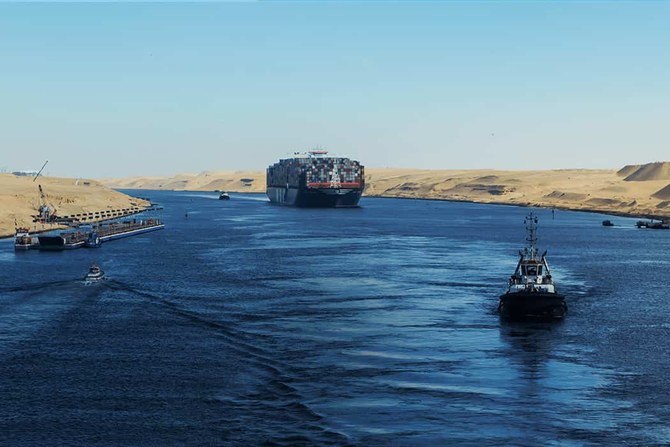
Egypt’s Suez Canal raises transit fees for ships by 15% in 2023 as inflation bites

The increase in fees is attributed to the rise in energy prices, freight rates and in the daily time rental values, according to the Cabinet statement. 
Short Url
Updated 19 September 2022
Follow

Egypt’s Suez Canal raises transit fees for ships by 15% in 2023 as inflation bites

RIYADH: Egypt’s Suez Canal Authority has increased transit fees for all types of ships by 15 percent starting January 2023 in order to deal with the impact of global inflation, the chairman said in a statement.

Osama Rabie added that transit fees for both dry bulk vessels and cruise ships will increase by 10 percent. 

The increase in fees is attributed to the rise in energy prices, freight rates and in the daily time rental values, according to the Cabinet statement. 

Rabie reasoned that the rise in fees for passing the canal “is inevitable and a necessity,” in order to deal with the impact of the current global inflation rates that have exceeded eight percent.

It comes in light of “unprecedented” daily increases in  charter rates for most types of vessels.

Daily charter rates for crude oil tankers increased on average in 2022 by 88 percent compared to 2021, while daily charter rates for LNG carriers rose on average by 11 percent during this year, compared to the year earlier. 

Rabie explained that the most important factor in determining Suez Canal transit fees is the average freight rates for various types of ships.

In recent months, freight rates, especially for containerships, have increased considerably, he explained, adding that it reached higher levels compared to the period before the COVID-19 pandemic.

He added that the current increased energy prices also impacted the authority’s fees calculations.

The continued rise in crude oil prices above the level of $90 per barrel, and the rise in the average prices of LNG above the level of $30 per million thermal units have led to a surge in the average prices of ship bunkers.

Consequently, the rise in energy prices increases the savings that ships achieve by transiting through the Suez Canal, compared to other alternative routes, he explained. 

This happens as the world’s largest wheat importer is intensifying its efforts to confront the challenges posed by the coronavirus pandemic, as well as the Russia-Ukraine crisis. 

Egypt has been hit hard by soaring oil and commodity prices, with the Egyptian pound further devaluing against the dollar and soaring inflation.


PIF’s Humain invests $3bn in Elon Musk’s xAI prior to SpaceX acquisition

Updated 18 February 2026
Follow

PIF’s Humain invests $3bn in Elon Musk’s xAI prior to SpaceX acquisition

JEDDAH: Humain, an artificial intelligence company owned by Saudi Arabia’s Public Investment Fund, invested $3 billion in Elon Musk’s xAI shortly before the startup was acquired by SpaceX.

As part of xAI’s Series E round, Humain acquired a significant minority stake in the company, which was subsequently converted into shares of SpaceX, according to a press release.

The transaction reflects PIF’s broader push to position Saudi Arabia as a central hub in the global AI ecosystem, as part of its Vision 2030 diversification strategy.

Through Humain, the fund is seeking to combine capital deployment with infrastructure buildout, partnerships with leading technology firms, and domestic capacity development to reduce reliance on oil revenues and expand into advanced industries.

The $3 billion commitment offers potential for long-term capital gains while reinforcing the company’s role as a strategic, scaled investor in transformative technologies.

CEO Tareq Amin said: “This investment reflects Humain’s conviction in transformational AI and our ability to deploy meaningful capital behind exceptional opportunities where long-term vision, technical excellence, and execution converge, xAI’s trajectory, further strengthened by its acquisition by SpaceX, one of the largest technology mergers on record, represents the kind of high-impact platform we seek to support with significant capital.” 

The deal builds on a large-scale collaboration announced in November at the US-Saudi Investment Forum, where Humain and xAI committed to developing over 500 megawatts of next-generation AI data center and computing infrastructure, alongside deploying xAI’s “Grok” models in the Kingdom.

In a post on his X handle, Amin said: “I’m proud to share that Humain has invested $3 billion into xAI’s Series E round, just prior to its historic acquisition by SpaceX. Through this transaction, Humain became a significant minority shareholder in xAI.”

He added: “The investment builds on our previously announced 500MW AI infrastructure partnership with xAI in Saudi Arabia, reinforcing Humain’s role as both a strategic development partner and a scaled global investor in frontier AI.”

He noted that xAI’s trajectory, further strengthened by SpaceX’s acquisition, exemplifies the high-impact platforms Humain aims to support through strategic investments.

Earlier in February, SpaceX completed the acquisition of xAI, reflecting Elon Musk’s strategy to integrate AI with space exploration.

The combined entity, valued at $1.25 trillion, aims to build a vertically integrated innovation ecosystem spanning AI, space launch technology, and satellite internet, as well as direct-to-device communications and real-time information platforms, according to Bloomberg.

Humain, founded in August, consolidates Saudi Arabia’s AI initiatives under a single entity. From the outset, its vision has extended beyond domestic markets, participating across the global AI value chain from infrastructure to applications.

The company represents a strategic initiative by PIF to diversify the Kingdom’s economy and reduce oil dependence by investing in knowledge-based and advanced technologies.