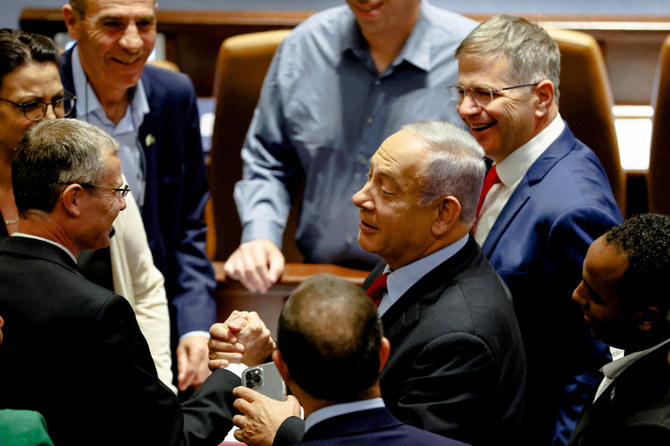

AMMAN: A bloc of Arab parties has split ahead of Israel’s November elections — a move that could dilute the minority’s political influence and strengthen former prime minister Benjamin Netanyahu’s hopes of a return to power.
The Arab nationalist Balad party will run separately from the other two parties in the Joint List in the general election.
The Nov. 1 poll is expected to be a hard-fought contest between Netanyahu and a constellation of parties from across the political spectrum.
But the last-minute decision by the Balad faction to split from the Joint Arab List may play into Netanyahu’s hands.
Balad, also known as Tajamu and headed by Sami Abu Shehadeh, has submitted a separate list for the Nov. 1 election.
Abu Shehadeh, a Knesset member and head of the Balad list, told Arab News that he is confident the party can pass the electoral threshold needed to enter the Knesset.
However, Botrus Mansour, a Nazareth-based lawyer and observer of the Arab political map in Israel, is not so sure.
”Balad has only a slim chance of crossing the threshold. Based on the estimates, the 3.25 percent threshold requires around 140,000 votes,” he said.
Polling and general estimates suggest that Balad can gain no more than half that number.
Explaining the last-minute withdrawal, Balad supporters said that they had signed an agreement with Hadash (the Democratic Front for Peace and Equality) and its leader Ayman Odeh on both ideological issues and seat allocations, but accused the party of reneging on the deal and pushing for a rotation of the sixth seat.
Wadie Abu Nassar, director of the International Center for Consultations, told Arab News that Balad has only a slim chance of sending any of its members to the Knesset.
“They are entering a race ahead of elections alone at a very late stage, less than two months before election day. The second reason is that the prevailing discourse among the Arab population has shifted inwardly.”
The Haifa-based analyst told Arab News that while in past decades the Palestinian and pan-Arab discourse was the prevailing focus of Palestinian citizens in Israel, they had other priorities today.
“The discourse is focusing on domestic issues and less on Palestinian-related issues, and this means that they (Balad) will not be able to garner the kind of voting numbers that are needed.”
Observers are unclear how the split will affect the already expected low voter turnout, which is forecast to be in the 40 percent range.
“The new split will add to the frustration and despair, combined with the general mood of helplessness because of lack of change toward Arabs of Israel from the current government. Therefore, and without a dramatic change, the percentage of the vote is likely to decrease,” Mansour said.
But Abu Nassar believes that the Balad split might have a different effect on the turnout.
“On the one hand, the competition will be tougher, and each faction will invest more time. On the other hand, more people will be angry, so I believe the split will have a limited impact on the turnout.”
If Balad fails to cross the threshold, the potential waste of about 70,000 Arab votes might help the Netanyahu bloc.
Abu Nassar said that Netanyahu’s chances had “improved significantly.”
However, he added that “the game is not over yet because things in the right wing are not clear,” referring to the possible scenarios between Netanyahu and the far-right versus the blocs of caretaker Prime Minister Yair Lapid and Defense Minister Benny Gantz.
Mansour believes that if the Netanyahu bloc is unable to garner the necessary 61 out of 120 Knesset seats, the absence of Balad will make it easier for Ayman Odeh and Ahmad Tibi, leader of the Ta’al party, to support the Lapid/Gantz alliance.
“If Balad is not in the Joint List, the chances of joining a governing coalition will be easier now, especially since this line has already been crossed by the Islamist leader Mansour Abbas,” he said.