

Pakistan’s floods have killed at least 528 children, says UNICEF

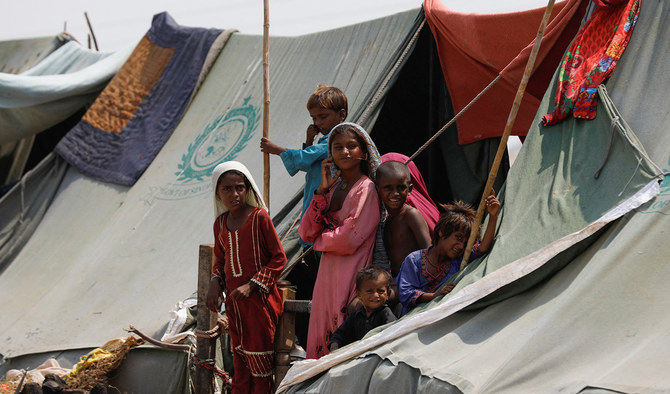
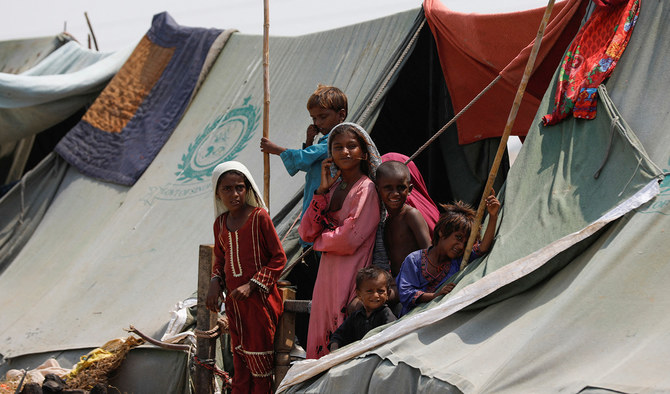
Children, who became displaced, stand outside their family tent while waiting for food handouts and relief material, following rains and floods during the monsoon season in Sehwan, Pakistan on September 14, 2022. (REUTERS)
Short Url
Updated 25 September 2022
Follow

Pakistan’s floods have killed at least 528 children, says UNICEF

  • UNICEF says floods have impacted around 16 million Pakistani children 
  • Many more children in Pakistan will die without 'massive support'—UNICEF

ISLAMABAD: Devastating floods in Pakistan have killed at least 528 children and impacted about 16 million others, the United Nations International Children’s Emergency Fund (UNICEF) said on Friday.  

Official data by Pakistan’s government shows children and women are becoming more vulnerable to floods, with tens of thousands of people suffering from infectious and water-borne diseases in Pakistan. 

According to the National Disaster Management Authority (NDMA), flash floods caused by unusually heavy monsoon rains have killed 1,545 people across the South Asian country since mid-June and affected over 33 million. 

“The catastrophic floods in Pakistan have now claimed the lives of at least 528 children, according to the latest Government figures. Each and every one of these deaths is a tragedy that could have been averted,” UNICEF Pakistan Representative Abdullah Fadil said in a statement. 

Fadil warned that without a “massive increase in support”, many more children would lose their lives. The UNICEF official further said the situation for Pakistani families is beyond bleak and malnourished children are battling diarrhea and malaria, dengue fever, and many are suffering from painful skin conditions. 

Fadil said a lot of Pakistani mothers in flood-hit areas are anaemic and malnourished themselves and have very low-weight babies.  

“An estimated 16 million children have been impacted by these ‘super floods’ and at least 3.4 million girls and boys remain in need of immediate, lifesaving support,” he said.  

Fadil added that “young children are living out in the open with their families, with no drinking water, no food, and no livelihood, exposed to a wide range of new flood-related risks and hazards - including from damaged buildings, drowning in flood waters and snakes.” 

He said vital infrastructure that children rely on, including thousands of schools, water systems and health facilities, has been destroyed and damaged.  

Thousands of families have been displaced by the floods, with many children separated from their parents due to the deluge.  

“Many children will have already experienced shock and distress from having lost their loved ones, their homes and their cherished possessions,” the UNICEF Pakistan representative said.  

UN Secretary-General Antonio Guterres, who visited Pakistan’s flood-battered areas earlier this week, blamed the crisis on the effects of climate change. 

Fadil said children are paying the price for a climate disaster that is not of their making. He urged the world to help Pakistan today but also to begin looking at the months ahead and the need to rebuild the lives of millions of vulnerable children. 

Pakistan has estimated damages inflicted by the floods to be somewhere around $40 billion. At one point, a third of the country’s territory was said to be inundated, with the hard-hit province of Sindh suffering massive damages.


Pakistan sells 480MHz for $507 million in 5G spectrum auction

Updated 10 March 2026
Follow

Pakistan sells 480MHz for $507 million in 5G spectrum auction

  • Mobile network operator Jazz buys 190 MHz, Ufone 180MHz and Zong 110MHz, says telecom authority chairman
  • Most mobile networks in Pakistan currently operate on fourth-generation (4G) infrastructure, while 5G rollout has faced delays

ISLAMABAD: Pakistan has sold 480 megahertz (MHz) of fifth-generation (5G) telecom spectrum for $507 million, the Pakistan Telecommunication Authority (PTA) confirmed after a live auction on Tuesday, marking a key step toward introducing faster mobile broadband.

The live auction was organized by the PTA to determine which telecom operators would acquire the frequencies needed to deploy 5G mobile networks across Pakistan.

Pakistan, a country of over 240 million people, is one of the world’s largest telecom markets by population, with over 190 million mobile phone users. However, most networks currently operate on fourth-generation (4G) infrastructure, and the rollout of 5G has faced delays in recent years due to regulatory, economic and spectrum-allocation challenges.

“In total out of 595 MHz, 480 MHz spectrum has been sold today,” PTA Chairman Hafeez-ur-Rehman said in a speech aired on state media. “This is a very big achievement and a big victory for Pakistan, in my opinion.”

Chinese mobile operator Zong ‌bought 110 MHz of the 5G spectrum, while Ufone bought ⁠180 ⁠MHz and Veon-backed firm Jazz bought 190 MHz, Rehman announced.

“And the price in total for this is $507 million,” the PTA chairman said. 

According to officials, 5G services are expected to be rolled out first in Islamabad, Lahore, Karachi, Peshawar and Quetta cities, before expanding nationwide as network infrastructure develops.

Information Technology Minister Shaza Fatima Khawaja has previously said the government is also encouraging wider adoption of 5G-compatible devices, noting that about 95 percent of mobile phones used in

Pakistan are locally manufactured, while premium models such as iPhones and Google Pixel devices are imported.

Officials say Pakistan currently uses around 274 megahertz of spectrum, much of it allocated decades ago, while the new auction will make 600 megahertz of spectrum available for next-generation services.

Under the government’s rollout plan, telecom operators are expected to add roughly 3,000 new network sites annually to support the expansion of 5G services.

PTA officials say Pakistan currently offers some of the world’s cheapest mobile data services and have pledged that consumer protection will remain a priority as the country moves toward next-generation connectivity.