

Germany takes control of Russian-owned refinery amid energy crisis

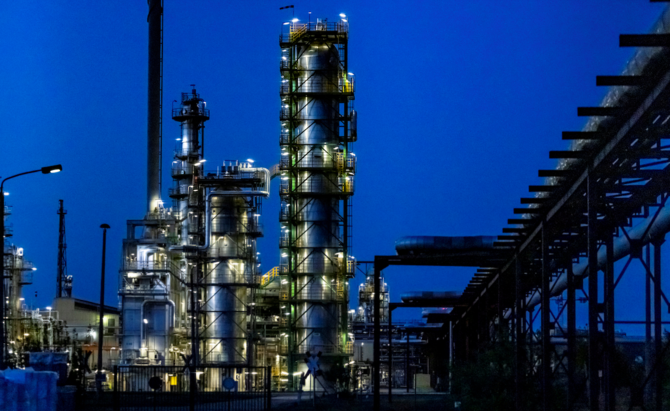
The PCK oil refinery in Schwedt, Germany (Reuters)
Short Url
Updated 16 September 2022
Follow

Germany takes control of Russian-owned refinery amid energy crisis

BERLIN: Germany took control of a major Russian-owned oil refinery on Friday, risking retaliation from Moscow as Berlin strives to shore up energy supplies and meet its EU commitment to eliminate Russian oil imports by the end of the year, according to Reuters.

The economy ministry said it was putting a unit of Russian oil firm Rosneft under the trusteeship of the industry regulator and taking over the business’ Schwedt refinery, which supplies 90 percent of Berlin’s fuel.

“With the trusteeship, the threat to the security of energy supply is countered and an essential foundation stone is set for the preservation and future of the Schwedt site,” the ministry said in a statement.

Governments across Europe have been racing to prop up their power providers and secure fuel deliveries as they ratchet up sanctions on major supplier Russia over its invasion of Ukraine.

Moscow has retaliated by reducing gas flows and has threatened to shut off all the taps, sending prices soaring and raising the prospect of energy rationing in Europe this winter.

Rosneft Deutschland, which was majority owned by the Russian oil group and accounts for about 12 percent of German oil processing capacity, is being placed under the trusteeship of the Federal Network Agency regulator.

The regulator said the original owner no longer had authority to issue instructions.

Rosneft Deutschland and Rosneft did not immediately respond to requests for comment.

Polish refiner PKN Orlen is interested in taking a controlling stake in the Schwedt refinery, which is Germany’s fourth-largest and also supplies parts of western Poland, sources in Berlin and Warsaw familiar with the matter told Reuters.

Shell, which owns a 37.5 percent stake in Schwedt, has wanted to sell that for some time. Shell said on Friday it was “unaffected” by the German move to take control of the refinery.

The Schwedt refinery has posed a dilemma for Berlin for several weeks, as it has received all of its crude from Russia, but Germany is resolved to eliminate imports of oil from Russia by the end of the year under EU sanctions.

Taking over Schwedt, however, risks retaliatory measures from Moscow.

Poland said earlier this year that ending Russian ownership of the refinery was a condition for potentially supplying it with seaborne oil via a terminal in Gdansk and via Polish pipelines to replace Russian crude.

Germany’s economy ministry said Friday’s move included a package to ensure the refinery could receive oil from alternative routes, without providing details.

Chancellor Olaf Scholz, Economy Minister Robert Habeck and Brandenburg’s state premier are due to announce more details at 1130 GMT.

Germany’s move on Rosneft Deutschland is its latest attempt to stabilize the energy market.

The government said this week it would step up lending to companies at risk of being crushed by soaring gas prices, and power utility Uniper said the state could take a controlling stake, adding a government rescue package worth 19 billion euros ($19 billion) was no longer enough.

The government has also put SEFE, formerly known as Gazprom Germania, under trusteeship after Russian energy giant Gazprom ditched it in April.

Berlin is grappling with Russia’s move to halt flows of gas through the Nord Stream 1 pipeline, which had been the biggest gas supply route powering Europe’s biggest economy.

As a result of Friday’s decision, the Federal Network Agency will take Rosneft Deutschland’s shares in the MiRo refinery in Karlsruhe and Bayernoil refinery in Vohburg.


Saudi Maaden reports 156% profit surge to $2bn on strong commodity prices, record production

Updated 05 March 2026
Follow

Saudi Maaden reports 156% profit surge to $2bn on strong commodity prices, record production

RIYADH: Saudi mining and metals company Maaden has reported a 156 percent jump in its net profit attributable to shareholders for 2025, driven by higher commodity prices, record production volumes, and a one-off bargain purchase gain.

The state-backed giant posted a net profit of SR7.35 billion ($1.95 billion) for the full year 2025, an increase from SR2.87 billion in the previous year. The firm’s revenue surged by 19 percent to SR38.58 billion, up from SR32.55 billion in 2024.

This comes as Saudi Arabia steps up efforts to expand its mining sector as a pillar of economic diversification, encouraging international participation and private investment to unlock the Kingdom’s estimated $2.5 trillion in untapped mineral resources under Vision 2030.    

In a statement on Tadawul, the company said: “Performance was led by record phosphate production, near record aluminum production, an increase in all three of Maaden’s main output commodity prices.”

The performance was also fueled by a 60 percent increase in gross profit, which reached SR14.79 billion. In its annual results announcement, Maaden attributed the top-line growth to “higher commodity market prices for phosphate, aluminum and gold business units,” as well as increased sales volumes in its phosphate and aluminum segments. This was partially offset by slightly lower sales volume in the gold unit.

Maaden’s CEO, Bob Wilt, hailed 2025 as a transformative year for the company, marked by strategic growth and operational excellence. “This was a great year for Maaden’s strategic growth. We delivered strong financial results and sustained operational excellence across the business,” he said in a statement.

“This was driven by growth in production across all businesses, including record-breaking DAP (di-ammonium phosphatevolumes), disciplined cost control across and a clear commitment to our role as a cornerstone of the Saudi economy,” Wilt added.

Profitability was further bolstered by an increased share of net profit from joint ventures and an associate. This included a one-off bargain purchase gain of SR768 million related to Maaden’s investment in Aluminium Bahrain B.S.C. The company also benefited from lower finance costs.

The fourth quarter of 2025 was strong, with Maaden swinging to a net profit of SR1.67 billion, compared to a loss of SR106 million in the same period of the prior year. Quarterly revenue rose 7 percent to SR10.64 billion.

The firm achieved record production of di-ammonium phosphate, reaching 6.72 million tonnes for the year, a 9 percent increase. Aluminum production remained near-record levels, while the company added a net 7.8 million ounces to its reportable gold mineral resources through discovery and resource development.

The phosphate division saw sales jump 17 percent to SR20.77 billion, with the earnings before interest, taxes, depreciation, and amortization margin expanding to 47 percent. The aluminum business reported a 9 percent increase in sales to SR10.99 billion, with EBITDA more than doubling in the fourth quarter.

Looking ahead, Wilt emphasized that the pace of growth will accelerate as the company advances key initiatives, including the Phosphate 3 Phase 1 and Ar Rjum projects, which remain on budget and schedule. Maaden has also secured a gas supply for its future Phosphate 4 project.

“This pace of growth will only accelerate. Not only as we advance projects and increase the scale of our exploration program, but as we continue to grow production and implement technology that will further modernize, streamline and unlock value,” Wilt added.

Earnings per share for the year rose sharply to SR1.91, up from SR0.78 in 2024. Total shareholders’ equity increased by 18.7 percent to SR61.59 billion.