

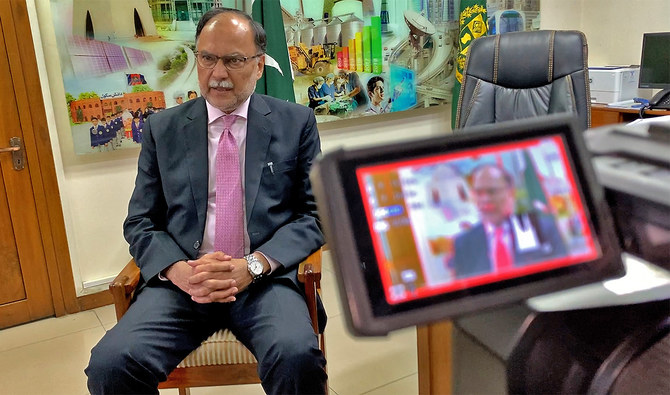
Islamabad: Pakistani planning minister Ahsan Iqbal has said the appointment of a new chief of army staff (COAS) would be made on time and as per merit and law, describing former prime minister Imran Khan’s alleged attempts to politicize the issue and create rifts within the army as “sad and very unpatriotic.”
Pakistan’s current army chief, General Qamar Javed Bajwa, will complete his tenure on November 28. Bajwa became the army chief in November 2016 and was given a three-year extension in 2019, when Khan was prime minister.
Khan, who was ousted from power in a no-trust vote in April, alleged during a speech at a rally this month that Prime Minister Shehbaz Sharif and his allies were delaying elections polls in the country as they hoped to appoint an army chief of their own choice who would not question them over corruption.
The military shot back at the former PM, saying it was “aghast” at the statement, which it saw as an attempt “to discredit and undermine the senior leadership.”
“[For army chief appointment], there is a mechanism in the Constitution. When the time will come, it will be made in routine, according to the law and on merit,” Iqbal told Arab News in an exclusive interview on Thursday.
“Everyone should talk about the mechanism, instead of trying to create division in the army, that there are patriotic generals and there are unpatriotic generals, I think that’s a shame.”
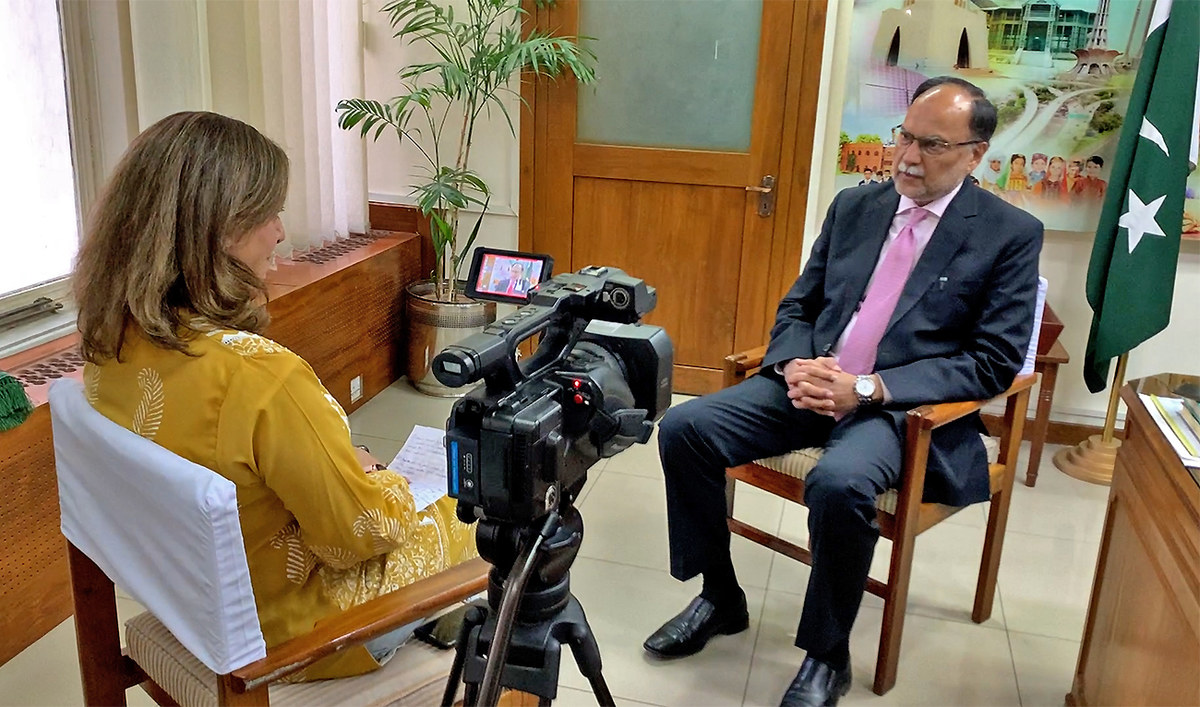
Pakistan’s planning minister, Ahsan Iqbal, speaks to Arab News Pakistan in Islamabad, Pakistan, on September 15, 2022. (AN Photo)
At his speech, Khan had alleged Sharif and his allies “want their man [as army chief] because they have stolen away money … They fear that if a strong, patriotic army chief is appointed, he will question them.”
“Pakistan’s military is a very important institution in Pakistan’s security and this, we have always maintained, should remain above politics,” Iqbal said. “Unfortunately, Imran Khan has tried to politicize even the army and now [he is] politicizing the appointment of the army chief. This is very sad and very unpatriotic.”
Speaking about damages caused by floods this monsoon season, Iqbal, who also heads the National Flood Response Coordination Center (NFRCC), said initial estimates for damages stood at more than $30 billion, but a final figure would be clear after a completion assessment, which was being carried out in collaboration with the United Nations (UN), the World Bank and the Asian Development Bank (ADB).
Unprecedented floods have killed more than 1,500 people and submerged a third of Pakistan since mid-June, affecting 35 million people across the South Asian country.
“Two to three years of effort would be required to rebuild infrastructure and rebuild people’s livelihoods,” the minister said, adding the UN would support a donor conference to help Pakistan mobilize international funding for rehabilitation and rebuilding.
Asked about the world’s response to a UN flash appeal for $160 million issued last month, he said the appeal had been subscribed to by the international community and there was assistance coming from friendly countries for rescue and relief operations.
“The funds are used very transparently through NDMA [National Disaster Management Authority] and we have created a dashboard on which we are posting on a daily basis how much relief is being collected and where it is being distributed,” Iqbal said.
He said the prime minister had said a leading international firm should carry out an audit of all the funds.
“The ministry of finance is carrying out the necessary processes because when you have to engage a firm you have to fulfill the coded formalities, but it will be one of the big four [PwC, Deloitte, EY and KPMG] who are internationally acclaimed and recognized and respected for their authenticity.”
Asked whether Pakistan would request the International Monetary Fund (IMF), in light of the floods, to reconsider its conditions for a loan program signed in 2019, the minister said the government was not considering it. “We do not right now intend to really give any message to the international community that Pakistan is facing a serious financial viability crisis,” he said.
Iqbal also spoke about disbanding the China-Pakistan Economic Corridor (CPEC) Authority, which was created by the Khan government to oversee projects that are part of a multi-billion dollar scheme under which Beijing has pledged over $60 billion for infrastructure projects in Pakistan, much of it in the form of loans.
Iqbal said the authority was a “redundant body” that created duplication and conflict within government departments and ministries.
“So, by reversing CPEC Authority, we are streamlining the implementation and execution of projects and we are going back to the old model of CPEC,” Iqbal said, “that was Ministry of Planning and Development leading the program through a very efficient, small CPEC secretariat and empowering the line ministries to do their job.”


