

Climate change likely made Pakistan’s extreme rainfall more intense — study

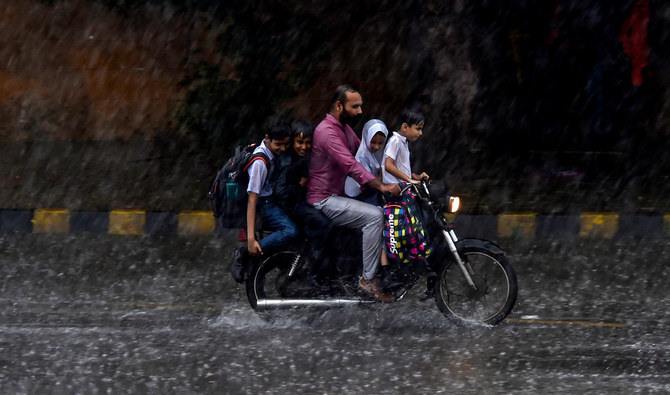
A man rides a motorcycle with children as pillion along a road during heavy rains in Karachi, Sindh-Pakistan on September 12, 2022. (AFP)
Short Url
Updated 16 September 2022
Follow

Climate change likely made Pakistan’s extreme rainfall more intense — study

  • In Sindh, Balochistan, climate warming made average maximum rainfall 75% more intense
  • Pakistan authorities have said it could take up to six months for flood waters to fully recede

LONDON: The torrential monsoon that has submerged more than a third of Pakistan was a one in a hundred-year event likely made more intense by climate change, scientists said on Thursday.

In the hardest-hit areas of Sindh and Balochistan provinces, where August rainfall was seven to eight times heavier than usual, climate warming made average five-day maximum rainfall about 75% more intense, according to a report by World Weather Attribution (WWA), an international research collaboration that teases out the role of climate change in extreme events.

Across the entire Indus River basin, the scientists found maximum rainfall was about 50% heavier during a two-month monsoon period due to climate change.

They used 31 computer models in their analysis, combined with real-world observations.

WWA previously analyzed the deadly heatwave that scorched India and Pakistan in March and April, with temperatures reaching 50C. Climate change, they said, had made that heatwave 30 times more likely.

Their findings were less concrete for Pakistan’s heavy rains.

“The role of climate change in heatwaves is much larger than in extreme rainfall when it comes to likelihood,” said WWA co-leader Friederike Otto, a climate scientist at Imperial College London.

It’s also trickier to parse out the role of climate change in the Pakistan floods, scientists said, because there have been so many drivers behind this year’s extremes.

Ongoing La Nina conditions — a global weather pattern that can affect ocean temperatures — combined with a negative dipole in the Indian Ocean — whereby rainfall is heaver in the eastern Indian Ocean – have been feeding the monsoon.

The floods have so far claimed the lives of more than 1,400 people and displaced millions, washing away roads, homes, and farmland. Damages are expected to total more than $30 billion.

Pakistan authorities say it could take up to six months for flood waters to fully recede, spiking concerns about waterborne diseases such as dengue and cholera.

While climate change may have made this year’s monsoon rains worse, the devastation they caused can’t be attributed to warming alone.

Scientists stressed the construction of homes and agricultural land on known flood plains, as well as inadequate infrastructure such as dams, had worsened the impacts of heavier rains.

“There have been significant drainage problems in the lower Indus Basin, even in non-flood years,” said geographer Ayesha Siddiqi at the University of Cambridge.


Bangladesh leader pushes for SAARC revival after meeting Indian, Pakistani dignitaries

Updated 5 sec ago
Follow

Bangladesh leader pushes for SAARC revival after meeting Indian, Pakistani dignitaries

  • Muhammad Yunus met Pakistan’s parliamentary speaker, Indian FM at Khaleda Zia’s funeral on Wednesday
  • SAARC has been dysfunctional since 2016, after India withdrew following a militant attack it blamed on Islamabad

ISLAMABAD: Bangladesh Chief Adviser Muhammad Younus this week pushed for reviving the South Asian Association for Regional Cooperation (SAARC) platform after meeting dignitaries from India, Pakistan and other parts of the region. 

SAARC has been effectively dysfunctional since 2016, when its planned Islamabad summit collapsed after India withdrew following a militant attack it blamed on Pakistan. Islamabad denied involvement, but New Delhi’s decision prompted Afghanistan, Bangladesh and Bhutan to pull out, leading to the indefinite postponement of the summit.

Younus met Pakistan’s National Assembly Speaker Ayaz Sadiq and Indian External Affairs Minister Subrahmanyam Jaishankar at former Bangladesh premier Khaleda Zia’s state funeral in Dhaka on Wednesday. The funeral also saw a handshake between the Indian and Pakistani representatives, the first high-level contact between officials of the two countries since their conflict in May. 

“During the meetings, Professor Yunus repeatedly emphasized the need to revive the South Asian Association for Regional Cooperation (SAARC),” Yunus’ account on social media platform X said.

“We witnessed a true SAARC spirit at the funeral yesterday,” the account quoted Yunus as saying. “SAARC is still alive. The SAARC spirit is still alive.”

The Bangladesh leader said apart from Jaishankar and Sadiq, representatives from South Asia who attended the funeral included Nepal’s Foreign Minister Bala Nanda Sharma, Sri Lanka’s Minister of Foreign Affairs, Employment and Tourism Vijitha Herath, and Maldives Minister of Higher Education and Labor Ali Haider Ahmed. 

Yunus said he tried to convene an informal gathering of SAARC leaders on the sidelines of the UN General Assembly in New York last year.

His statement to revive SAARC follows that of Pakistan’s Prime Minister Shehbaz Sharif, who earlier this month also called for reviving the South Asian platform. 

Sharif’s message last month came as the bloc marked the 40th anniversary of its founding charter. The Pakistani premier stressed the importance of deeper economic collaboration and collective responses to shared regional challenges such as poverty, climate-induced natural disasters, food and energy insecurity, and public-health vulnerabilities.