

Pakistan reopens key highway to speed aid to flood victims

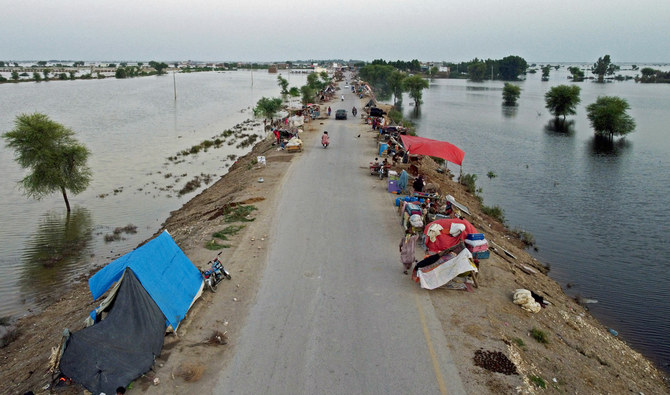
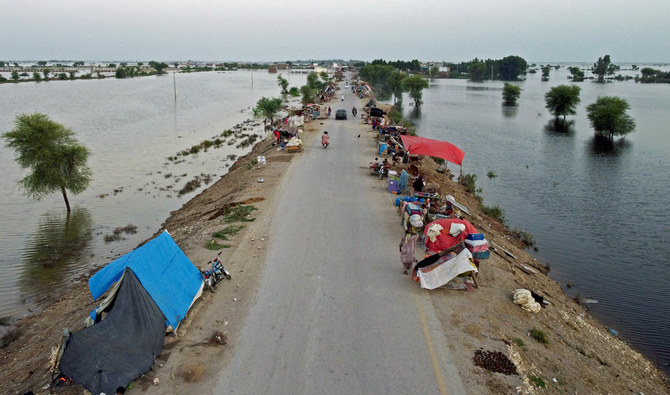
This aerial photograph taken on September 5, 2022 shows the makeshift tents of internally displaced flood-affected people after heavy monsoon rains at Dera Allah Yar town in Jaffarabad district of Balochistan province. (AFP/File)
Short Url
Updated 25 September 2022
Follow

Pakistan reopens key highway to speed aid to flood victims

  • Traffic between the flood-hit city of Quetta and southern Sindh province remained suspended for weeks
  • Floods destroyed 390 bridges and washed away over 12,000 kilometers of roads across the country

ISLAMABAD: Pakistani engineers and troops cleared a key highway Thursday that will enable aid workers to speed supplies to survivors of devastating floods that have left thousands homeless and killed 1,486 people.

Traffic between the flood-hit city of Quetta and southern Sindh province remained suspended for weeks after floods damaged the key highway. The blockage had forced the military to deliver aid to victims by helicopters and boats.

As they reopened the route, engineers in flood-hit Baluchistan provinces also restored the power supply for millions, according to a government statement. And the disaster’s deady toll became more clear. On Thursday, the United Nations’ children agency said 528 children were among those killed in the floods.

The National Flood Response and Coordination Center said the worst-ever deluge destroyed 390 bridges and washed away over 12,000 kilometers of roads across the country. The inundation of roads affected the government’s response to floods, and people complained they were still waiting for the government’s help.

The crisis affected over 33 million people and displaced over half a million people who are still living in tents and make-shift homes. The water has destroyed 70 percent of wheat, cotton and other crops in Pakistan. At one point, a third of the country’s territory was submerged.

Initially, Pakistan estimated that the floods caused $10 billion in damages, but now multiple economists say the cost is more like $30 billion in damages. That’s five times more than what Pakistan’s government will get under the 2019 bailout signed with the International Monetary Fund.

So far, 100 flights from different countries and international aid agencies have delivered the much-needed supplies to Pakistan, the Foreign Ministry said Thursday. The UN weeks ago urged the international community to generously help Pakistan in relief, rescue and rehabilitation work.

On Wednesday, the UN resident coordinator in Pakistan, Julien Harneis, told reporters that the member states had committed so far $150 million in response to an emergency appeal for $160 million. So far, he said, $38 million pledges from the world community had been converted into assistance for Pakistan.

The impoverished nation is diverting funds allocated for development projects to help flood victims. Prime Minister Shahbaz Sharif this week promised the country’s homeless people that the government will ensure they are paid to rebuild and return to their lives. With winter just weeks away, displaced people living in tents are worried about their future.

Sharif on Thursday traveled to Uzbekistan to attend a summit of a security group formed by Beijing and Moscow as a counterweight to US influence. Washington is one of the most generous responders to floods in Pakistan. The United States has announced $50 million aid, which is being delivered by military planes.

On the sideline of the eight-nation Shanghai Cooperation Organization summit, Sharif was expected to brief world leaders about the climate-induced damages caused by floods in his struggling Islamic nation.


Pakistan’s president defends ongoing strikes in Afghanistan, urges Kabul to dismantle militants

Updated 02 March 2026
Follow

Pakistan’s president defends ongoing strikes in Afghanistan, urges Kabul to dismantle militants

  • Afghanistan on Thursday launched attacks in retaliation for Pakistani airstrikes the previous Sunday
  • Pakistan’s military says it is only targeting Afghan military installations to avoid civilian casualties

ISLAMABAD: Pakistan’s president on Monday defended his country’s ongoing military strikes in neighboring Afghanistan, saying Islamabad tried all forms of diplomacy before targeting militants operating from Afghan territory, and called on the Taliban government in Kabul to disarm groups responsible for attacks in Pakistan.

Pakistan earlier said it is in “open war” with Afghanistan, alarming the international community. The border area remains a stronghold for militant organizations including Al-Qaeda and the Daesh (Islamic State) group.

“(The Afghan Taliban) must choose to dismantle the terror groups that survive on conflict and its war economy,” Asif Ali Zardari said during a speech to lawmakers, adding that “no state accepts serial attacks on its soil.”

Afghanistan on Thursday launched attacks in retaliation for Pakistani airstrikes the previous Sunday. Since then, Pakistan has carried out operations along the border, with Information Minister Attaullah Tarar claiming the killing of 435 Afghan forces and the capture of 31 Afghan positions.

Kabul has denied such claims.

In Afghanistan, the deputy government spokesman Hamdullah Fitrat said Pakistan’s military fired mortar shells at a refugee camp in eastern Kunar province, killing three children and injuring three others.

Afghanistan’s defense ministry said Afghan forces carried out strikes targeting a Pakistani military facility near Paktia province, causing “substantial losses and heavy casualties.”

Pakistan’s military did not respond to questions. It has said Pakistan is only targeting Afghan military installations to avoid civilian casualties.

Pakistan has witnessed a surge of violence in recent months and blames it on the outlawed Pakistani Taliban, known as Tehreek-e-Taliban Pakistan or TTP. It operates both inside Pakistan and from Afghan territory.
Islamabad accuses Afghanistan’s Taliban government of providing safe havens for the TTP, which Kabul denies.

The latest cross-border fighting ended a ceasefire brokered by Qatar and Turkiye in October. The two sides failed to reach a permanent agreement during talks in Istanbul.

Zardari reiterated Pakistan’s call for talks, saying, “We have never walked away from dialogue.”

The Pakistani leader again accused Afghanistan of acting as a proxy for India by sheltering militant groups.

“Stop being used by another country as a battlefield for their ambitions,” he said.

Zardari cited a recent report from the United Nations Security Council’s monitoring team that described the presence of militant groups in Afghanistan as an extra-regional threat.