



TOKYO: Bahrain’s undersecretary for political affairs, Dr. Shaikh Abdulla bin Ahmed Al-Khalifa, and its Ministry of Foreign Affairs on Tuesday participated in an Arab News Japan roundtable event in Tokyo.
Speaking at the discussion, that took place at the Foreign Correspondents’ Club of Japan where Arab News Japan first launched nearly three years ago, Al-Khalifa began his talk by mourning former Japanese prime minister, Shinzo Abe.
He said: “I would like to express our deepest condolences on the death of former PM Abe. He was a great leader who served his country and worked on developing the bilateral relations between Bahrain and Japan and we recall his historical visit to Bahrain in 2013.”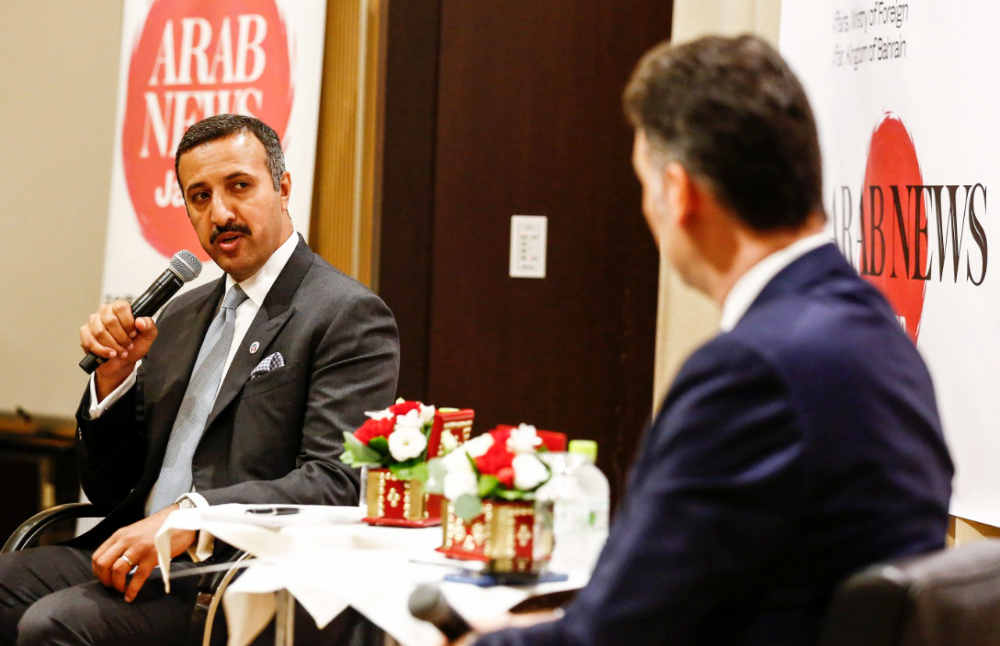
He then went on to talk about the strengthening of bilateral relations through the sixth Japan-Bahrain policy dialogue which he undertook in Tokyo with a delegation from Bahrain.
In light of this year marking the 50th anniversary of diplomatic relations between the two countries, he added: “We are commemorating the 50th anniversary of bilateral relations between Bahrain and Japan, and we have already started a series of events to celebrate.
“The relations between Japan and Bahrain go even further, as commercially Bahrain has been engaging with Japan for more than 90 years. The first oil well in the Gulf was in Bahrain in 1932 and our first international shipment of oil was shipped to Japan in 1934 and has continued to develop ever since. The commercial ties supersede our diplomatic ties.”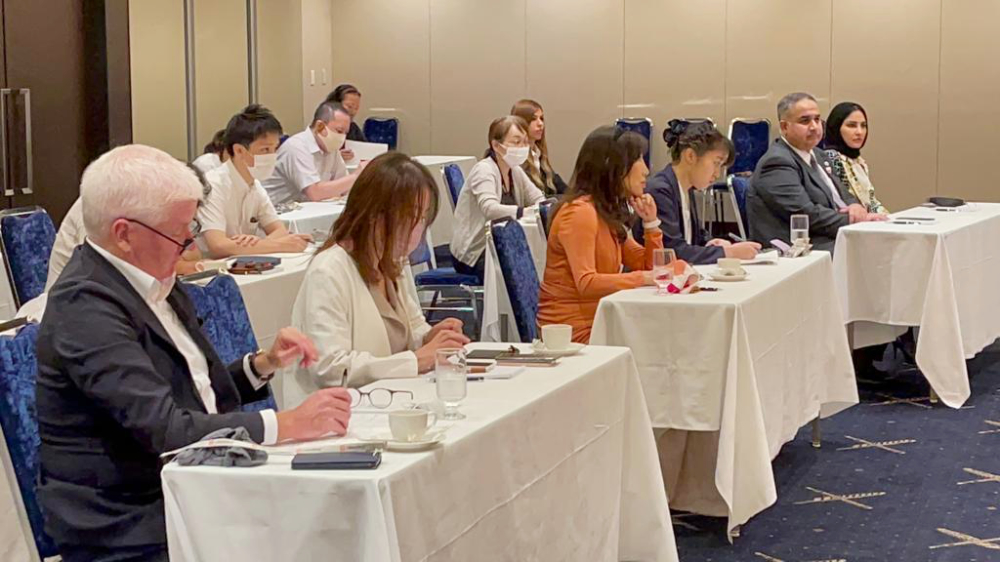
One year ago, Bahrain signed the Abraham Accords, a series of US-brokered diplomatic agreements inked between Israel and Arab states. Al-Khalifa discussed the effect of the agreement on Bahrain’s relationship regionally and internationally, while highlighting how the Palestinian people have benefited from Bahrain’s initiative.
He said: “On signing the Abraham Accords and building bilateral relations with Israel stems from the mere purpose of building visions of peace, and prosperity with countries of the region.
“Bahrain is a diverse multicultural island with longstanding, deep-rooted cultural heritage of religious tolerance, acceptance, and co-existence.
He pointed out that apart from Muslims, “we do have Christians, Jews, Hindus, Baha’is, all living side by side peacefully.”
Al-Khalifa reiterated Bahrain’s position on the Israeli-Palestinian conflict and the country’s commitment to the establishment of a Palestinian state. “Bahrain is fully supporting the Palestinians on their historical cause, of the Palestinian people to establish their own independent state with Eastern Jerusalem as its capital on the borders of 1967.
“Establishing the relations with Israel does not mean abandoning Palestinians or changing Bahrain’s position toward the support to the Palestinians. On the contrary, we believe it will enhance it in the sense that establishing open communications, establishing confidence in trust, would provide a platform to develop that,” he added.
On the relationship between Saudi Arabia and Bahrain, Al-Khalifa said that the two nations had agreed to strengthen cooperation on all political issues and to work together to develop common positions that preserved security and stability in the region.
“The relationship between the Kingdom of Bahrain and Saudi Arabia is a strategic relationship and extends over the centuries, and currently Saudi Arabia is our biggest trade partner, and we are very much convinced on our commitment to enhance all the areas of collaborations between our two countries to the highest level.
“So, there is an ongoing working mechanism on the highest level, with five different committees each chaired by a minister to follow up on each and every matter of bilateral ties. Leadership in both countries are fully determined to the regional security and stability following the successful Security Development Summit (hosted by Saudi Arabia in Jeddah).”
He noted that King Salman’s leadership of Saudi Arabia was “very much needed as always” in the region and pointed out Bahrain’s membership of the Gulf Cooperation Council, and its collaboration with Saudi Arabia, the chair of the GCC, on various subjects.
On the prospect of collaboration between Japan and Bahrain in new fields such as space, Al-Khalifa told Arab News Japan: “The cooperation within the sector of space is one of the new additions of our cooperation. Bahrain’s space agency has a cooperation with JAXA, who has supported Bahrain in launching its first artificial satellite.
“And we look forward to enhancing this bilateral cooperation between our space agencies and JAXA, through materializing it into an agreement hopefully to be signed soon. That was one of the areas that has been discussed.”
The discussion was moderated by Arab News Japan’s regional head, Ali Itani, and was open to a question-and-answer session by leading Japanese media outlets such as NHK, Mainichi Shimbun, Jiji Press, and Kyodo News.
The roundtable took place in the presence of Bahrain’s Ambassador to Japan Ahmed Al-Doseri as well as the accompanying delegation from Bahrain composed of government officials and members of the business community.


