Cholera outbreak: Syria reports two dozen cases, three deaths

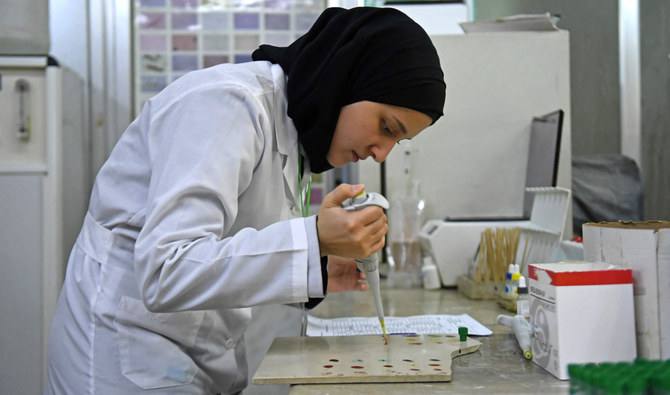
A lab technician works on samples to test for cholera in Aleppo. (AFP)
Short Url
Updated 12 September 2022
Follow

Cholera outbreak: Syria reports two dozen cases, three deaths

  • The main cause of the spread appears to be people drinking polluted water as well as watering plants in some areas with unclean water

DAMASCUS: Hospitals in the Syrian capital have been put on alert after more than two dozen cases of cholera and at least three deaths were reported in the war-torn country, health officials said on Monday.

The main cause of the spread appears to be people drinking polluted water as well as watering plants in some areas with unclean water.

Syria’s infrastructure has suffered severe damage since the country’s conflict began in March 2011 where residents of some areas have no access to clean water.

The conflict had killed hundreds of thousands and displaced half the country’s pre-war population of 23 million, many of them living in tent settlements around the country.

The World Health Organization’s office in Damascus had no immediate comment.

Pro-regime news agency SANA quoted the head of the Health Ministry in Damascus, Mohammed Samer Shahrour, as saying that the ministry is coordinating with departments in all provinces to test water as well as some fruits and vegetable. He added that hospitals in government-held parts of the country have the medicines to deal with cholera cases.

In areas controlled by US-backed fighters in northeast Syria, the head of the health department in the region, Jwan Mustafa, reported three deaths and several other cases over the weekend.

Mustafa added in a statement that most of the cases in areas under the control of the Autonomous Administration of North and East Syria are in the eastern province of Deir Exxor.

He said some were discharged from hospital.

In the northern city of Aleppo, Syria’s largest and once commercial center, the Health Ministry reported 15 cases, including a nine-year-old child who suffered diarrhea and vomiting before getting treatment and being discharged.

The ministry said cholera was also discovered in a factory that makes ice cubes and was closed immediately.

The Health Ministry urged residents to make sure they are drinking water from a known clean source as well as to wash well fruits and vegetables.


President Abbas hopes 2026 brings progress on Palestinian statehood

Updated 6 sec ago
Follow

President Abbas hopes 2026 brings progress on Palestinian statehood

  • Leader endorses Gaza committee, cites positive indications from US administration to resolving cause

RAMALLAH: Palestinian Authority President Mahmoud Abbas said on Thursday that Palestine is determined to continue its efforts with US President Donald Trump and other relevant partners.

He expressed hope that 2026 will witness progress toward resolving the Palestinian cause, citing positive indications from the US administration.

He was speaking during a ceremony marking his receipt of an honorary doctorate from the Arab American University in Ramallah.

Abbas said the state of Palestine has announced its support for the formation of the Palestinian Administrative Committee in the Gaza Strip during the transitional phase.

He expressed appreciation for the efforts of Trump and mediators Egypt, Qatar, and Turkiye, and for moving toward the implementation of the second phase of Trump’s plan.

Abbas reaffirmed the importance of linking the institutions of the PA in the West Bank and Gaza, stressing the need to avoid creating parallel administrative, legal, or security systems that would entrench division.

He outlined his political vision based on the Palestinian people’s right to self-determination and return, and the establishment of an independent, fully sovereign Palestinian state with East Jerusalem as its capital, living in peace and security with its neighbors.

The president said the Palestinian state would be democratic, based on equal citizenship, political pluralism, freedom of expression, the formation of political parties, the rule of law, good governance, human rights, integrity, and equality.

Abbas stressed that direct legislative and presidential elections are the foundation of democratic governance and the only path to the peaceful transfer of power under the rule of law, transparency, accountability, and the empowerment of women and youth.

He noted that work is underway to draft a temporary constitution and a political parties law in preparation for the upcoming elections.

Abbas affirmed that the Palestinian state remains committed to international law and the agreements and treaties signed with other states and international organizations.

The president reiterated that peaceful popular resistance, alongside political, diplomatic, and legal action, remains the strategic choice to end the occupation.

He said the Palestinian people continue to safeguard their presence, history, identity, and national memory despite immense challenges, adding that despite the catastrophe caused by the war in Gaza, they remain determined to rebuild the enclave and what has been destroyed across the West Bank.

Abbas also voiced confidence in Palestinian universities, saying they will not only transmit knowledge but also advance it through investment in scientific research and partnerships with the private sector and the state, emphasizing that science and technology are key drivers of national progress.

He stressed that it is time for the Palestinian people to write their own complete history, present their authentic narrative, and decisively refute false and distorted accounts that seek to misrepresent the reality and history of the Palestinian people.