

Volvo, UNESCO join hands for education drive in Pakistan

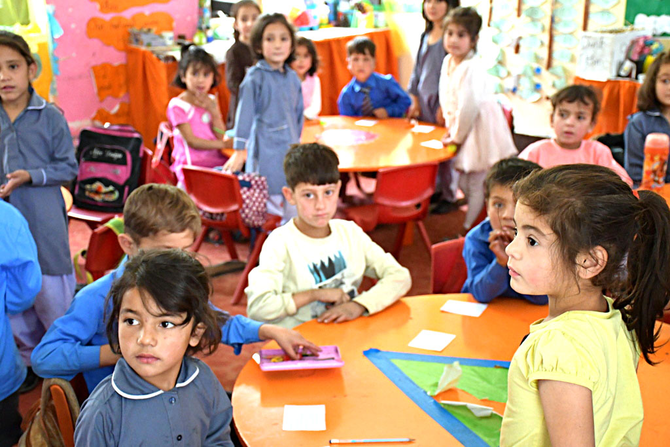
Primary students in Gilgit-Baltistan were introduced to the book ‘Pippi Longstocking.’
Short Url
Updated 12 September 2022
Follow

Volvo, UNESCO join hands for education drive in Pakistan

Students across 40 primary schools in northern Pakistan have benefited from a unique collaboration between the UN’s cultural agency UNESCO, Volvo Group, and the Swedish Embassy in Pakistan.

As the project executing agency, the UNESCO Islamabad office undertook the project in close collaboration with the education department in Gilgit-Baltistan.

Volvo invested nearly $100,000 to provide young children with the much-loved children’s book “Pippi Longstocking.”

The project — Providing Primary School Students Inspiring and Motivational Reading Material — was designed to enhance the learning of primary students in two districts of Gilgit-Baltistan, Pakistan’s mountainous northern region.

It aimed at improving the retention of students by creating a culture of reading and providing support to both students and teachers, and improving learning opportunities for the students through a focused approach toward teacher training and classroom strategies. It strove to improve the school-learning environment by enhancing teachers’ capabilities and ensuring students had access to interactive reading materials.

To promote reading as a fun activity, “Pippi Longstocking,” a story of a brave and curious girl written by Swedish author Astrid Lindgren, was translated into Urdu and introduced as additional reading material.

Target schools were given a set of storybooks, along with reading and interactive teaching and learning material. Teachers were trained in active learning strategies.

The project helped 6,000 students and 77 teachers, in addition to 42,000 parents and community members, who were widely engaged.

While the project originally introduced the active learning material and co-curricular books to the 40 target schools, other schools also benefited by borrowing them.

The project was launched in 2019 to help children in many parts of Pakistan who did not have access to primary education. Children in rural areas and especially girls are affected more by inequalities in education.

The annual Status of Education report revealed that only 50 percent of boys and 37 percent of girls in public schools in the Gilgit-Baltistan region could read complete sentences
in Urdu.

Patricia McPhillips, director of UNESCO Islamabad, appreciated the contribution made by Volvo Group and stressed the need to scale up the project in other provinces and areas of Pakistan.

She said the provision of storybooks and other learning aids enhanced students’ access to interactive and empowering reading materials.

McPhillips underlined the importance of the availability of reading material in schools for developing reading habits among students to improve their analytical and critical thinking skills.

Farida Timsiet, marketing and communication manager at Volvo Middle East, said that partnering with UNESCO and the Embassy of Sweden in Pakistan “further solidified our objective of giving back to our communities around the globe.”


LuLu marks Founding Day with ‘Made in Saudi’ campaign

Updated 25 February 2026
Follow

LuLu marks Founding Day with ‘Made in Saudi’ campaign

The Ministry of Industry and Mineral Resources honored LuLu Hypermarket in recognition of its pivotal role as the exclusive retail partner of the “Najoud Bikhairna 2026” initiative, commending its continued efforts in supporting and empowering national industries while showcasing the quality and competitiveness of locally manufactured products.

The initiative, led by the ministry in partnership with the Saudi Export Development Authority, represented by the Made in Saudi program, stands as a pioneering model of public-private sector collaboration in activating community-driven initiatives with sustainable impact. Through this program, more than 280,000 Saudi-made products were distributed to 10,000 families across various regions of the Kingdom during the holy month of Ramadan, reinforcing the presence of national products and strengthening the values of social solidarity among individuals and institutions alike.
The ministry’s recognition of LuLu Hypermarket coincided with the official launch of its Saudi Founding Day celebrations at the Dharat Laban branch in Riyadh, marked by the unveiling of a comprehensive promotional campaign dedicated to Saudi-made products. On this occasion, a wide range of special offers was introduced on local products, available across all LuLu Hypermarket branches throughout the Kingdom.
The inauguration ceremony was attended by Mohammed bin Dayel, general supervisor of the Made in Saudi program at the Saudi Export Development Authority, and Mohamed Haris, director of LuLu Saudi Arabia, alongside members of LuLu’s executive management team. The event featured a ribbon-cutting ceremony to officially open the specially designed Founding Day gateway.
Following the inauguration, guests toured several dedicated zones and exhibitions highlighting national products. The tour commenced at the grocery and “Made in Saudi” consumer goods sections, showcasing the diversity and quality of local brands. It also included the “Made in Saudi” dates pavilion, presenting a premium selection of the finest locally sourced dates in celebration of one of the Kingdom’s most iconic national symbols.
The visit continued to the fruits and vegetables section under the theme “From Our Land,” featuring an exceptional assortment of Saudi agricultural products, reflecting the richness and excellence of the local agricultural sector. Guests also explored the LuLu private label corner, which features products exclusively manufactured within the Kingdom for LuLu, reaffirming the company’s commitment to supporting local manufacturing.
The tour concluded with a presentation of “Made in Saudi” products within the chilled and frozen categories, underscoring the rapid growth and qualitative advancement of the Kingdom’s food manufacturing sector, and further reinforcing the strong market position and competitiveness of Saudi products.