

PM Sharif extends warm wishes to Britain’s King Charles on accession to throne

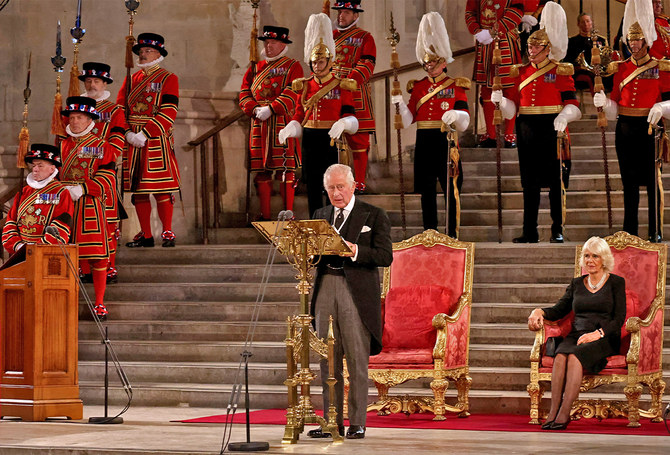
Britain's King Charles III attends the presentation of Addresses by both Houses of Parliament in Westminster Hall, inside the Palace of Westminster, central London on September 12, 2022. (AFP)
Short Url
Updated 12 September 2022
Follow

PM Sharif extends warm wishes to Britain’s King Charles on accession to throne

  • Queen Elizabeth, her country’s longest serving monarch, passed away in Scotland on Thursday
  • Pakistan is observing a day of mourning today to honor the memory of the late British Queen

ISLAMABAD: Prime Minister Shahbaz Sharif on Monday extended his warm wishes to King Charles III of the United Kingdom on his accession to the throne while hoping his people would continue to prosper under his rule in the coming days.

Queen Elizabeth II, Britain’s figurehead and a towering presence on the world stage for seven decades, died at her Scottish home on Thursday, hours after doctors said she was under medical supervision.

The royal family has revealed plans for a grand state funeral of Britain’s longest serving monarch on September 19, which is expected to be attended by foreign leaders and watched by millions worldwide.

Following the British political tradition, Queen Elizabeth’s eldest son automatically became King of the United Kingdom and the head of 14 realms, including Australia, Canada and New Zealand.

“On behalf of the people & government of Pakistan, I wish to convey our sincere good wishes to His Majesty King Charles III on his accession to the throne,” the prime minister said in a Twitter post. “May the people of the United Kingdom continue to prosper under his benevolent reign.”

Members of the British Royal Family, including the new King, have periodically visited Pakistan since its independence in August 1947 and enjoy cordial relations with its leaders.

Pakistan’s information minister announced over the weekend the country would observe a day of mourning on Monday to honor the memory of the late British Queen.


Excavations resume at Mohenjo-Daro to study early Harappan city wall

Updated 6 sec ago
Follow

Excavations resume at Mohenjo-Daro to study early Harappan city wall

  • A joint Pakistani-US team probes multi-phase wall dating to around 2800 BC
  • Research remains limited despite Mohenjo-Daro’s archaeological importance

ISLAMABAD: Archaeologists working at the ancient site of Mohenjo-Daro have resumed excavations aimed at better understanding the city’s early development, including the structure and chronology of a massive perimeter wall first identified more than seven decades ago, officials said on Saturday.

The latest excavation season, launched in late December, is part of a joint Pakistani-US research effort approved by the Technical Consultative Committee of the National Fund for Mohenjo-Daro, which met at the site this week to review conservation and research priorities. The work focuses on reassessing the city’s defensive architecture and early occupation layers through controlled excavation and carbon dating.

Jonathan Mark Kenoyer, a senior archaeologist involved in the project, told the committee that the excavation targets a section of the city wall originally uncovered by British archaeologist Mortimer Wheeler in 1950.

“This wall was over seven meters wide and built in multiple phases, reaching a height of approximately seven meters,” Kenoyer said, according to an official statement circulated after the meeting. “The lowest part of the wall appears to have been constructed during the early Harappan period, around 2800 BC.”

Organic material recovered from different excavation levels is being analyzed for carbon dating to establish a clearer timeline of the site’s development, the statement continued, adding that the findings would be published after detailed study.

The committee noted that despite Mohenjo-Daro’s status as one of the world’s earliest and largest urban centers, systematic research at the site has remained limited in recent decades. Its members agreed to expand archaeological studies and invited new research proposals to help formulate a long-term strategy for the site.

The committee also approved the continuation of conservation work on previously excavated material, including dry core drilling data, and reviewed progress on preserving a coin hoard discovered at the site in 2023, the results of which are expected to be published after conservation is completed.

Mohenjo-Daro, a UNESCO World Heritage site in Pakistan’s Sindh province, was a major center of the Indus Valley Civilization, which flourished more than 4,000 years ago.