

Pakistan races to keep floodwaters out of power station that supplies millions

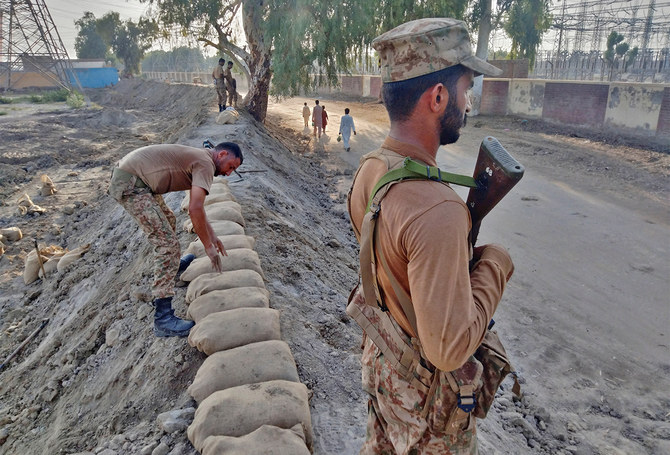
Members of Pakistan's Army guard and look after a dike to protect a power station, following rains and floods during the monsoon season, in Dadu, Pakistan on September 11, 2022. (REUTERS)
Short Url
Updated 12 September 2022
Follow

Pakistan races to keep floodwaters out of power station that supplies millions

  • The electricity station in Dadu in southern Sindh province supplies power to six districts
  • Troops have been strengthening a dike built in front of the station to keep floodwaters out

DADU, Pakistan: Authorities in Pakistan are scrambling to protect a vital power station supplying electricity to millions of people against a growing threat of flooding, officials said on Monday, taking steps such as building a dike in front of it.

Floods from record monsoon rains and glacial melt in the mountainous north have affected 33 million people and killed almost 1,400, washing away homes, roads, railways, livestock and crops, in damages estimated at $30 billion.

Both the government and UN Secretary General Antonio Guterres have blamed climate change for the extreme weather that led to the flooding, which submerged nearly a third of the nation of 220 million.

The electricity station in the district of Dadu in the southern province of Sindh, one of the country’s worst affected areas, supplies power to six provincial districts.

Troops were busy strengthening a dike built in front of the station, a visit to the site showed on Sunday.

“All preventive measures have been taken already to save the grid in case any flooding happens,” Syed Murtaza Ali Shah, a top district official, told Reuters on Monday.

The comment followed orders from Prime Minister Shehbaz Sharif, reported by state broadcaster Radio Pakistan, to ensure the 500kV power station did not get flooded.

UN agencies have begun work to assess the South Asian nation’s reconstruction needs after it received 391 mm (15.4 inches) of rain, or nearly 190 percent more than the 30-year average, in July and August.

Sindh received 466 percent more rain than average and all the flood waters pass through Dadu, a district with a population of 1.5 million, thanks to its location.


Pakistan reviews austerity measures amid Middle East crisis, urges strict nationwide implementation

Updated 11 March 2026
Follow

Pakistan reviews austerity measures amid Middle East crisis, urges strict nationwide implementation

  • Deputy Prime Minister Ishaq Dar chairs review meeting of austerity steps
  • Officials briefed on salary cuts, school closures, four‑day week, petrol conservation

ISLAMABAD: Pakistan’s government on Wednesday assessed progress on a sweeping set of austerity measures introduced to mitigate the country’s economic strain from sharply rising global oil prices and supply disruptions linked to the ongoing war in the Middle East.

Prime Minister Shehbaz Sharif this week announced a series of austerity steps, including a four‑day work week for government offices, requiring 50  percent of staff to work from home, cutting fuel allowances for official vehicles by half, grounding up to 60  percent of the government fleet and closing all schools for two weeks to conserve fuel amid the global oil crisis.

The measures were unveiled in response to global oil market volatility triggered by the conflict involving the United States, Israel and Iran, which has disrupted supply routes such as the Strait of Hormuz and pushed crude prices sharply higher, straining Pakistan’s heavily import‑dependent energy sector.

“The meeting stressed the importance of strict and transparent adherence to the austerity measures, promoting fiscal responsibility and prudent use of public resources,” Deputy Prime Minister and Foreign Minister Senator Mohammad Ishaq Dar said in a statement.

He was chairing a meeting of the Committee for Monitoring and Implementation of Conservation and Additional Austerity Measures, constituted under the directions of the PM, bringing together federal and provincial officials to review execution of the broad cost‑cutting plan. 

Dar emphasized the government’s commitment to enforcing the PM’s austerity steps nationwide. The committee’s review also covered reductions in departmental expenditure, deductions from salaries of senior officials earning over Rs. 300,000 ($1,120), and coordination with provincial administrations to ensure uniform implementation of the plan.

Participants at the meeting reiterated that all ministries and divisions must continue strict monitoring and reporting, with transparent oversight mechanisms, as Pakistan navigates the economic pressures from the prolonged Middle East crisis and its fallout on global energy and trade markets.
