Iraq’s ancient ruins open up to tourism after Daesh atrocities

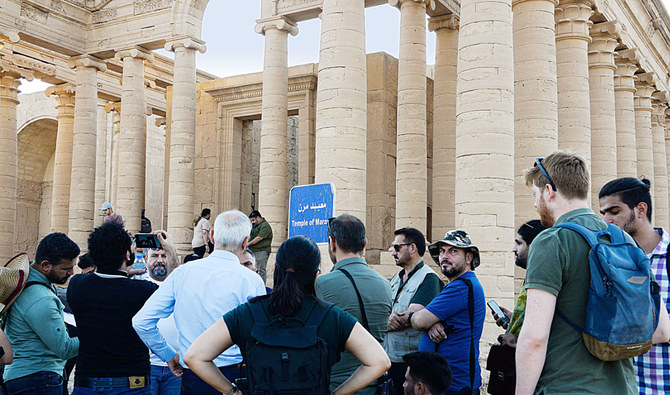
Some 40 visitors, most of them Iraqis, were allowed to walk around the more than 2,000-year-old archaeological site in the golden hour of twilight. (AFP)
Short Url
Updated 11 September 2022
Follow

Iraq’s ancient ruins open up to tourism after Daesh atrocities

  • Designated an endangered world heritage site by UNESCO, Hatra dates back to the 2nd and 3rd centuries BC

HATRA, Iraq: Strolling along the ancient ruins of Hatra in Iraq’s north, dozens of visitors admired the site, where local initiatives seek to turn over a new leaf after a brief but brutal Daesh rule.

Designated an endangered world heritage site by UNESCO, Hatra dates back to the 2nd and 3rd centuries BC.

It is a two-hour drive from Mosul, the former “capital” proclaimed by Daesh, which was recaptured in 2017 by Iraqi forces and an international coalition that backed them.

A tour of the site on Saturday, the first of its kind organized by a private museum in Mosul, aimed to boost tourism in the area.

Some 40 visitors, most of them Iraqis, were allowed to walk around the more than 2,000-year-old archaeological site in the golden hour of twilight.

The tourists took selfies in front of impressive colonnades and inspected the reliefs vandalized by Daesh jihadists.

“It has great history” allowing a peek into an ancient civilization, said Luna Batota, a 33-year-old on tour with her Belgian husband.

“A lot of history but at the same time a lot of unfortunate events took place here with Daesh,” she said.

Batota works for a pharmaceutical company in Belgium, where she has lived since the age of nine.

Twenty-four years later, this is the first time she has returned to her homeland.

Visiting Hatra stirred up “mixed feelings” for her, she said. “You see bullet holes, you see many empty bullets.”

An important religious and trading center under the Parthian empire, Hatra had imposing fortifications and magnificent temples, blending Greek and Roman architectural styles with oriental decorative elements.

In 2015, Daesh released a video showing its militants destroying a series of reliefs, firing at them and hacking away at a statue with a pickaxe.

In February, the authorities unveiled three restorations at the site: A Roman-style sculpture of a life-size figure and reliefs on the side of the great temple.

Five years after the defeat of Daesh, Mosul and its surroundings have regained a sense of normalcy, even as rehabilitation efforts suffer setbacks and many areas still bear the scars of the fight against the militants.

The tour of Hatra was organized by the Mosul Heritage House, a private museum inaugurated in June.

But even before it, the site drew individual visitors, according to one of the organizers, Fares Abdel Sattar, a 60-year-old engineer.

This new initiative seeks to “showcase the heritage and identity” of Mosul and its broader Nineveh province, he said.

After its rise to power in 2014 and the conquest of swathes of Iraq and Syria, Daesh faced counteroffensives in both countries. Iraqi forces finally claimed victory in late 2017.

As Iraq gradually opens up to foreign tourism, dozens of visitors — particularly from the West — are now exploring the country, with some even venturing into Mosul.

The Hatra group are pioneers, visiting at a time when the US, British and other governments are warning their citizens against travel to Iraq, citing the risks of terrorism, kidnapping, armed conflict and civil unrest.

The tourism sector also suffered a setback with the case of British pensioner James Fitton, who was detained and condemned to 15 years in jail over pottery shards he picked at an archaeological site, before a court in July overturned the sentence and he flew back home.

Challenges remain and tourist infrastructure is still basic in Iraq, a country rich in oil but ravaged by decades of fighting.

“Mosul isn’t only war, Daesh, terrorism,” said Beriar Bahaa Al-Din, a doctoral student in anthropology at the University of Exeter in Britain, on the Hatra visit.

“Mosul is a civilization, heritage, culture,” he added. “This impressive site should be full of tourists from across the globe.”


Battered by Gaza war, Israel’s tech sector in recovery mode

Updated 21 February 2026
Follow

Battered by Gaza war, Israel’s tech sector in recovery mode

  • “High-tech companies had to overcome massive staffing cuts, because 15 to 20 percent of employees, and sometimes more, were called up” to the front as reservists, IIA director Dror Bin told

JERUSALEM: Israel’s vital tech sector, dragged down by the war in Gaza, is showing early signs of recovery, buoyed by a surge in defense innovation and fresh investment momentum.
Cutting-edge technologies represent 17 percent of the country’s GDP, 11.5 percent of jobs and 57 percent of exports, according to the latest available data from the Israel Innovation Authority (IIA), published in September 2025.
But like the rest of the economy, the sector was not spared the knock-on effects of the war, which began in October 2023 and led to staffing shortages and skittishness from would-be backers.
Now, with a ceasefire largely holding in Gaza since October, Israel’s appeal is gradually returning, as illustrated in mid-December, when US chip giant Nvidia announced it would create a massive research and development center in the north that could host up to 10,000 employees.
“Investors are coming to Israel nonstop,” Prime Minister Benjamin Netanyahu said at the time.
After the war, the recovery can’t come soon enough.
“High-tech companies had to overcome massive staffing cuts, because 15 to 20 percent of employees, and sometimes more, were called up” to the front as reservists, IIA director Dror Bin told AFP.
To make matters worse, in late 2023 and 2024, “air traffic, a crucial element of this globalized sector, was suspended, and foreign investors froze everything while waiting to see what would happen,” he added.
The war also sparked a brain drain in Israel.
Between October 2023 and July 2024, about 8,300 employees in advanced technologies left the country for a year or more, according to an IIA report published in April 2025.
The figure represents around 2.1 percent of the sector’s workforce.
The report did not specify how many employees left Israel to work for foreign companies versus Israeli firms based abroad, or how many have since returned to Israel.

- Rise in defense startups -

In 2023, the tech sector far outpaced GDP growth, increasing by 13.7 percent compared to 1.8 percent for GDP.
But the sector’s output stagnated in 2024 and 2025, according to IIA figures.
Industry professionals now believe the industry is turning a corner.
Israeli high-tech companies raised $15.6 billion in private funding in 2025, up from $12.2 billion in 2024, according to preliminary figures published in December by Startup Nation Central (SNC), a non-profit organization that promotes Israeli innovation.
Deep tech — innovation based on major scientific or engineering advances such as artificial intelligence, biotech and quantum computing — returned in 2025 to its pre-2021 levels, according to the IIA.
The year 2021 is considered a historic peak for Israeli tech.
The past two years have also seen a surge in Israeli defense technologies, with the military engaged on several fronts from Lebanon and Syria to Iran, Yemen, Gaza and the occupied West Bank.
Between July 2024 and April 2025, the number of startups in the defense sector nearly doubled, from 160 to 312, according to SNC.
Of the more than 300 emerging companies collaborating with the research and development department of Israel’s defense ministry, “over 130 joined our operations during the war,” Director General Amir Baram said in December.
Until then, the ministry had primarily sourced from Israel’s large defense firms, said Menahem Landau, head of Caveret Ventures, a defense tech investment company.
But he said the war pushed the ministry “to accept products that were not necessarily fully finished and tested, coming from startups.”
“Defense-related technologies have replaced cybersecurity as the most in-demand high-tech sector,” the reserve lieutenant colonel explained.
“Not only in Israel but worldwide, due to the war between Russia and Ukraine and tensions with China.”