

Pakistan urges international community to deal with climate change after devastating floods

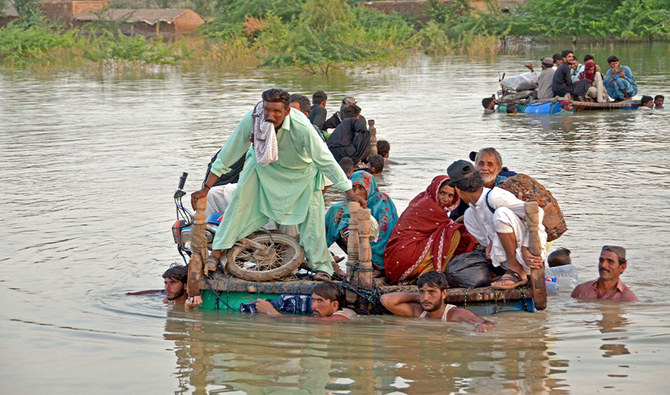
Internally displaced people wade through floodwaters after heavy monsoon rains in Jaffarabad district in Balochistan province on September 8, 2022. (AFP)
Short Url
Updated 11 September 2022
Follow

Pakistan urges international community to deal with climate change after devastating floods

  • Prime Minister Shehbaz Sharif says UN secretary general’s visit to Pakistan raised awareness about the climate disaster
  • General Bajwa says army engineers have been tasked to carry out initial study on building proper dams, drainage systems

ISLAMABAD: Prime Minister Shahbaz Sharif on Sunday applauded United Nations Secretary General António Guterres for raising international awareness about the devastation caused by recent floods in Pakistan while urging the global community to address the issue of climate change.
Pakistan witnessed record monsoon rains since the beginning of the season in June that led to flash floods and destroyed houses, farmlands and public infrastructure. The climate catastrophe also claimed about 1,400 lives across Pakistan while uprooting millions of others.
The UN secretary general, who arrived in the country on Friday, went to several flood-ravaged areas while calling for increased global financial assistance toward the end of his two-day visit aimed at raising awareness of the disaster.
The Pakistani prime minister described his visit as “critical,” saying he was deeply touched by the empathy and leadership of the top UN official.
“During his visit to the flood-affected areas & camps under scorching heat, UN Secretary General was overwhelmed by the scale of devastation that has engulfed Pakistan,” he said in a Twitter post. “His voice has become the voice of flood victims. The world should pay heed to what he said about climate change.”


Meanwhile, other senior Pakistani officials continued to visit the flood-hit regions in the country. The army chief, General Qamar Javed Bajwa, went to Sindh on Saturday where he urged affluent Pakistanis to step forward and provide financial assistance.
Speaking to the media in Dadu, he noted the area had been deeply affected by the floods.
“Manchar and Hamal lakes, which are about 100 kilometers apart, have merged,” he said, adding the government was still performing rescue and relief activities in the area.
“People will continue to suffer if we do not build proper dams and drainage system,” he continued. “The army engineers have been tasked to carry out an initial study on it. We will also seek international assistance from experts.”


Pakistan stocks plunge 9 percent, trading halted as Middle East tensions rattle markets

Updated 4 sec ago
Follow

Pakistan stocks plunge 9 percent, trading halted as Middle East tensions rattle markets

  • Benchmark index triggers automatic halt minutes after opening
  • Rising oil prices raise concerns over inflation, import bill and currency pressure

ISLAMABAD: Pakistan’s stock market fell nearly 9 percent within the first few minutes of trading on Monday, triggering an automatic one-hour halt under risk management rules, following intensifying hostilities in the Middle East.

Trading on the Pakistan Stock Exchange (PSX) was temporarily suspended after the sharp early selloff, reflecting panic across regional markets. The market reaction came after the United States and Israel conducted strikes in Iran over the weekend that killed Supreme Leader Ayatollah Ali Khamenei and other senior officials. Iran retaliated by bombing US bases in Gulf states and direct attacks on Israel. Concerns over potential disruption to energy supplies, particularly through the Strait of Hormuz l, which handles roughly one-fifth of global oil shipments, pushed crude prices sharply higher.

Although Pakistan, which borders Iran, is not directly involved in the conflict, the country remains vulnerable to external shocks due to its heavy reliance on imported energy and remittances from the Gulf region, analysts said.

“Due to the evolving nature of the conflict and involvement of various countries, the volatility may continue till the resolution or de-escalation of this conflict,” Topline Securities said in a note to clients.

The brokerage said Pakistan’s benchmark index has already fallen about 19 percent from its January high of 189,000 points and warned that further instability could weigh on investor sentiment.

Oil prices rose 6–7 percent in the latest session and are up about 15 percent over the past seven trading sessions amid mounting regional uncertainty, according to the brokerage note.

Pakistan imports an estimated $15–16 billion worth of petroleum products annually, including crude oil, refined fuel, LNG and LPG. Every 10 percent increase in oil prices could raise the country’s import bill by approximately $1.5–1.6 billion, Topline said. Other imports linked to energy prices include edible oil, coal and rubber-based products.

Higher oil prices could also feed into inflation. 

“Every 10 percent increase in crude oil prices may elevate inflation estimates by 40–50 basis points,” the brokerage said, noting both direct fuel price impacts and secondary effects across supply chains.

Analysts also flagged potential currency pressure, as rising import costs and concerns over Middle East instability, a region that accounts for more than half of Pakistan’s remittance inflows, could weigh on the rupee.

However, Topline said Pakistan’s foreign exchange reserves remain at relatively comfortable levels due to recent credit rating improvements and proactive central bank interventions.

With Monday’s decline, the market is now trading below 6.5 times projected 2027 earnings, compared with a historical average of 6.9 times, the brokerage added.

The conflict’s trajectory remains uncertain, and investors are closely watching developments in the Gulf, particularly around energy routes and further retaliatory actions.